Jeff Bezos Sets His Sights on a $70 Trillion Market. That’s 10X Bigger than the Ecommerce Market Amazon Dominated
Jeff Bezos built one of the largest fortunes in history by dominating a roughly $7 trillion global ecommerce market. His next act aims at a target an order of magnitude larger. In his first sit-down as a chief executive since…

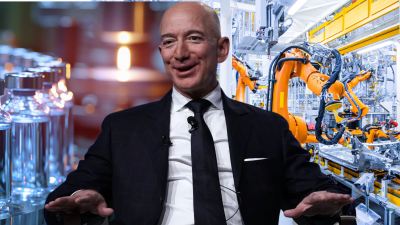
Jeff Bezos built one of the largest fortunes in history by dominating a roughly $7 trillion global ecommerce market. His next act aims at a target an order of magnitude larger. In his first sit-down as a chief executive since leaving Amazon, Bezos told CNBC’s David Faber that his new venture, Prometheus, is going after the physical economy: manufacturing, drug development, and chip production, a sector representing 60% of global GDP and roughly $70 trillion in economic activity.
The framing is important. The ecommerce opportunity that made Amazon (NASDAQ:AMZN | AMZN Price Prediction) a multi-trillion-dollar company is, on these numbers, about one-tenth the size of what Bezos is now pointing at. Bezos isn’t alone in pointing to the size of physical AI. NVIDIA (Nasdaq: NVDA) CEO Jensen Huang has talked in depth about physical AI being the biggest opportunity facing the company, and one which will see massive growth across the next decade.
If physical AI takes off, it will be the biggest catalyst yet for the technology, and provide not only massive ROI to companies but also the biggest step-change to the economy since the invention of electricity. Let’s dive deeper into what Prometheus is trying to achieve.
What Prometheus Actually Is
Bezos and co-founder Vik Bajaj are co-CEOs of Prometheus, a startup using AI-powered tools to accelerate innovation across the physical economy. The company has stayed quiet through months of speculation about robots, world models, and other capabilities. I’ve covered Prometheus previously, noting how the company’s goal is to be the ‘platform’ off which the next great wave of inventors is created.
Bezos addressed the rumor mill directly: “We’re not being secretive. We’re just being heads down and trying to do the work.” He added, “We’ve raised money. We have a brilliant team. We have tremendous work ahead of us.”
Bajaj characterized Prometheus as one small participant inside that $70 trillion market, working to lift the pace of innovation over the next decade. On capital, he said, “Well, I think we’d always be looking for investors who are interested in manufacturing and improving the manufacturing world and who can help in that regard.”
Why the Physical Economy Is So Large
The size of physical AI is staggering. U.S. manufacturing value added reached $2,961.4 billion in 2025 Q4, with the broader physical economy (manufacturing, construction, mining, utilities, transportation) totaling roughly $6.2 trillion, or 19.7% of U.S. GDP. Corporate profits in manufacturing alone hit $759.6 billion in 2025 Q4, and nonfinancial domestic profits grew 12% year over year in 2026 Q1.
Gross private investment surged to 7% in 2026 Q1, the strongest reading in the recent dataset. Capital is rotating into physical assets, supply chains, and infrastructure. T. Rowe Price has described it as a “great rotation” in which AI is forcing hyperscalers into capital-intensive competitions and redirecting value to physical supply chains, infrastructure, and manufacturing.
From Jet Engines to Drug Discovery
Bezos framed the opportunity around jet engines. “What if instead of a team of 1000 people working for ten plus years to build a next generation of jet engine, what if they could do that in five years or two years or one year? You need to simulate all of the physics and all of the things, even down to the manufacturing processes inside a computer,” Bezos said. Bajaj framed the engineering challenge plainly: “A jet engine takes teams of engineers a decade just to come up with the design. What has changed is the ability to formulate even something that complicated as an end to end AI problem.”
However, jet engines are just the beginning. Other industries impacted include:
- Robotics
- Energy and Utilities
- Healthcare and Drug Discovery
The bottom line is that while models will get increasingly intelligent, there will increasingly need to be an ‘orchestration’ layer that targets that intelligence at unique problems.
Amazon’s Parallel Push, and What It Tells You
Bezos’s old company is already executing on the same thesis from another angle. Amazon recently launched Amazon Supply Chain Services, opening its logistics network to outside businesses including Procter & Gamble, 3M, Lands’ End, and American Eagle Outfitters. It signed a multibillion-dollar, multi-year fiber optics deal with Corning that will add 1,000 manufacturing jobs in North Carolina, and committed to a $150 billion AI data center buildout in partnership with TSMC. The map of where serious capital is flowing in 2026 runs through factories, fabs, and fiber.
For background on Amazon’s own infrastructure pivot, see its most recent 10-K filings with the SEC.
What Investors Should Watch
Prometheus is private and early stage. Bajaj’s framing of a decade-long arc is the correct way to think about AI’s progression from the digital economy into the physical world. The investable read-through is in the picks-and-shovels names already monetizing the physical economy buildout: chip equipment vendors, industrial automation platforms, power and cooling suppliers, and the fiber and logistics layer feeding AI infrastructure.
Manufacturing growth has cooled to 0.3% in 2025 Q4 after a 3.2% jump in 2025 Q3, so progress will be lumpy and take time. The directional call will play out across the next decade.
The man who took a $7 trillion market and built a giant inside it is now pointing at one ten times larger. That is the bet worth tracking.
Contact [email protected] for any questions or corrections.
Eric Bleeker, CFA has been investing for more than 20 years. He began his career working at Microsoft before joining Motley Fool, one of the largest publishers of financial research. In his 15 years at Motley Fool Eric served as the General Manager for Fool.com and led coverage in the Technology & Telecom sector. In addition, he was a featured columnist and has hosted dozens of investing seminars attended by more than a million total investors. Eric has more than 1,000 financial bylines to his name and has been featured in The Wall Street Journal, CNBC, Fox Business, and many other leading publications. He is currently focused on artificial intelligence investing and is a CFA Charterholoder.