SpaceX Ripped Past a $2.5 Trillion Valuation Following Its Historic IPO. Is SPCX Stock a Dangerous Bubble at $185?
At $185, SpaceX (NASDAQ:SPCX | SPCX Price Prediction) faces a stretched setup. The newly public rocket and connectivity giant has become the loudest IPO story on Wall Street, and the price action since listing demands a verdict.SpaceX operates the Falcon…


At $185, SpaceX (NASDAQ:SPCX | SPCX Price Prediction) faces a stretched setup. The newly public rocket and connectivity giant has become the loudest IPO story on Wall Street, and the price action since listing demands a verdict.
SpaceX operates the Falcon and Starship launch systems, runs roughly 9,600-satellite Starlink broadband constellation across 164 countries, and houses xAI after an early-2026 acquisition that folded Grok into the group. Since 2023 it has launched more than 80% of the world’s mass to orbit every year.
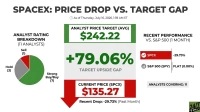
The IPO priced at $135, spiked above $225 in overnight trading, and has since cooled to $185, taking the market cap to roughly $2.44 trillion.
The Bull Case: A Multi-Platform Infrastructure Monopoly
Bulls argue the market is mispricing SpaceX by treating it as a launch company. Defiance ETFs CIO Sylvia Jablonski put it bluntly: “Investors are underestimating SpaceX by viewing it solely as an aerospace company,” framing it as a multi-platform infrastructure company spanning launch, communications, defense, and AI connectivity, with Starlink poised to exceed expectations.
Falcon rockets carry a 99%+ mission success rate, Starlink serves millions of consumer, enterprise, and government customers, and xAI gives the group a frontier model integrated with X. KGI Securities initiated coverage at Outperform, and an internal price model sees a base case of $197.57 a year out, with a bull case at $222.89.
The Bear Case: A Valuation Untethered From Earnings
Bears see a textbook post-IPO blowoff. CFRA set a $115 price target, implying roughly 38% downside. The Atlantic’s Charlie Warzel described the valuation as “seemingly untethered from traditional corporate finance metrics” and called the stock “a meme, and a testament to the irrationality of the modern stock market.”
Forward EPS sits at -0.7, and the internal model excluded earnings from its weighting because of negative profitability. CNBC noted the five-day volume-weighted average price of $181.71 already has the average post-IPO buyer near breakeven. Lock-up dynamics, captured in widely shared posts like “Who is even allowed to sell SPCX right now?”, point to a supply cliff ahead.
The Hold Case: Price Discovery Is Not Finished
SPCX has traded for only five sessions, with a 52-week range running from $135 to $225.64. The composite prediction-sentiment index reads 49.4, neutral, with medium confidence, and the AI base case implies just 1.51% upside to the consensus target of $187.80. Until Starlink revenue disclosures, the first 10-Q, and lock-up expiry clarify the story, the case for action in either direction is thin.
What The Numbers Actually Say
SPCX trades at $185, after a one-week gain of 14.94% that dwarfed the S&P 500’s roughly flat move over the same stretch, and a 3.56% drop in the most recent session. Analyst targets bracket the stock wide, with CFRA at $115 and KGI at Outperform, while a model-blended target sits at $187.80.
Formal consensus ratings are not yet available across the sell side. Reddit sentiment is 37.11, bearish, with only 1 of 40 readings categorized bullish. Analyst targets are one input among many, and with the float still tiny they should be weighted accordingly.
The Verdict: Why $185 Looks Stretched
At $185, SpaceX is a Sell. Index-inclusion flows and retail FOMO have pushed the market cap to roughly $2.44 trillion on a company carrying negative forward EPS. As the lock-up clock ticks down and insiders gain the ability to monetize, supply will meet a retail bid that is already softening. The most-upvoted r/investing post on the IPO was titled “The math isn’t mathing on the SpaceX IPO,” and the average IPO buyer is already near water.
Risk/reward at this price is unattractive. Even the in-house base case offers 6.79% over a full year, while the bear case at $167.14 and CFRA’s $115 mark out 10% to 38% downside. A structural entry closer to that lower band, after lock-up unwinds and the first earnings report, offers a far better setup than chasing a stock that has already round-tripped from $225.
The thesis breaks if Starlink revenue and free cash flow blow past expectations, or if xAI monetization arrives faster than modeled. Until then, paying a mega-cap multiple on a profitless launch-and-broadband group during the post-IPO sugar rush carries an unfavorable risk/reward at current levels.
Contact [email protected] for any questions or corrections.
Alex Sirois is a financial writer with experience spanning both retail and institutional investing. He has written for InvestorPlace and held roles at BNY Mellon and Bernstein, giving him a perspective that bridges Main Street portfolios and Wall Street analysis.
Alex holds an MBA from George Washington University and has built his career across multiple industries, including e-commerce, education, and translation — a breadth of experience that informs how he breaks down complex financial topics for everyday investors. His writing is conversational, actionable, and grounded in long-term, buy-and-hold investing principles.
At 247 Wall St., Alex focuses on delivering analysis that is both accessible and useful, with a clear emphasis on helping readers make more informed decisions with their money.