Billionaire Hedge Fund Manager: AI Could Produce the First $10 Trillion Company as We Enter the “Intelligence Age”
Philippe Laffont, billionaire founder and portfolio manager of Coatue Management, framed artificial intelligence as the defining economic shift of the coming decades and predicted that the first $10 trillion company is on the horizon. Laffont argues AI is the “Intelligence…

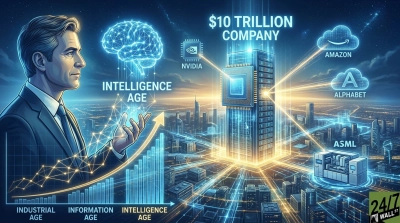
Philippe Laffont, billionaire founder and portfolio manager of Coatue Management, framed artificial intelligence as the defining economic shift of the coming decades and predicted that the first $10 trillion company is on the horizon. Laffont argues AI is the “Intelligence Age,” following the Industrial Age that ran a couple hundred years and the Information Age of the last 40 to 50 years. “Now it seems like intelligence is going to become this utility for $50-100 bucks a month.”
By Laffont’s estimate, AI could lift global GDP growth by 1-1.5% annually over the next 10 to 20 years, and he sees world market capitalization potentially expanding from roughly $120 trillion to $200 trillion. U.S. real GDP grew at a 1.6% annualized rate in Q1 of 2026, so his projected acceleration would be meaningful at the index level.
The $10 Trillion Question
“Is there going to be a $10 trillion company in 10 to 15 years?” Laffont asked, calling that question “easier for me than figuring out where bitcoin is going to be in ten years.”
He frames AI as the fifth great idea of his career after Internet stocks, mobile internet, and Apple. “I only came up with about five good ideas in the last 30 years.”
NVIDIA: The Closest $10 Trillion Candidate
The clearest current $10 trillion candidate is NVIDIA (NASDAQ:NVDA | NVDA Price Prediction), with a market cap sitting near $5.1 trillion. Laffont estimates that NVIDIA trades at 13-14 times forward 2027 earnings, which he considers cheap.
NVIDIA posted Q1 FY27 revenue of $81.61 billion, up 85.2% year over year, with Data Center revenue of $75.25 billion and non-GAAP EPS of $1.87. CEO Jensen Huang described “the buildout of AI factories“ as the largest infrastructure expansion in human history. Laffont also called selling NVIDIA “one of the biggest mistakes” he has made, a lesson he uses to argue for holding transformational positions through drawdowns.

Amazon and Alphabet: The Capex Customers
Amazon (NASDAQ:AMZN) and Alphabet (NASDAQ:GOOGL) sit at roughly $2.53 trillion and $2.03 trillion in market value. Both are pouring capital into the buildout Laffont describes. AWS grew 28% in Q1 2026, its fastest pace in 15 quarters, and CEO Andy Jassy called this period “some of the biggest inflections of our lifetime.”
Google Cloud revenue rose 63%, with backlog nearly doubling quarter-on-quarter to over $460 billion, per Sundar Pichai. Laffont framed the GPU race neutrally: “You’ve got Nvidia, you’ve got Amazon with a training chip, you’ve got Google with a chip, you’ve got newcomers on the GPU side. All of them at the end of the day will need the same machines.”
ASML: The Picks-and-Shovels Bet
ASML (NASDAQ:ASML) is the sole producer of EUV and High NA lithography systems, the tools every advanced chipmaker uses. Laffont’s view: “If I’m a supplier to the fabs, I don’t need to make an exact bet on which of the chips is going to win.” ASML shares are up 80.97% year to date and 157.03% over one year. CEO Christophe Fouquet said “demand for chips is outpacing supply,” and the company raised its FY2026 revenue outlook to a range of €36-€40 billion.
What Investors Should Watch
Laffont’s thesis ultimately depends on whether the physical infrastructure needed to support AI can be built fast enough. His argument is that GPUs alone aren’t the only opportunity, because AI data centers require enormous amounts of electricity, land, transmission infrastructure, and specialized equipment, creating several potential bottlenecks between today’s AI boom and a future $10 trillion company.
He estimates the buildout could require more than 100 gigawatts of new power capacity. Supporting that view, the U.S. Energy Information Administration projects data center electricity consumption could reach 818 billion kilowatt-hours by 2050 under its High Electricity Demand scenario, more than 16 times the level seen in 2020.
For investors, the key indicators to watch are hyperscaler capital spending plans, demand trends for semiconductor equipment, and the pace of new power projects connecting to the grid. If power generation, permitting, and equipment production can keep up with AI demand, Laffont’s vision becomes much more plausible.
Contact [email protected] for any questions or corrections.
Thomas Richmond is a financial writer and content strategist with 5+ years of experience covering stocks and financial markets. He has published over 500 articles focused on individual stock analysis, helping investors better understand business fundamentals, stock valuations, and long-term opportunities.
Thomas previously served as a Content Lead at TIKR, a stock research platform, where he helped scale the company’s blog to hundreds of articles per month and contributed to a weekly newsletter reaching more than 100,000 investors.
Outside of work, Thomas enjoys weight lifting and soccer.