Axon Soars on Trump Stock Purchase Highlighting Insider Trading Issues
Markets have become increasingly sensitive to any headline that hints at government spending or political influence. Defense contractors, AI companies, and cybersecurity firms can all move sharply on a single news report, even when the underlying information isn’t actually new. …

Markets have become increasingly sensitive to any headline that hints at government spending or political influence. Defense contractors, AI companies, and cybersecurity firms can all move sharply on a single news report, even when the underlying information isn’t actually new.
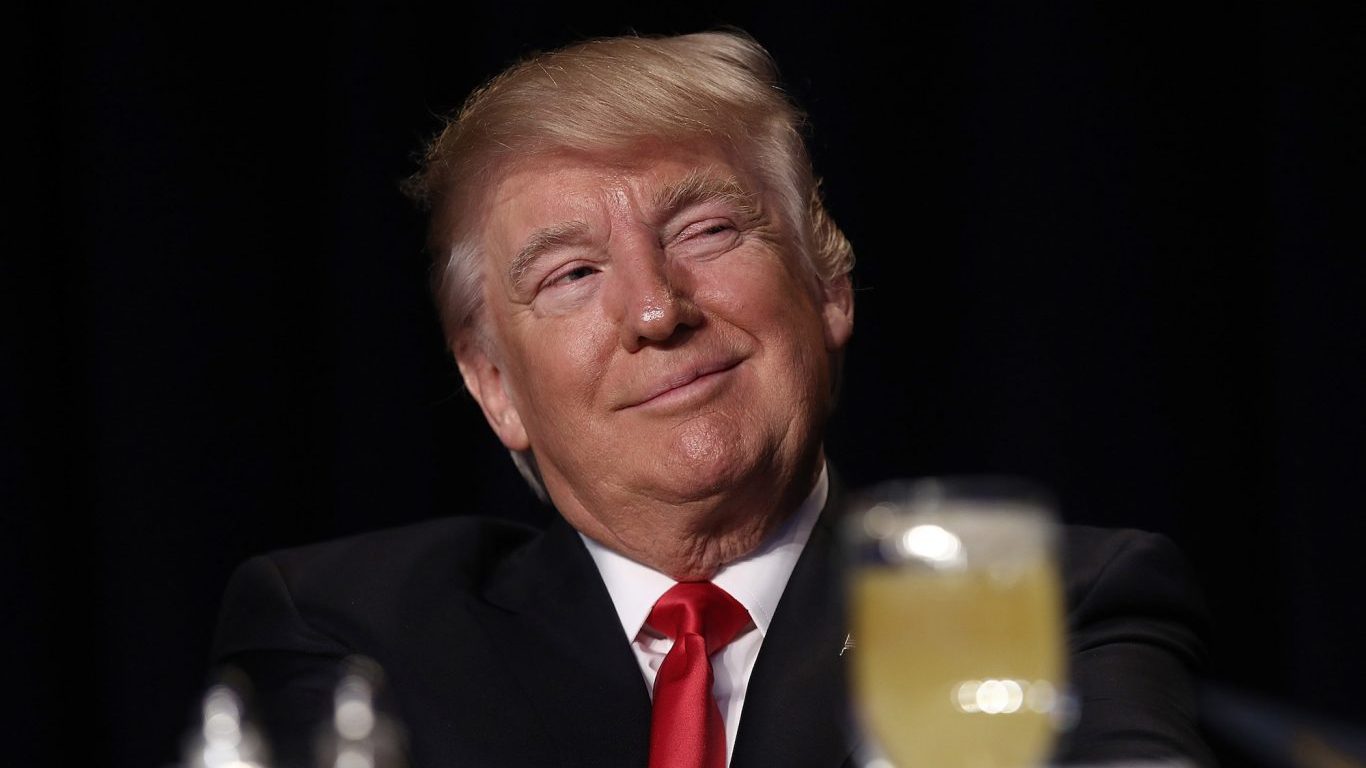
That happened again today after CNBC reported that President Trump bought between $1 million and $5 million worth of Axon Enterprise (NASDAQ:AXON | AXON Price Prediction), the maker of Tasers and police body cameras. The stock is up 10% in morning trading today, but the purchase itself wasn’t the news. Investors have known about it for weeks. What changed was the timeline surrounding the transaction.
The Trade Was Already Public — The Timing Wasn’t
Trump revealed nearly 3,700 stock trades in May, according to federal financial filings released in May. His purchase of Axon shares was already included among those transactions. But CNBC’s reporting added an important detail.
The records show Trump purchased Axon stock on Feb. 10. Just two weeks later, on Feb. 24, U.S. Immigration and Customs Enforcement sought a five-year, $220 million contract for approximately 17,800 Tasers, along with unlimited cartridges and training. That sequence immediately raised eyebrows.
The White House has maintained that Trump’s assets are held in a trust managed by his children and that independent third-party investment managers — not Trump or his family — make investment decisions. If that process worked exactly as described, the purchase may have been entirely coincidental.
Coincidence isn’t the same as misconduct. Yet markets rarely ignore optics, especially when government contracts and presidential investments appear in the same timeline.
Stock Trading Rules Are The Bigger Problem
Congress passed the STOCK Act in 2012 to prevent lawmakers and senior government officials from profiting on nonpublic information obtained through their official duties. The law requires disclosure of stock trades and prohibits insider trading.
In practice, however, enforcement has been weak. Numerous members of Congress from both political parties have faced allegations of violating disclosure requirements over the past decade. Yet no sitting politician has faced meaningful legal consequences for alleged STOCK Act violations.
That leaves an uncomfortable reality. Even when transactions are perfectly legal, they can undermine public confidence if elected officials — or those closely connected to them — appear positioned to benefit from government decisions they oversee or influence.
Another Deal Is Fueling More Questions
The Axon story also arrives just one day after The New York Times reported another transaction drawing scrutiny.
According to the newspaper, the Trump administration negotiated an agreement with Kazakhstan to secure access to tungsten, a metal used in missiles, armor-piercing ammunition, and other defense applications. The deal reportedly included $1.6 billion in federal financing for the little-known company Kaz Resources that was awarded the rights to develop the tungsten reserves.
Notably, Trump’s sons, Donald Trump Jr. and Eric Trump, through their company Dominari Securities, took a combined 20% ownership stake in Kaz within weeks of the negotiations. Commerce Secretary Howard Lutnick reportedly played a central role in the discussions, while Cantor Fitzgerald, controlled by Lutnick’s family, helped raise financing for Dominari that could have generated millions of dollars in fees.
Those facts do not prove wrongdoing. But they reinforce why appearances matter as much as legal technicalities when public officials and government contracts intersect.
Key Takeaway
In short, today’s rally in Axon wasn’t driven by a newly discovered stock purchase. Investors already knew Trump owned the shares. The new information was how closely the purchase preceded a proposed $220 million ICE contract.
Regardless of whether every transaction proves legitimate, the pattern highlights a larger issue. The STOCK Act was intended to reassure Americans that elected officials could not profit from their positions. Fourteen years later, repeated controversies suggest it has fallen far short of that goal.
For investors, Axon’s long-term prospects will depend on demand for its public safety technology, not a single political headline. But for Washington, these episodes continue to make the strongest case yet that politicians — and perhaps senior executive branch officials as well — should be prohibited from buying and selling individual stocks while in office.
Contact [email protected] for any questions or corrections.
After two decades of patrolling the dark corners of suburbia as a police officer, Rich Duprey hung up his badge and gun to begin writing full time about stocks and investing. For the past 20 years, he’s been cruising the markets looking for companies to lock up as long-term holdings in a portfolio while writing extensively on the broad sectors of consumer goods, technology, and industrials. Because his experience isn’t from the typical financial analyst track, Rich is able to break down complex topics into understandable and useful action points for the average investor. His writings have appeared on The Motley Fool, InvestorPlace, Yahoo! Finance, Money Morning, and, of course, 24/7 Wall St. He has been featured in both U.S. and international publications, including MarketWatch, Financial Times, Forbes, Fast Company, and USA Today.