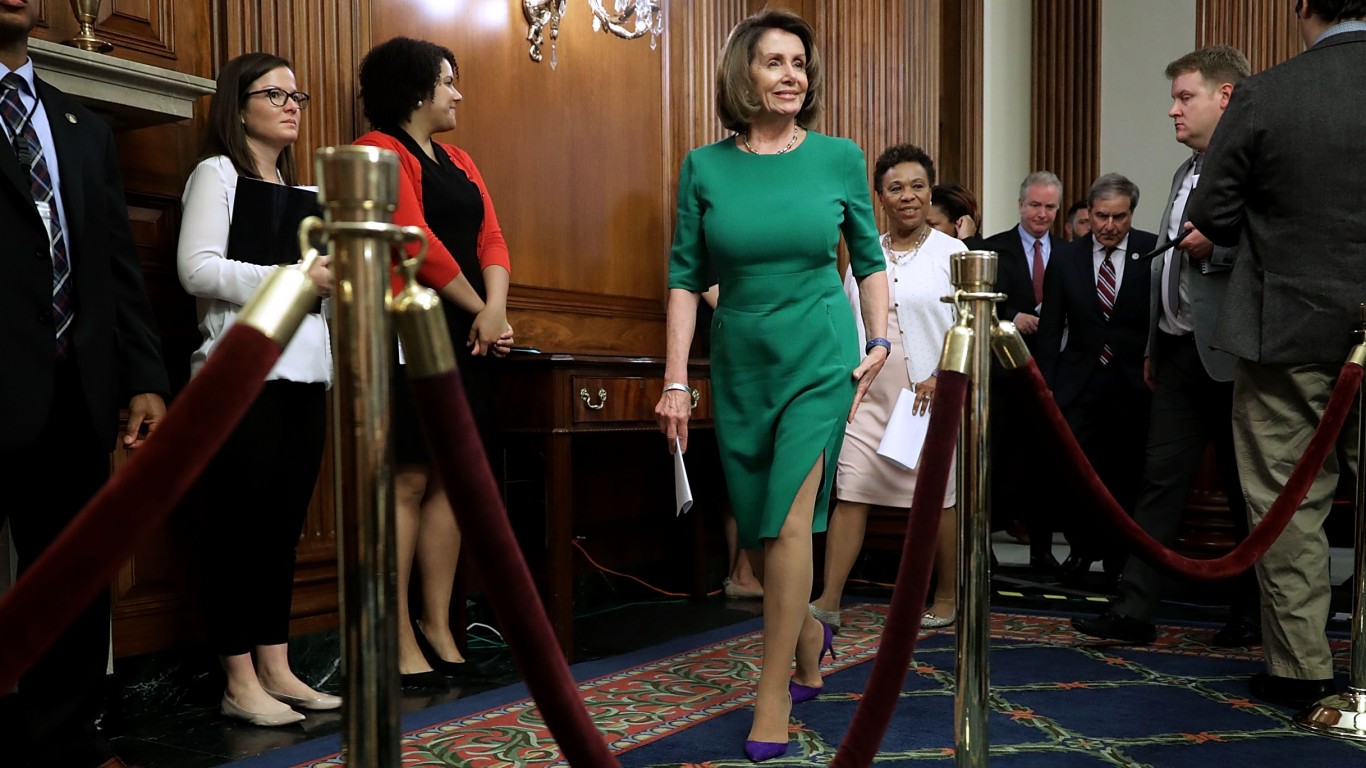
Here’s How Nancy Pelosi Beat the Stock Market and Warren Buffett
The S&P 500 has delivered roughly 13% annualized returns over the past decade, one of the strongest bull runs in modern history. Berkshire Hathaway (NYSE:BRK-A)(NYSE:BRK-B), long the gold standard for patient capital, has matched that pace with about 13% annually…


The S&P 500 has delivered roughly 13% annualized returns over the past decade, one of the strongest sustained bull runs in modern history. Berkshire Hathaway (NYSE:BRK-A | BRK-A Price Prediction)(NYSE:BRK-B), long the gold standard for patient capital, matched that pace with roughly 13% annually over the same stretch. Impressive numbers for most investors. Yet both look like amateur hour next to the woman still serving her final term in Congress: Nancy Pelosi.
While Warren Buffett spent years building his Apple position before eventually trimming it, the former House Speaker was running concentrated, leveraged bets on the entire tech landscape and timing them with uncanny precision. Buffett announced his retirement at Berkshire’s annual shareholder meeting on May 3, 2025, and Berkshire’s board voted the following day to appoint Greg Abel as President and CEO, with the transition taking effect January 1, 2026. Buffett stayed on as Chairman. The decade-long return comparison still holds, though the company Pelosi is outrunning now has a new driver at the wheel.
Congress: The World’s Biggest Hedge Fund
From 2019 through 2024, Pelosi’s disclosed trades (executed by her husband, venture capitalist Paul Pelosi) crushed the market by more than 3-to-1. A widely cited analysis by Unusual Whales showed her portfolio gained roughly 65% in 2023 alone, when the S&P 500 rose 24.8%. In 2024, the gap widened further: the portfolio surged 70.9% against the index’s 24.9% gain. Worth noting: even at that pace, Pelosi ranked only 10th among congressional traders that year, according to Unusual Whales, with Rep. David Rouzer and Rep. Debbie Wasserman Schultz posting returns of 149% and 142.3%, respectively.
According to The New York Post, Pelosi’s record during her 37-year tenure in Congress produced cumulative returns of 16,930%, compared to just 2,300% for the benchmark index. That is not merely beating the market. It is thrashing it by an order of magnitude.
When Pelosi entered the House in 1987, she and her husband reported between roughly $610,000 and $785,000 in stocks on their initial disclosure filing. Capitol Trades, which tracks congressional portfolios, estimates her net worth at approximately $642 million to $649 million as of mid-2026, driven largely by compounding returns on core chip positions and the valuation of Paul Pelosi’s private venture capital holdings. She is serving through January 2027 after announcing she would not seek re-election.
The natural question is how a congresswoman earning $174,000 a year (or $223,000 when she served as Speaker) built such extraordinary wealth through the market. The answer involves strategy, timing, and the persistent controversy over whether the two are connected.
From FAANG Darling to AI Queen
Paul Pelosi did not invent momentum investing, but he developed a distinctive variation: buying just before Congress regulates or funds a sector. Early concentrated bets on Apple (NASDAQ:AAPL), Amazon (NASDAQ:AMZN), Alphabet (NASDAQ:GOOG)(NASDAQ:GOOGL), and Netflix were already well documented. Then came the pivot that genuinely turned heads: massive call option purchases in Nvidia (NASDAQ:NVDA) in 2022 and 2023, timed right as the AI boom ignited.
Those Nvidia purchases landed just as Congress was debating hundreds of billions in chip subsidies through the CHIPS Act. The timing on Tesla calls before EV tax-credit expansions, and on Microsoft before large Azure cloud contracts with the federal government, followed a similar pattern. Critics describe this as an informational edge. Defenders call it good sector instinct.
The January 2026 Disclosures: Branching into Infrastructure and Dividends
The portfolio expanded meaningfully following financial disclosures filed on January 23, 2026. Those filings revealed that on January 16, 2026, Paul Pelosi exercised long-term calls across several positions, converting leveraged options into direct equity. The round included 50 call options each for Nvidia (5,000 shares at an $80 strike), Alphabet (5,000 shares at a $150 strike), Amazon (5,000 shares at a $150 strike), and Tempus AI (5,000 shares at a $20 strike).
The early 2026 moves also signaled a clear shift toward backend AI data center infrastructure. Pelosi exercised 50 call options in utility company Vistra Corp, acquiring 5,000 shares at a $50 strike price. Vistra has built out its nuclear power capacity in recent years and has been swept up in the AI investment boom as leading tech companies aggressively pursue nuclear energy to power their data centers. At the same time, the portfolio added 25,000 shares of asset management firm AllianceBernstein, valued between $1 million and $5 million, providing institutional dividend exposure outside pure tech. Additional purchases of Broadcom and Apple call options in late 2025 sustained the portfolio’s long-term semiconductor concentration.
The Million-Dollar Question Washington Wants to Ignore
The official explanation is straightforward: Paul Pelosi is a skilled venture investor with a sharp feel for technology cycles. The more skeptical reading is that a spouse who helps write semiconductor, cloud computing, and electric vehicle policy gains access to information that carries real market value before it becomes public.
The STOCK Act of 2012 was supposed to curb congressional insider trading, but the law still gives members and their spouses a 45-day disclosure window and imposes no blind-trust requirements. Legislative pressure built steadily, and 2025 brought the most serious movement yet. On July 30, 2025, the Senate Homeland Security and Governmental Affairs Committee voted to advance the Halting Ownership and Non-Ethical Stock Transactions (HONEST) Act, a bipartisan bill led by Sens. Josh Hawley, Gary Peters, Jeff Merkley, and Jon Ossoff. The measure would ban lawmakers, the President, the Vice President, and their spouses from holding, buying, or selling individual stocks. In a notable development, Nancy Pelosi herself publicly endorsed the bill after it cleared committee, saying she would be “proud to support it” when it reaches the House floor.
On the House side, the Stop Insider Trading Act, introduced by Rep. Bryan Steil (R-WI) and backed by Rep. Mariannette Miller-Meeks, passed the full chamber on July 22, 2026, by a 232-198 vote, marking the first time the House had ever passed legislation to limit lawmakers’ stock trading. Nearly all Republicans joined 13 Democrats in support. The bill would prohibit members of Congress, their spouses, and dependent children from purchasing individual stocks, while requiring public notice before any sales. President Trump is exempt from its provisions. Despite clearing the House with bipartisan support, the bill failed in the Senate on September 30, 2026, falling short of the 60-vote threshold needed for cloture. Democrats largely voted against it, arguing the legislation did not go far enough and that its exclusion of the White House made it inadequate as an ethics reform.
Multiple competing reform proposals remain active, but none have yet become law. The HONEST Act, which would cover the executive branch, remains stalled without a Senate floor vote scheduled.
Replicating Pelosi’s Success
Outside of entering politics, here are four practical strategies average investors can use to beat the market and perhaps even Buffett himself:
- Embrace Emerging Technologies and Infrastructure as Core Holdings. Pelosi’s success stems from heavy bets on transformative tech themes: FAANG stocks in the 2010s, AI software in the early 2020s, and utility-scale energy infrastructure to backstop computing demands more recently. Using ETFs or index funds rather than individual stock picks lets ordinary investors capture broad sector momentum without the concentration risk.
- Concentrate on What You Know Best. The Pelosi portfolio often holds just a handful of names, with Nvidia comprising roughly 22% of the total at times, amplifying gains during sector booms. Focusing most assets on a small number of well-understood sectors or themes tends to outperform excessive diversification, though limiting any single holding to around 10% to 15% provides a cushion against catastrophic losses.
- Hold for the Long Term. Pelosi’s trades reflect genuine patience: exercising options and retaining shares through full sector cycles, including Nvidia’s AI-driven rally from 2023 onward. Letting the power of compounding work over years rather than quarters is the clearest lesson from the disclosed trading record.
- Seek Asymmetric Opportunities with Controlled Leverage. The strategy relies on call options for outsized returns on modest upfront costs, timed to anticipated catalysts such as stock splits or major government contracts. Options carry real risk, but the core principle of pursuing investments with high potential upside and defined downside applies broadly to any investor’s approach.
Key Takeaway
Ordinary investors cannot sit in on classified briefings, but they can read about where Congress plans to spend tens of billions of dollars and position in the pure-play leaders months before appropriations bills hit the floor. The government has recently been taking direct equity stakes in companies involved in semiconductor production, rare earth mining, battery-grade lithium production, and critical mineral extraction.
Following legislative trends can be just as financially rewarding as combing through a company’s latest SEC filings, particularly when paired with awareness of where politicians are directing their own capital. It does not level the playing field entirely, but it tilts the odds a little further in an ordinary investor’s favor.
Editor’s note: This pass corrects the Buffett CEO transition detail (the Berkshire board voted on May 4, 2025, and Greg Abel’s appointment took effect January 1, 2026, not December 31, 2025), and updates the congressional stock-trading reform section to reflect that the Stop Insider Trading Act, introduced by Rep. Bryan Steil, failed a Senate cloture vote on September 30, 2026 after Democrats largely opposed it, and that President Trump is exempt from the bill’s provisions.
Contact [email protected] for any questions or corrections.
After two decades of patrolling the dark corners of suburbia as a police officer, Rich Duprey hung up his badge and gun to begin writing full time about stocks and investing. For the past 20 years, he’s been cruising the markets looking for companies to lock up as long-term holdings in a portfolio while writing extensively on the broad sectors of consumer goods, technology, and industrials. Because his experience isn’t from the typical financial analyst track, Rich is able to break down complex topics into understandable and useful action points for the average investor. His writings have appeared on The Motley Fool, InvestorPlace, Yahoo! Finance, Money Morning, and, of course, 24/7 Wall St. He has been featured in both U.S. and international publications, including MarketWatch, Financial Times, Forbes, Fast Company, and USA Today.