A Portfolio Manager Says the Real Crowded Trade Isn’t the Mag 7. It’s Hiding in Plain Sight
Zachary Hill, Head of Portfolio Management at Horizon Investments, went on CNBC this morning and said the quiet part loud. “The semis and the memory names are the most crowded ones in the market right now.” The AI trade, in…


Zachary Hill, Head of Portfolio Management at Horizon Investments, went on CNBC this morning and said the quiet part loud. “The semis and the memory names are the most crowded ones in the market right now.” The AI trade, in his framing, has split into two separate trades, and retail is looking at the wrong one.
Hill’s point is that the megacaps everyone assumes are the crowded consensus longs are actually being disciplined by the market, while the picks-and-shovels names on the other end of the capex pipe have quietly become the concentration risk. The numbers back him up in ways that would surprise anyone who has been reading Mag 7 headlines all year.
Where the money is actually crowded
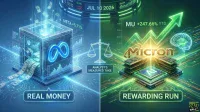
Start with the memory side of the ledger. Micron Technology (NASDAQ:MU | MU Price Prediction) is up 227% year to date and 753% over the past year. Fiscal Q3 revenue landed at $41.46 billion, up 345.7% year over year, with GAAP gross margin at 84.6% against 37.7% a year earlier. The company guided fiscal Q4 revenue to $50.0 billion plus or minus a billion, per the Q3 press release filed with the SEC.
That is a supercycle being priced into a single ticker. JPMorgan raised its price target to $1,540 from $550 on June 30, citing strategic customer agreements totaling roughly $100 billion in cumulative revenue at floor pricing. Meanwhile the iShares MSCI USA Value Factor ETF now holds Micron at around 25% of the portfolio due to methodology rules. When a value factor ETF is a quarter Micron, “crowded” is doing a lot of work.
The hyperscalers everyone thinks are crowded
Now flip the tape. Microsoft (NASDAQ:MSFT) is down 22.53% year to date. Meta Platforms (NASDAQ:META) is down 14.52%. Alphabet (NASDAQ:GOOGL) is up 14.32%, trailing the SPY’s 9.51% gain but well behind the QQQ’s 19.87%. Hill’s data check holds. “Only one of the seven mag seven is above the s&p 500 so far this year. They’re all behind the NASDAQ 100.”
What did they do to deserve this? Spend money. Alphabet guided 2026 capex to $175 billion to $185 billion. Meta raised its range to $125 billion to $145 billion. Microsoft’s Q3 capex alone came in at $30.88 billion, up 84% year over year. The market’s response was to compress multiples. Microsoft trades at a forward P/E of 19, Meta at 17, Alphabet at 24. Hill’s read lands hard. “Those hyperscalers within the mag-7 cohort have really been punished by the market… Versus the s&p 500, they’re as cheap as they were at the end of 2022.” That 2022 comparison matters because it was the last time hyperscaler managements got religion on cost discipline.
Where NVIDIA fits in this split
NVIDIA (NASDAQ:NVDA) is the strange middle child of Hill’s framework, a semi that is also a $4.8 trillion megacap. It sits inside the crowded trade by industry and outside it by market cap. Year to date the stock is up only 7.42%, trailing SPY. Q1 FY27 revenue hit $81.61 billion, up 85.2%, and management guided Q2 to $91.0 billion. Forward P/E sits at 23, which for a company growing this fast is not obviously the top of a bubble.
NVIDIA’s Q1 supply commitments now stand at $119 billion. Those are the checks the hyperscalers are being punished for writing. The gain flows one way, the pain flows the other.
What to watch into Q2 earnings
Hill’s setup for the next couple of weeks is that a rotation back into the Mag 7 laggards is plausible if hyperscaler managements signal any spending discipline on Q2 calls. If they double down instead, the punishment continues and the crowded trade in memory keeps eating fund flows. Watch how Alphabet and Meta guide 2027 capex versus their current 2026 ranges. That is the tell.
Contact [email protected] for any questions or corrections.
Omor Ibne Ehsan is a writer at 24/7 Wall St. He is a self-taught investor with a focus on growth and cyclical stocks that have strong fundamentals, value, and long-term potential. He also has an interest in high-risk, high-reward investments such as cryptocurrencies and penny stocks.