





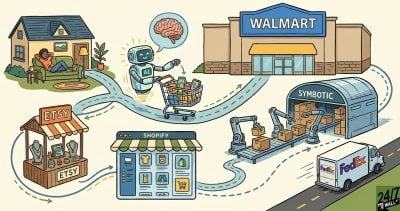
The Walmart (NYSE:WMT | WMT Price Prediction) partnership with Google to build a Gemini-powered agentic shopping experience reshapes who captures value when artificial intelligence handles browsing, recommending, and buying. The retailer supplies the catalog and customer base, but the stack underneath (the model, card network, checkout financing, discovery layer) is where public-market investors own a piece of the shift. Ranking beneficiaries by execution, growth, and centrality to agentic commerce infrastructure reveals a clear top five of winners.
5. PayPal: The Rail That Needs a Reboot
PayPal (NASDAQ:PYPL) is the checkout button agentic shoppers already recognize. New CEO Enrique Lores delivered a Q1 FY26 beat with shares at $45.47 after non-GAAP EPS of $1.34 vs. $1.27 expected on revenue of $8.35 billion, up 7.2% year over year, with total payment volume of $463.95 billion. Branded checkout underperformed, GAAP operating margin contracted 182 basis points to 17.8%, and management guided Q2 non-GAAP EPS to decline roughly 9% year over year. Prediction markets peg odds of a full Stripe takeover in 2026 at just 11.5%. The stock is down 22.1% year to date. Relevant, but the weakest execution in this group.


4. Wayfair: Agentic Discovery for a Giant Catalog
Wayfair (NYSE:W) is the natural laboratory for AI-assisted shopping. Millions of home goods SKUs are exactly what a Gemini agent needs to excel. CEO Niraj Shah’s Q1 FY26 showed revenue of $2.93 billion, up 7.4% year over year, active customers of 21.4 million, AOV of $312, and the best Q1 adjusted EBITDA margin in five years at 5.2%. Shares trade near $94.50, up 67.4% over the past year, with analyst target at $93.54. Wayfair carries a $2.8 billion stockholders’ deficit and $2.9 billion in long-term debt, so leverage remains a meaningful overhang. It wins if AI agents turn browsing paralysis into completed carts.


3. Affirm: BNPL Along for the Ride
Affirm (NASDAQ:AFRM) is the financing layer that an agentic checkout presents when a cart reaches a certain size. Q3 FY26 revenue rose 32.6% year over year to $1.04 billion, gross merchandise volume (GMV) hit $11.60 billion (the 10th consecutive quarter above 30% growth), Affirm Card GMV jumped 146% to $2.10 billion, and cardholders doubled to 4.4 million. Cost of funds fell to 5.8%, its lowest in three and a half years. Management called it “genuine product market fit.” Shares trade at $84.58, up 19.1% over the past month, with forward P/E of 42x. Concentration risk: top five partners drive 42% to 46% of GMV.


2. Mastercard: Every Agentic Swipe Settles Here
Mastercard (NYSE:MA) is the pipe every agent-initiated purchase rides. CEO Michael Miebach is explicitly building for this future with Mastercard Agent Pay and a planned acquisition of BVNK for stablecoin settlement. Q1 FY26 delivered adjusted EPS of $4.60 vs. $4.41 expected, revenue of $8.40 billion up 15.8% year over year, cross-border volume up 13%, value-added services up 22%, and adjusted operating margin of 60.8%. The company returned $4.0 billion via buybacks. Shares at $539.39 rallied 12.9% over the past month, though the stock is still down 5.5% year to date. It is boring, essential, and quietly reworking its rails for the agent era.


1. Alphabet: The Engine That Does the Shopping
Alphabet (NASDAQ:GOOGL) is the deal. Walmart’s agentic shopping surface runs on Gemini, scaling faster than any other Alphabet asset. Q1 FY26 revenue hit $109.90 billion, up 21.8% year over year, EPS came in at $5.11 vs. $2.63 expected, Google Cloud grew 63% to $20.03 billion with backlog above $460 billion, and Gemini API usage reached more than 16 billion tokens per minute, up 60% sequentially. Sundar Pichai said, “Our AI investments and full stack approach are lighting up every part of the business.” 2026 capital expenditure is guided to $180 billion to $190 billion.

Shares at $359.91 are up 101.5% over the past year and 15.0% year to date, with forward P/E near 25x and analyst target of $432.65. Prediction markets see a 76.8% chance the next Gemini Pro ships within weeks. If Walmart proves the model, every big-box retailer will call Mountain View next.


The Bottom Line
Alphabet owns the model doing the work; Mastercard, Affirm, Wayfair, and PayPal each capture a slice of what happens after the agent decides. Agentic commerce is early and unproven. Consumers may resist letting software authorize purchases, and regulators are watching buy-now-pay-later and AI-mediated transactions closely. Alphabet is the cleanest way for investors to own the pick-and-shovel of AI-driven retail, backed by $402.8 billion in annual revenue and a cloud business compounding at triple-digit rates on a large base.
Contact [email protected] for any questions or corrections.









 Top Gaining Stocks
 Top Losing Stocks