Why Michael Burry’s Massive Bet Against Micron Could Be His Biggest Mistake Yet
The market has a habit of rewarding investors who recognize when an old pattern no longer applies. Cyclical industries eventually boom and bust, but structural shifts can stretch those cycles far longer than anyone expects. Artificial intelligence has done exactly…


The market has a habit of rewarding investors who recognize when an old pattern no longer applies. Cyclical industries eventually boom and bust, but structural shifts can stretch those cycles far longer than anyone expects.
Artificial intelligence has done exactly that for semiconductors. Companies supplying the hardware behind AI training are no longer serving ordinary PC and smartphone demand alone. They’re supplying an infrastructure buildout measured in hundreds of billions of dollars. That environment is important because legendary investor Michael Burry is betting that the evidence suggesting this cycle is different is just wrong.
Burry’s Bear Case Isn’t Without Merit
In a recent Substack post, Burry revealed he established a direct short position against Micron Technology (NASDAQ:MU | MU Price Prediction) after the stock traded around $1,052 per share. He noted that he typically prefers buying put options, but implied volatility had made them too expensive. If volatility eases, he said he may add put positions to expand his bearish bet.
His reasoning follows the classic semiconductor playbook. Memory has historically been among the industry’s most cyclical businesses. Producers eventually expand manufacturing capacity, supply catches demand, prices collapse, and profits evaporate. Investors who buy near the top of that cycle often endure painful declines.
Burry has built his reputation by recognizing exactly those moments. The trade fits his long-held investing style. It also subverts the current narrative around memory that AI demand has broken that cycle, or at least significantly delayed its eventual onset.
Granted, Micron has experienced multiple brutal downturns over the past two decades. The company’s revenue fell from $30.8 billion in fiscal 2022 to $15.5 billion in fiscal 2023, as memory prices collapsed following pandemic-era overproduction.
But let’s examine why today’s environment looks very different.
AI Has Changed the Memory Market
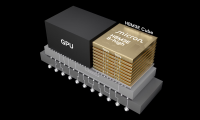
The key difference is demand. Unlike prior cycles driven largely by PCs and smartphones, today’s memory market is being powered by AI infrastructure spending. High-bandwidth memory (HBM) has become an essential component inside AI accelerators from Nvidia (NASDAQ:NVDA), and demand continues to outpace supply.
Micron’s HBM production is effectively sold out through the end of 2026. Meanwhile, the four largest cloud providers are collectively expected to spend more than $700 billion on AI infrastructure this year with substantially more over the next several years, creating sustained demand for advanced memory.
The competitive landscape also favors producers.
| Market | Industry Structure |
| DRAM | Three companies control roughly 90% of global production |
| HBM | Micron, Samsung Electronics, and SK hynix account for essentially the entire market |
That oligopoly matters because manufacturers have become far more disciplined about adding capacity than they were a decade ago. Instead of flooding the market, they’re expanding cautiously while prioritizing profitability.
Surprisingly, that’s exactly the opposite of the conditions that fueled previous memory crashes.
Capacity Is Growing — But Not Fast Enough
That doesn’t mean Micron is risk-free. New fabrication plants are under construction, and eventually supply will increase. At some point, pricing will normalize. Burry is almost certainly correct that memory remains cyclical over the very long term. The problem is timing.
Building leading-edge memory fabs requires tens of billions of dollars and years of construction. Even after facilities open, ramping advanced HBM production isn’t immediate. Meanwhile, AI demand continues growing faster than manufacturers can satisfy it.
In other words, the cycle has been stretched by an unprecedented wave of AI investment.
Key Takeaway
In short, Michael Burry may ultimately prove right that Micron won’t escape cyclicality forever. History argues that no commodity semiconductor business does.
But investors should distinguish between eventually and today. The current memory market is supported by an AI spending boom unlike anything the industry has previously experienced. With three companies controlling nearly all advanced memory production, disciplined capacity expansion, and demand exceeding supply for years rather than quarters, the traditional boom-and-bust playbook appears less useful than it once was.
For long-term investors, betting against Micron today may mean betting against the very AI infrastructure buildout that’s reshaping the semiconductor industry. That has rarely been a profitable position to take. Ultimately, Burry may be taking the right stance, but far too early.
Contact [email protected] for any questions or corrections.
After two decades of patrolling the dark corners of suburbia as a police officer, Rich Duprey hung up his badge and gun to begin writing full time about stocks and investing. For the past 20 years, he’s been cruising the markets looking for companies to lock up as long-term holdings in a portfolio while writing extensively on the broad sectors of consumer goods, technology, and industrials. Because his experience isn’t from the typical financial analyst track, Rich is able to break down complex topics into understandable and useful action points for the average investor. His writings have appeared on The Motley Fool, InvestorPlace, Yahoo! Finance, Money Morning, and, of course, 24/7 Wall St. He has been featured in both U.S. and international publications, including MarketWatch, Financial Times, Forbes, Fast Company, and USA Today.