Did SK Hynix’s Record $42 Billion Q2 Profit Just Prove the Memory Boom Went Bust?
SK Hynix just posted the most explosive profit growth any chipmaker has seen in years, yet investors responded by selling the stock below its IPO price. The reason reveals something unsettling about where the AI memory boom may be headed.

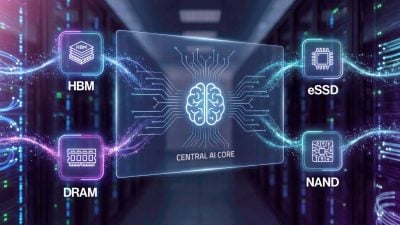
Artificial intelligence has rewritten the rules for much of the semiconductor industry over the last two years. Nvidia‘s (NASDAQ:NVDA | NVDA Price Prediction) GPUs sparked the first wave, but memory makers quickly became some of the biggest beneficiaries as high-bandwidth memory (HBM) emerged as the critical ingredient powering AI servers.
Demand has been so strong that prices surged, supply remained tight, and memory manufacturers reported results that would have seemed impossible just a few years ago. Yet markets don’t reward the past — they price in the future. That’s exactly why SK Hynix‘s (NASDAQ:SKHY) latest quarter, despite setting records across the board, left investors wanting much more.
Record Results Weren’t Enough
Recently IPO’d SK Hynix reported second-quarter operating income of $42 billion, a 557% increase from the year-ago period. Revenue climbed 257% year over year, reflecting booming demand for AI memory and continued shortages across the HBM market.
Those are extraordinary numbers by any historical standard. Yet Wall Street wasn’t comparing SK Hynix to last year. It was comparing the company to expectations that had grown even faster.
| Metric | Q2 Result | Year-Over-Year Change | Wall St. Est. |
| Operating income | $41.7 billion | +557% | $44.2 billion |
| Revenue | $54.6 billion | +257% | $57.9 billion |
| Share price | $128.25 premarket | Down 34.2% from highs | – |
Analysts expected even stronger profitability after months of rising HBM prices and insatiable AI infrastructure spending. Instead, SK Hynix’s record results suggested pricing momentum may already be beginning to normalize.
That’s a dangerous message for a stock priced for perfection.
Investors Are Looking Past Today’s Numbers
The company priced its U.S. IPO at $149 per share on July 10. Shares opened at $170, briefly climbed to nearly $195, then reversed sharply. At roughly $128 in premarket trading, the stock has lost over one-third of its value from its post-IPO peak and now trades below its offering price.
Ironically, that decline came while the company was reporting the strongest financial results in its history. The problem isn’t SK Hynix’s execution. It’s the market’s growing concern that memory remains one of technology’s most cyclical businesses.
Unlike Nvidia, whose software ecosystem creates sticky customer relationships, memory chips remain largely commodity products. When supply tightens, prices soar. When additional capacity enters the market, pricing often falls much faster than demand.
That’s exactly what investors are beginning to fear. Micron Technology (NASDAQ:MU), SK Hynix, and Sandisk (NASDAQ:SNDK) have all sold off sharply in recent weeks as concerns spread that today’s AI memory shortage could eventually become tomorrow’s oversupply.
The AI Boom Doesn’t Eliminate Cyclicality
Granted, AI has fundamentally changed memory demand. HBM commands premium pricing and remains supply constrained. Major cloud providers continue spending hundreds of billions of dollars expanding AI infrastructure. But those tailwinds don’t eliminate the industry’s historical boom-and-bust cycles.
Every memory upcycle has eventually encouraged more manufacturing capacity, and more supply has almost always pressured prices. Investors are beginning to ask whether today’s record margins represent a new normal — or simply the peak of another cycle.
Surprisingly, the market appears to be leaning toward the second answer. That doesn’t mean SK Hynix’s long-term outlook has deteriorated. It simply means expectations had climbed even faster than earnings.
Key Takeaway
In short, SK Hynix delivered one of the strongest quarters any semiconductor company has reported in years. A 557% jump in profit and 257% revenue growth would normally send a stock higher. Instead, the shares fell because investors were already looking beyond those results toward what comes next.
Ultimately, that’s the lesson for investors. Stocks don’t trade on today’s numbers — they trade on tomorrow’s expectations. As long as concerns persist that the AI memory market could follow its familiar cyclical pattern, even record-breaking earnings may not be enough to support higher valuations. That said, if AI-driven demand remains stronger for longer than the market currently expects, today’s post-IPO selloff could eventually look like an opportunity rather than a warning.
Contact [email protected] for any questions or corrections.
After two decades of patrolling the dark corners of suburbia as a police officer, Rich Duprey hung up his badge and gun to begin writing full time about stocks and investing. For the past 20 years, he’s been cruising the markets looking for companies to lock up as long-term holdings in a portfolio while writing extensively on the broad sectors of consumer goods, technology, and industrials. Because his experience isn’t from the typical financial analyst track, Rich is able to break down complex topics into understandable and useful action points for the average investor. His writings have appeared on The Motley Fool, InvestorPlace, Yahoo! Finance, Money Morning, and, of course, 24/7 Wall St. He has been featured in both U.S. and international publications, including MarketWatch, Financial Times, Forbes, Fast Company, and USA Today.