Wall Street Just Called SpaceX the ‘Apex of Civilizational Ambition’ and Slapped an $800 Target on It
SpaceX (NASDAQ:SPCX | SPCX Price Prediction) begins trading as a Nasdaq 100 constituent today, less than a month after going public, and Wall Street celebrated with coverage normally reserved for a moon landing. Jim Cramer flagged it on CNBC’s Squawk…


SpaceX (NASDAQ:SPCX | SPCX Price Prediction) begins trading as a Nasdaq 100 constituent today, less than a month after going public, and Wall Street celebrated with coverage normally reserved for a moon landing. Jim Cramer flagged it on CNBC’s Squawk on the Street this morning, quoting Deutsche Bank calling the company “the apex of civilizational ambition, oftentimes expressed in steel and fire.”
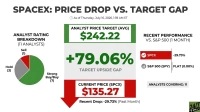
The initiation flood is real. Nineteen firms opened coverage, eighteen of them bullish, with a median price target of $225 and a range from $131 to $800. JPMorgan came in at $300, Deutsche Bank at $225, and Moffett Nathanson stood alone at $131 as the lone skeptic. The $800 target implies a market cap over $10 trillion, which would make SpaceX larger than any company currently in existence. For reference, the stock’s market cap as of this morning sits around $2 trillion, and shares are trading at $152, down 5% on the session even as the index inclusion prints.
Selling on the induction day is telling. One of the top Reddit threads this morning is literally titled “SPCX finally joined the Nasdaq-100. The first reaction was to sell it.”
The $131 to $800 Chasm
A $73 spread is normal. A $669 spread is analysts admitting they have no idea. When targets fan out this widely, the median stops functioning as consensus and becomes an average of guesses. Statisticians call it positive skew. A handful of ultra-bullish outliers drag the average up while most probability mass sits far lower.
Real money agrees with the skeptics. Polymarket’s end-of-July market currently prices only a 19.5% probability that SPCX closes above $210, and just 50.5% probability of closing above $150. The crowd is pricing modest upside at best. Deutsche Bank is pricing a species. Somebody is wrong.
The stock closed at $162 on July 3 after the June IPO priced at $135, briefly pushed the company’s valuation above $2 trillion, then gave back roughly $600 billion in market value amid profit-taking. Volatility this size in a stock this new is baked into the setup.
The Starlink and AI Bull Case
The bullish thesis is coherent. Starlink now runs roughly 9,600 satellites in Low-Earth Orbit and delivers connectivity to millions of customers across 164 countries. Falcon rockets carry more than 80% of the world’s mass to orbit and have maintained a 99% mission success rate. SpaceX acquired xAI in early 2026, making the AI stack part of the same corporate entity that owns the pipes running underneath it.
Cramer’s summary is that Starlink and AI form a self-reinforcing system, with space as a potential “halo scalar.” Sylvia Jablonski, CIO of Defiance ETFs, argued in June that “investors are underestimating SpaceX by viewing it solely as an aerospace company” and that Starlink is “poised to exceed expectations.” Compelling. Also unfalsifiable in the near term, which is exactly what happens when traditional valuation breaks down.
What a Retail Investors Should Do
Cramer’s own analogy on Mad Money on June 11 was Goldilocks and the Three Bears, and he warned that once IPO pricing leaves Musk’s hands, “these are lions Musk can’t tame.” The stock has ripped from $135 to over $220 and back near $150, all in about four weeks. Retail is now piling into short-squeeze narratives.
When 18 of 19 analysts are cheerleading a stock that has been public for under a month, and one writes prose about steel and fire, treat the euphoria as data. The bull case may be right. The valuation risk is real. Both things are true, and position sizing is the only lever you actually control.
Contact [email protected] for any questions or corrections.
Omor Ibne Ehsan is a writer at 24/7 Wall St. He is a self-taught investor with a focus on growth and cyclical stocks that have strong fundamentals, value, and long-term potential. He also has an interest in high-risk, high-reward investments such as cryptocurrencies and penny stocks.