Fundstrat’s Tom Lee: July will be stronger for stocks as valuations become more reasonable
Tom Lee sees a narrow window opening for stocks in July, but his bullish call comes with a stark warning about what follows that most investors are ignoring.


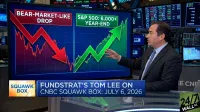
Fundstrat’s Tom Lee returned to CNBC last week with a specific call: after a soft June, July should mark a turn higher for U.S. stocks. His argument rests on a simple observation. Even with the SPDR S&P 500 ETF Trust (NYSEARCA: SPY) sitting up 9.22% year to date through July 2, the market’s price-to-earnings multiple has actually compressed since January, giving earnings room to catch up and multiples room to expand.
The setup matters because June was choppy. SPY finished down 1.95% over the past month, and the CBOE Volatility Index touched 19.95 on June 25 before easing back to 15.56 by July 6. Lee’s thesis is that the reset in sentiment created the conditions for the next leg up.
The valuation math behind Lee’s July call
Speaking with Scott Wapner on CNBC’s Closing Bell, Lee said “the market’s P/E is actually lower now than it was in January by 1.1 full turn,” and he expects second quarter earnings to surprise to the upside again. That combination, higher earnings against a lower multiple, is what he sees as the fuel for a rally.
He put a concrete number on it. “8,000 would be roughly 20 times the 2026 earnings of 400. I think that’s a low estimate. I think the P/E multiple could be 22 or better. So that would be, you know, even 8,400, 8,800 kind of would be the upside into year-end,” Lee said. In other words, if S&P 500 companies deliver on the earnings side, he sees a path to roughly 8,000 to 8,800 by year-end.
That framing echoes what other strategists have been laying out. Goldman Sachs (NYSE: GS | GS Price Prediction) flagged AI investment and a stable economy as key drivers of S&P 500 earnings growth in late June, and Citigroup (NYSE: C) raised its year-end S&P 500 target to 8,100 on the same AI-driven earnings thesis. Skeptics such as Seeking Alpha’s Cory Cramer have countered that the projected 27% earnings growth for 2026 is “largely misleading” and reliant on accounting effects.
Why underperforming managers could power the rally
Lee also pointed to a positioning tailwind. “Only 23% of fund managers are beating the large-cap growth index. That’s the lowest number in almost five years,” he said, arguing that the performance gap will force portfolio managers to chase gains and buy dips in July. Institutional flows already show that behavior taking shape: SPY absorbed a $24.95 billion net inflow during a down week in late June, and technical analysts flagged a potential “golden cross” formation on the ETF.
The August through October warning
Lee’s bullish July view carries a caveat. He told CNBC he expects “something that might feel like a bear market” between now and year-end, driven by two catalysts: the market testing the new Fed chair’s inflation framework, and a gradual unlock of SpaceX shares that could pressure liquidity. He drew a parallel to earlier in 2026, when a February to April drawdown of only 7% still felt like a bear market, and the VIX briefly reached 31.65 on March 27.
That is worth taking seriously. Benzinga reported that institutional investors are actively building put-spread collars on SPY and QQQ, and the CBOE SKEW index has been rising even as VIX drifts lower. Smart money is buying insurance for tail risk while riding the rally.
What to watch next
The immediate tests are Q2 earnings season, which will confirm or reject Lee’s upside surprise thesis, and Fed communications on the pace of any rate cuts after June payrolls came in soft. For readers who track prior 24/7 Wall St coverage, JPMorgan (NYSE: JPM) has laid out a similar earnings-driven framework with a bull case around 8,900 by year-end, providing a useful benchmark for Lee’s numbers. The window Lee describes is narrow, and the second half looks bumpier than the first.
Contact [email protected] for any questions or corrections.
Ian Cooper is a veteran market analyst and investment strategist with more than 20 years of experience covering stocks, commodities, and macro trends. Since 1999, he has helped investors identify market opportunities using a blend of technical analysis, fundamental research, and market sentiment.
He is the creator of the ADD News Flow Strategy, which focuses on trading market reactions to major news events and investor psychology. Cooper was also among the analysts who warned about the 2008 financial crisis and major financial institution collapses ahead of the broader market.
Before joining 247 Wall St., Cooper wrote extensively for InvestorPlace and other financial publications, covering market trends, trading strategies, and investment opportunities.