Price Prediction: Synopsys Stock Will Be Worth This In 2030
Synopsys powers every AI chip on the planet yet trades nearly 20% below where it stood a year ago, which raises a question Wall Street has not fully answered: how far can this stock run before 2030?


Synopsys (NASDAQ:SNPS | SNPS Price Prediction) is the picks-and-shovels play on every AI chip designed on Earth, yet the market has treated it like a problem. Shares are down 19.53% over one year even as revenue jumped 42% YoY in Q2 FY2026 and management raised guidance to a midpoint of $14.76 in non-GAAP EPS.
CEO Sassine Ghazi says “AI is scaling semiconductor demand, architectural diversity and complexity of chips and the systems they power, driving demand across our portfolio.” Can this stock reach $1,100 by 2030?
What’s Holding Synopsys Back Right Now
The stock is stuck because the Ansys deal broke the reported earnings line. GAAP net income collapsed to $17.1 million in Q2 FY2026, down 95.05% YoY, weighed down by $403.6 million of quarterly amortization on acquired intangibles.
Design IP weakness added pressure, with margins collapsing from 36.7% to 20.1% in Q3 FY2025 on foundry customer softness.
Shares are off 5.61% YTD, 4.71% over the past month, and sit 14% below the 52-week high of $651.73. With a beta of 1.222, this name amplifies every wobble in the AI trade. Add $10 billion of long-term debt and export-control noise, and buyers have been happy to wait.
Wall Street Sees 27% Upside. Our Model Sees More
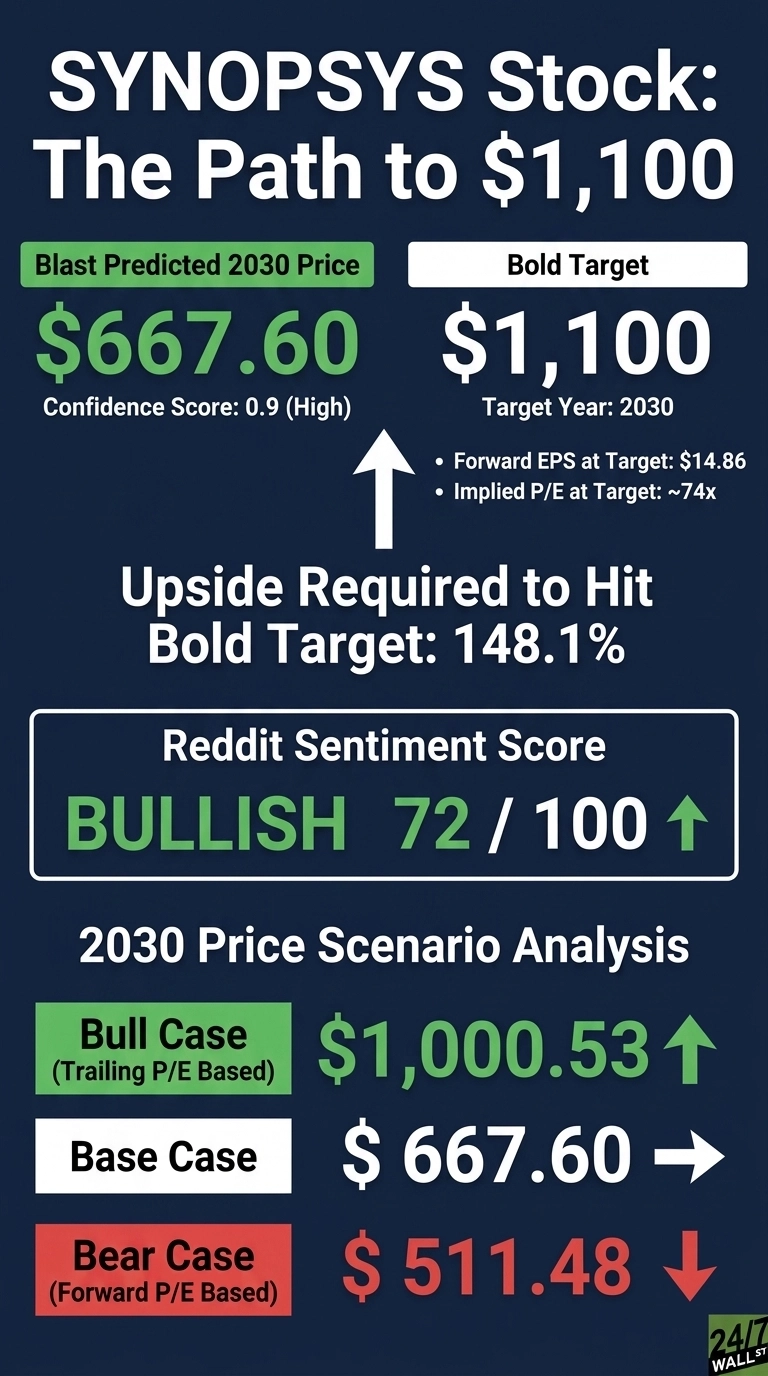
Consensus target is $563.74, with 2 Strong Buys, 15 Buys, 7 Holds, 0 Sells and 1 Strong Sell, and 68% bullish sentiment. Our base case for 2030 lands at $667.60 (+57.74% total return, 9.54% annualized), with a high confidence score of 0.9. The conservative path is $511.48.

The bull path is $1,000.53. Analysts are anchored to near-term Design IP softness and integration noise, underweighting what happens when Ansys synergies compound against a semiconductor R&D backdrop that keeps accelerating. The model’s 1.15x technology sector multiplier may still be too polite.
The Path to $1,100 Per Share
Reaching $1,100 from today’s price of $443.37 would require a gain of 148.1%. With forward EPS of $14.86, a price of $1,100 implies a forward P/E of 74x. Our base case of $667.60 already implies 33x, meaning the bold target requires roughly 41x of additional multiple expansion on today’s earnings power.
That only works if 2030 EPS is materially higher. Guidance is already at $14.76 for FY2026 with an adjusted operating margin of 43.3% in Design Automation, and free cash flow is guided to $2 billion. Compound that at a mid-teens rate through 2030 and $1,100 stops looking absurd.
The setup: the 1.143 adjustment factor, 68% analyst bullish share, a $2 billion buyback, $3.45 billion of debt repaid in H1 FY2026, and Ghazi’s framing that “the increasing AI capabilities throughout our portfolio strengthen our strategic advantage.”
The single biggest risk is a durable Design IP share loss that caps segment margins below management’s targets.
Where Synopsys Trades Today vs Its Earnings Power
On forward EPS of $14.86, SNPS trades at roughly 30x forward earnings, with a trailing P/E of 101 distorted by Ansys amortization.
Shares sit between a 52-week low of $376.18 and a high of $651.73, and the stock has returned 710.99% over the past 10 years. For an EDA duopolist growing revenue north of 40%, that forward multiple looks reasonable. It is the price you pay for a business every AI chip designer needs.
Is $1,100 Realistic?
Reaching $1,100 by 2030 requires a 148.1% gain and forward multiple support of 74x on today’s EPS, or roughly 30x on a materially higher 2030 number. It is a stretch, not a fantasy.
Three things need to go right: Ansys synergies must convert into sustained margin expansion, Design IP must stabilize and rebuild share, and AI-driven chip design demand must continue compounding through the decade.
A hard hit to semiconductor R&D budgets, whether from export controls or a broader capex reset, would derail it. We’ve outlined the blueprint for how Synopsys could reach $1,100 in 2030.
Contact [email protected] for any questions or corrections.
Vandita Jadeja is a financial copywriter who loves to read and write about stocks. She believes in buying and holding for long term gains. Her knowledge of words and numbers helps her write clear stock analysis. She has contributed to several publications, including the Joy Wallet, Benzinga, The Motley Fool and InvestorPlace.