IBM Just Crashed. If Wall Street Pros Are Right The Stock Could Soar From Here
IBM just suffered its worst single-day collapse since 1968, wiping out two years of gains in one brutal session. Wall Street analysts refuse to budge on their targets, creating one of the widest price dislocations in large-cap tech and a…

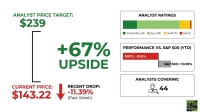
IBM (NYSE:IBM | IBM Price Prediction) currently trades at $214.46 after a brutal reset, while Wall Street’s consensus price target sits at $294.94. That gap implies roughly 37% upside to the average target, one of the widest dislocations in large-cap tech.
IBM is the century-old hybrid cloud, mainframe, consulting, and enterprise software franchise that spent the last two years re-rating higher on AI traction. The company’s generative AI book of business crossed $12.5 billion and IBM Z mainframe revenue kept posting double- and triple-digit growth quarter after quarter. That narrative just fractured.
Analysts have not blinked. The Street still sees a stock that should trade meaningfully higher, even as retail sentiment has gone visibly bearish and prediction markets are pricing in a miss.
A One-Day Reset That Erased Two Years of Progress
IBM cratered more than 25% in a single session, its worst day since 1968, after management preannounced a Q2 revenue and EPS shortfall. The one-week decline came in at -29.09%. Year to date, IBM is down 25.75%.
The catalyst was concrete. Preliminary Q2 revenue is tracking $17.2 billion versus a $17.86 billion estimate, and non-GAAP EPS $2.93 against $3.01 expected. CEO Arvind Krishna attributed the miss to customers shifting budgets from software and mainframes to AI servers and memory amid a global memory shortage. In plain English: hyperscaler AI capex is crowding out traditional enterprise IT spend.
This is company-specific. The S&P 500 is up 10.25% year to date. IBM’s collapse hit every software and IT services name in the neighborhood.
Why the Street Still Sees $294 and Change

Analysts have not capitulated because the pre-warning fundamentals were legitimately good. IBM beat EPS in four consecutive quarters, with Q1 revenue of $15.917 billion, up 9.46% year over year, and IBM Z mainframe revenue up 51%. Free cash flow guidance still calls for roughly $1 billion of year-over-year improvement.
Current ratings skew constructive: 3 Strong Buy, 12 Buy, 7 Hold, 0 Sell, and 1 Strong Sell. The target range is unusually wide, with the Street-high at $375 from Citigroup and the Street-low at $191 from HSBC. The low target sits below the current price, so the bullish view is not unanimous.
The bull case: the Q2 shock is a timing distortion tied to hyperscaler capex crowding out enterprise IT spend. Enterprise AI spending eventually rotates back through IBM’s watsonx, Red Hat, and consulting layers, and the mainframe cycle keeps humming. Bears counter that hyperscaler capex durably eats software wallet share. Prediction markets side with the bears in the near term, pricing a 93.9% probability IBM misses next quarter.
Everyone in the Enterprise Aisle Got Hit
Microsoft (NASDAQ:MSFT) trades at $395.76, down 20.05% YTD, against a consensus target of $559.86. Analyst posture remains overwhelmingly bullish at 13 Strong Buy, 41 Buy, 3 Hold. Microsoft is the capex spender driving the market’s concern.
Oracle (NYSE:ORCL) sits at $131.66, off 33.34% YTD, versus a target of $251.85. Ratings are heavily positive at 8 Strong Buy, 29 Buy, 5 Hold, 1 Sell. Oracle’s problem is the mirror image of IBM’s: enormous capex, deeply negative free cash flow, and rising debt.
Salesforce (NYSE:CRM) trades at $170.33, down 36.42% YTD, with a consensus target of $245.41 and analyst posture at 6 Strong Buy, 34 Buy, 10 Hold, 2 Strong Sell. The AI-crowding-out narrative hits CRM directly.
Accenture (NYSE:ACN) is the group’s worst performer at $138.67, down 48.51% YTD, against a target of just $179.13. Ratings sit at 2 Strong Buy, 12 Buy, 13 Hold, and revisions have drifted down as growth decelerates.
IBM’s forward P/E of 23 is friendlier than peers, against a business still growing revenue high-single digits.
What the Numbers Actually Say
IBM currently trades at $214.46, hugging the $212.34 52-week low and well below the $332.46 high. Consensus target: $294.94. Roughly 19 analysts cover the name, with ratings running 15 Buy-equivalent, 7 Hold, and 1 Strong Sell.
IBM is down 25.75% YTD and 21.54% over the past year. The S&P 500 is up 10.25% YTD and 20.33% over one year. Beta is 0.675, which makes the size of the move striking.
The dividend yield sits at 2.28%, backed by a 31st consecutive year of increases. Investors get paid to wait.
Contact [email protected] for any questions or corrections.
Joel South covers large-cap stocks, dividend investing, and major market trends, with a focus on earnings analysis, valuation, and turning complex data into actionable insights for investors.
He brings more than 15 years of experience as an investor and financial journalist, including 12 years at The Motley Fool, where he served as an investment analyst, Bureau Chief, and later led the Fool.com investing news desk. He has also co-hosted an investing podcast and appeared across TV and radio discussing market trends.