Price Prediction: Figma Will End The Year at This Price
Figma has shed nearly 80% of its value over the past year, yet analysts are quietly converging on a target that implies serious upside from here. The question is whether the fundamentals support the recovery or the risks swallow it…


Figma (NYSE:FIG) has whipsawed from post-listing euphoria into a brutal reset. After a punishing drawdown, the setup is more interesting than the recent price action suggests. Our analysis points to meaningful upside from current levels, driven by 46% top-line growth, a rebuilt valuation, and consensus quietly settled around a target well above the current price.
The 24/7 Wall St. price target for Figma is $30.56 over the next 12 months, implying 30.04% upside from the recent close of $23.50. Our recommendation is buy, with medium confidence.
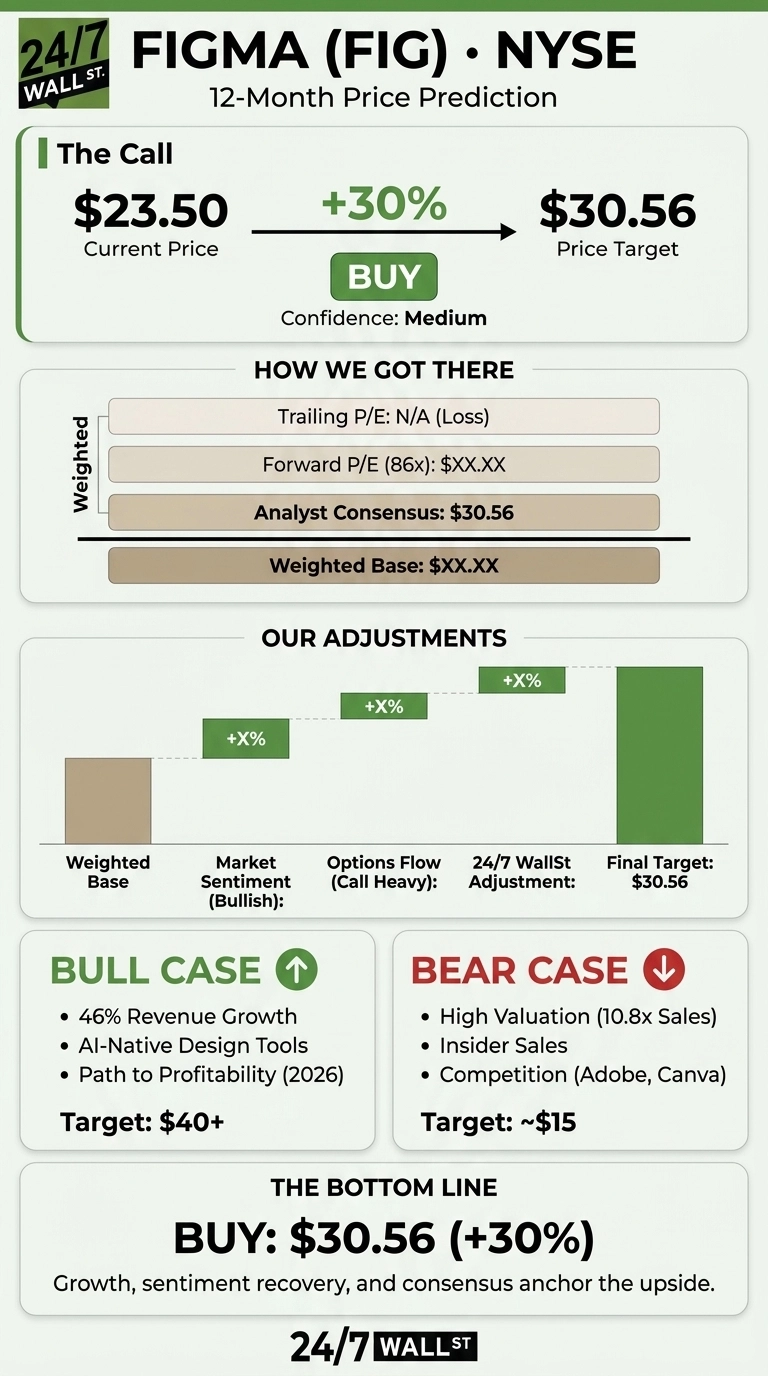
24/7 Wall St. Price Target Summary
| Metric | Value |
|---|---|
| Current Price | $23.50 |
| 24/7 Wall St. Price Target | $30.56 |
| Upside | 30.04% |
| Recommendation | BUY |
| Confidence Level | Medium (approximately 60%) |
From a $50 Billion Wipeout to a Cautious Comeback
Figma is down 79.65% over the past year and 37.12% year to date, having collapsed from a 52-week high of $142.92 to a low of $16.60. Shares are up 26.96% in the past month and 8.44% in the past week.
The turn is grounded in fundamentals. Q1 2026 revenue hit $333.44 million, growing 46% year over year, with a GAAP net loss of $142.4 million largely from stock-based compensation. CEO Dylan Field sold 174,430 shares on May 29, 2026 under a pre-arranged 10b5-1 plan. The next earnings report lands August 5, 2026.
Why Bulls See a Path to $40+
The bull case rests on hypergrowth, category dominance, and AI leverage. Revenue growing 46% nearly doubles what mature design software peers deliver. J.P. Morgan and RBC hold $28 price targets, while Piper Sandler projects profitability by year-end 2026.
If Figma monetizes AI-native design tools and paid subscribers expand, a bull scenario multiple of 13x forward sales supports $40 or higher.
The Risks Worth Watching
Figma trades at 10.76x sales while losing money, and its EV/EBITDA of 441x is not a real multiple. Insider sales from the CEO, CFO, CRO, and CTO between May and June signal capped near-term enthusiasm.
Bulls counter that these were pre-arranged 10b5-1 sales, and stock-based comp drove the GAAP loss. A downside scenario with multiple compression to 6x sales points to roughly $15.
How Figma Compares to Adobe and Autodesk
Adobe (NASDAQ:ADBE | ADBE Price Prediction) is the direct incumbent in creative software. Adobe posted Q2 FY26 revenue of $6.62 billion growing 13% with non-GAAP EPS of $5.96, and trades at roughly 3.4x forward sales. Figma grows more than three times faster but at three times the sales multiple, making our target reasonable rather than aggressive.
Autodesk (NASDAQ:ADSK) is the design-and-make comparable. Autodesk posted Q1 FY27 revenue of $1.93 billion up 18.4% at roughly 5.4x forward sales. Figma’s premium over Autodesk is justified by the growth gap but leaves less room for execution error.
| Company | Revenue Growth | P/S (approx.) |
|---|---|---|
| Figma | 46% | 10.76x |
| Adobe | 13% | 3.4x |
| Autodesk | 18% | 5.4x |
Figma Price Prediction 2026-2030
The 24/7 Wall St. price target of $30.56 implies buy with medium confidence. Growth, sentiment recovery, and consensus anchor the upside.
I’d be a buyer if the August 5 earnings report confirms revenue growth staying above 40% and paid subscriber momentum continues. I’d stay on the sidelines if Figma guides down or gross margin compresses. The risk-reward tilts constructive.
| Year | 24/7 Wall St. Price Target |
|---|---|
| 2026 | $30.56 |
| 2027 | $38.00 |
| 2028 | $46.00 |
| 2029 | $54.00 |
| 2030 | $62.00 |
These projections assume Figma sustains 25% to 35% annual revenue growth and reaches GAAP profitability by 2027. Significant upside or downside could result from AI-driven design disruption or aggressive competition from Adobe and Canva.
Contact [email protected] for any questions or corrections.
Vandita Jadeja is a financial publisher with over a decade of experience writing about financial topics, including investment, savings, retirement, insurance and banking. Vandita is a Chartered Accountant who loves to debunk financial concepts for readers.
Her work has appeared on sites that include The Motley Fool, InvestorPlace, and Benzinga. She covers investing and focuses on stock picks and price prediction for 24/7 Wall St.
When not looking for the next stock investment opportunity, she can be found traveling, reading, chasing sunsets and enjoying her iced latte.