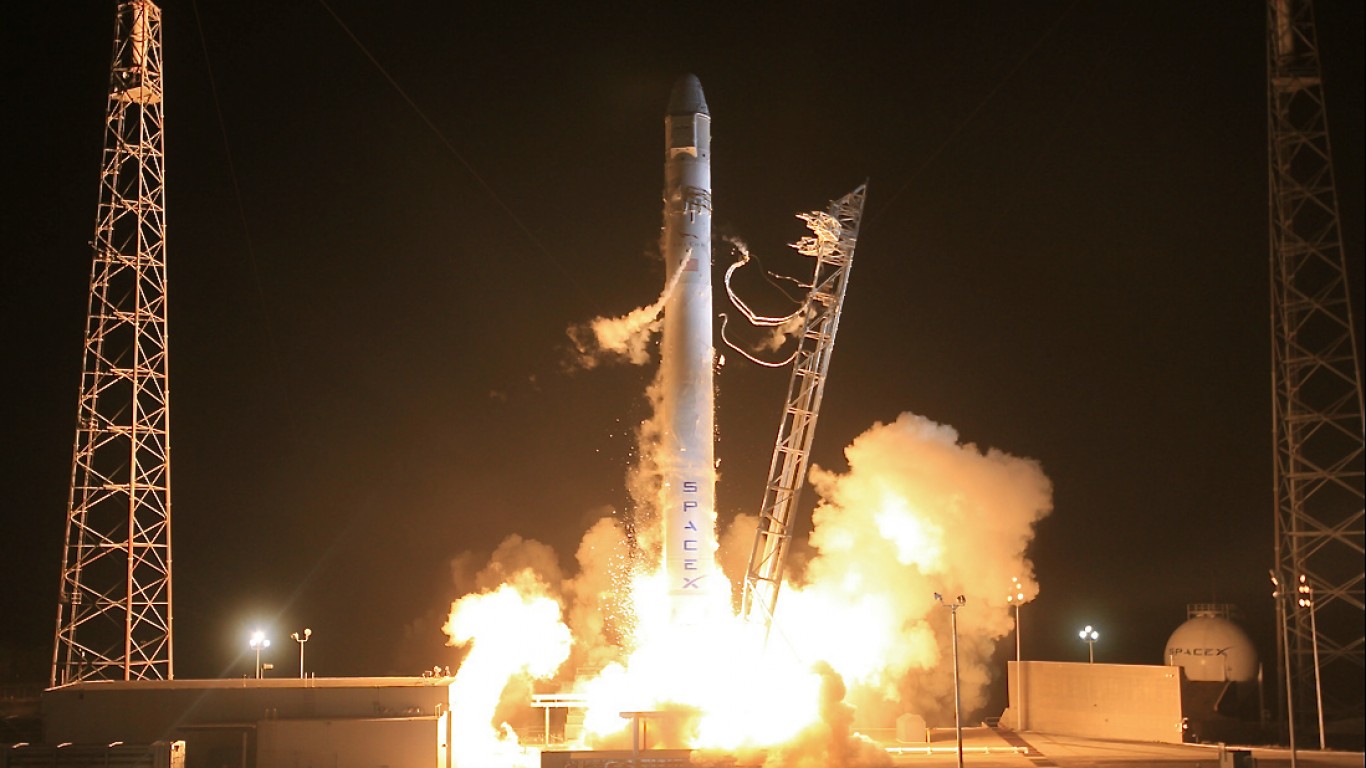
AT&T CEO Dismisses the Starlink Threat: “They’re Coming to the Game Very Late”
AT&T just posted its fifth straight earnings beat while adding over a million new accounts, yet its stock sits near a multiyear low as Starlink looms. CEO John Stankey says satellite competitors are decades too late to matter, but Wall…

AT&T Chairman and CEO John Stankey appeared on a Wednesday, July 22, CNBC interview tied to the company’s Q2 earnings call to push back against the narrative that satellite operators like SpaceX’s Starlink pose an existential threat to legacy telecom carriers.
He believes that decades of terrestrial infrastructure investment, combined with a fiber-plus-wireless convergence strategy, have built a moat that a satellite entrant cannot economically replicate.
AT&T Beats Earnings as Fiber and Wireless Add 1 Million Accounts
AT&T (NYSE:T | T Price Prediction) delivered adjusted EPS of $0.65 against a $0.5871 consensus, a 10.71% beat and the company’s fifth consecutive quarterly earnings beat. Revenue reached $31.558 billion, up 2.3% year over year, slightly below the $31.81 billion estimate. Net income climbed 11.96% to $5.038 billion.
Stankey cited over a million new strategic accounts, the most in three years, alongside nearly 370,000 new fiber additions and 430,000 postpaid voice additions. Fixed wireless subscribers via AT&T Internet Air grew 77.4% year over year to 2.611 million connections, and consumer wireline broadband revenue rose 27.3% to $2.926 billion. Full-year guidance was reiterated at $2.25 to $2.35 adjusted EPS, with EBITDA and EPS lifted to the upper end of the range.

AT&T’s CEO Says Starlink Cannot Replicate Its Infrastructure Moat
On the product itself, Stankey said: “We have the best broadband product that’s out there that’s built on a foundation of fiber. Our wireless business gets stronger and stronger. We bolstered the performance of that business with some really important and strategic spectrum acquisitions.”
On Starlink’s positioning, he argued: “They’re coming to the game very late, after this industry has been established. They have to catch up with substantial amounts of infrastructure investment that’s been going on for decades inside hospitals, on university campuses, in stadiums, in tall buildings.” He added that AT&T “handles 98%+ of the traffic on a converged customer” already today, with partnerships expected to cover remaining edge cases by next year.
Rather than pursuing a wholesale Starlink deal, AT&T is co-buying satellite capacity through a JV consortium alongside T-Mobile and Verizon for coverage gaps. As Stankey framed it: “I don’t feel a need right now that I need to have a satellite partner as a main distribution vehicle for me, because I don’t think it addresses a part of the market that I can’t get to on my own.“
AT&T’s CEO Says Its Current Multiple Is Too Cheap
Stankey acknowledged the disconnect between operating momentum and share price: “I do believe our multiple right now is probably suppressed based on what this business is going to do and perform moving forward. When the cash shows up, eventually the valuation dynamic takes care of itself.“
The stock is up 55% over three years but down 16% over the past year. $T trades at a trailing P/E of 7 and a forward P/E of 9, with an EV/EBITDA of 5 and an average analyst price target of $29.03, slightly above the stock’s current price of $22.81.
AT&T is accelerating repurchases to approximately $10 billion in 2026, part of a $45+ billion capital return plan through 2028. Free cash flow is guided to $18 billion in 2026, $19 billion in 2027, and $21 billion in 2028. Fiber locations reached 38.6 million, targeting 40 million by year-end 2026 and 60 million by 2030.
Wall Street Still Sees Starlink and Cash Flow Risks
CEO Stankey’s confidence collides with skepticism from parts of the Street. Bernstein and Scotiabank have cut price targets citing Starlink competition, and TechStock² flagged that AT&T needs to generate $11.0 to $11.5 billion in free cash flow in the second half to hit guidance.
Jim Cramer has said he does not want to own AT&T or Verizon (NYSE:VZ) due to Starlink. Verizon is up 10.09% over the past year, having closed its Frontier fiber acquisition in January.
The next test will be whether AT&T can meet its second-half-of-the-year cash flow targets and convince investors that satellite competition does not threaten its long-term growth.
Contact [email protected] for any questions or corrections.
Thomas Richmond is a financial writer and content strategist with 5+ years of experience covering stocks and financial markets. He has published over 500 articles focused on individual stock analysis, helping investors better understand business fundamentals, stock valuations, and long-term opportunities.
Thomas previously served as a Content Lead at TIKR, a stock research platform, where he helped scale the company’s blog to hundreds of articles per month and contributed to a weekly newsletter reaching more than 100,000 investors.
Outside of work, Thomas enjoys weight lifting and soccer.