Morgan Stanley Slashes Salesforce Price Target By 35%
A top Morgan Stanley analyst just abandoned his bullish Salesforce stance, and the reason has less to do with Agentforce failing than with a timing problem that could keep the stock under pressure longer than investors expect.

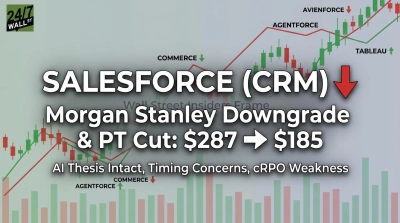
Morgan Stanley analyst Adam Wood cut Salesforce (NYSE:CRM | CRM Price Prediction) price target by 35% on July 21, 2026, Morgan Stanley analyst Adam Wood downgradedfrom Overweight to Equal Weight and slashed his Salesforce price target from $287 to $185, a reduction of roughly 35%. CRM stock fell as much as 3.9% intraday and closed at $170.06, down about 2.2% on a day the NASDAQ Composite rallied around 1.4%. It was the second ratings downgrade for Salesforce this month.
| Ticker | Company | Firm | Action | Old Rating | New Rating | Old Target | New Target |
|---|---|---|---|---|---|---|---|
| CRM | Salesforce | Morgan Stanley | Downgrade & PT Cut | Overweight | Equal Weight | $287 | $185 |
A Call About Timing, With the AI Thesis Intact
The key nuance: Wood is bullish on the leading indicators for Agentforce, Salesforce’s agentic AI platform, and its adoption trajectory. His concern is timing and scale.
The disconnect is real. Agentforce momentum exists, but it has not yet shown up where it matters most for the stock: current remaining performance obligations, or cRPO, a key forward indicator of future subscription revenue. cRPO has stayed weak, signaling company-wide growth has not yet inflected.
The Scale Problem, in Numbers
Agentforce generated a $3.4 billion annualized revenue run rate last quarter. Against roughly $46 billion in total company revenue projected for the fiscal year, Agentforce is still only about 7% of the business, not yet large enough to offset drag from weaker legacy segments, specifically Commerce and Tableau.
Wood still thinks Salesforce could emerge as an AI winner. He believes the inflection to company-wide organic growth will take longer than expected, and his lower target reflects compressed valuation multiples across the software sector. Salesforce continues pushing deeper into agents: in June 2026 it acquired Fin, a customer-service AI agent company built on an outcome-based pricing model and running on its own custom AI model, independent of the major AI labs.
The Bargain Counterargument
At around $168 to $174, Salesforce shares trade below Wood’s new $185 target, at roughly 12 times this year’s earnings estimates. Some investors read that as pricing in almost no growth. If the agentic AI transition delivers, the stock could look cheap in hindsight. Salesforce is also returning significant cash to shareholders through buybacks, a support beneath the price while the market waits.

The 2026 Backdrop
The downgrade lands in a rough year for CRM stock. Salesforce is down about 35% year to date, a slide driven less by any single quarter and more by broad multiple compression across software. Investors face a hard question: will AI coding and agent tools disrupt traditional SaaS business models, or supercharge them? Until that resolves, Salesforce trades under uncertainty.
Wood’s note underscores the real issue. The bull and bear cases hinge on the same variable: how fast AI revenue scales to outrun legacy weakness. Wood thinks it takes longer than the market hoped, so he moved to the sidelines. Whether that proves cautious or prescient depends on numbers Salesforce has not yet delivered.
Contact [email protected] for any questions or corrections.
I've spent more than 15 years inside enterprise software, working alongside the finance, sales operations, and HR leaders who run the revenue engines at some of the largest tech companies in the country.
My day job is helping enterprise executives make smarter decisions about retention, compensation, and growth. These are the same operational levers that show up in every earnings report investors actually read. That perspective shapes my writing for 24/7 Wall St.
The headline numbers are easy. The interesting stuff is underneath: how companies make money, what executives are worried about, and what any of it means for the person checking their 401(k) on a Sunday afternoon. I write about personal finance and business as someone who has spent her career inside the rooms where these decisions get made.