IBM Is The World’s Worst Big Tech Company
Once ranked among America's corporate giants, IBM has missed nearly every major tech revolution of the past four decades. Now a stunning earnings report reveals just how far and how fast the company continues to fall.

This post may contain links from our sponsors and affiliates, and Flywheel Publishing may receive compensation for actions taken through them.
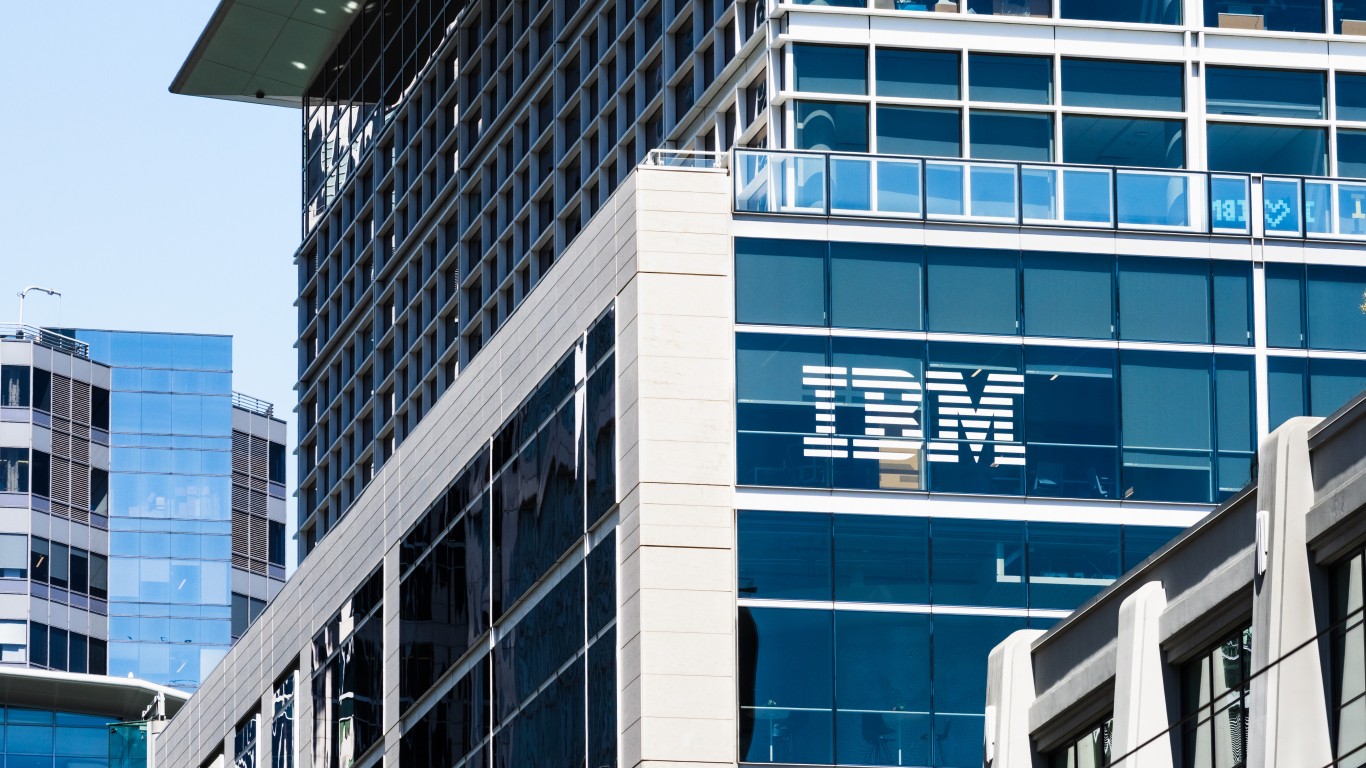
IBM (NYSE: IBM | IBM Price Prediction), which has been poorly run for decades, is on the ropes. The company has had plenty of practice managing decline. When it warned about its earnings a week ago, the stock dropped over 20%. It is down 30% for the year, while the S&P is up 9%. The picture is even bleaker from another vantage point: in early June, the stock changed hands at $329, but it trades at very slightly better than $200 now.
Yesterday, IBM reported the full extent of its failure with weak Q2 results. First, IBM announced it would cut guidance, although the revision was minor. The staggering news, however, was that revenue from IBM’s Z mainframe dropped 42%. This, in turn, dragged down infrastructure revenue by 7% year-over-year to $3.8 billion. While IBM suggested that customers were not abandoning the mainframe platform entirely, the data shows they are certainly moving away from IBM’s offerings at an accelerating pace.
Revenue for the second quarter was $17.2 billion, which was up 1% year over year. Net income was down 1% to $2.2 billion. IBM’s future depends on the credibility of a comment by CEO Arvind Krishna: “We are confident in IBM’s strategy and portfolio, and in our ability to capture growth opportunities ahead. We fundamentally believe that we are in the early innings of a structural shift for business, and that our portfolio — across software, infrastructure, and consulting — is well-positioned to help our clients tap the value, and manage the challenges of an AI-driven future.” The market begs to differ. Investors are not confident.
IBM acts as if it were still an important pillar of America’s megatech industry, but it is not. By way of contrast, the much larger Microsoft (NASDAQ: MSFT) saw a 17% increase in its most recent quarter to $81.3 billion. The software giant’s EPS hit $5.18, compared to $3.24 in the year-ago period. Microsoft’s net income of $38.5 billion for the period is 2.3 times IBM’s total revenue for its most recent quarter.
Amazon (NASDAQ: AMZN), Apple (NASDAQ: AAPL), and Alphabet (NASDAQ: GOOG) all have higher revenue than Microsoft’s, and Nvidia’s (NASDAQ: NVDA) is almost as high as any of those. It is another sign of how small and inconsequential IBM’s revenue is compared to that of the larger tech companies
IBM is special, in a sense. The company lost whatever clout it had decades ago. In 1980, IBM ranked ninth on the Fortune 500, America’s largest companies based on revenue. Since then, it has missed the opportunity to lead in personal computers, PC operating systems, e-commerce, tech operating systems, search, and, more recently, AI. It is hard to find a tech company that lost that many chances to be a leader.
IBM’s market cap is just under $200 billion. Microsoft’s market cap is $2.9 trillion. Alphabet’s is $4.2 trillion. Privately held OpenAI is estimated at $900 billion.
IBM has lost ground for decades, and it can’t make any of that up.
Contact [email protected] for any questions or corrections.
Douglas A. McIntyre is the co-founder, chief executive officer and editor in chief of 24/7 Wall St. and 24/7 Tempo. He has held these jobs since 2006.
McIntyre has written thousands of articles for 24/7 Wall St. He is an expert on corporate finance, the automotive industry, media companies and international finance. He has edited articles on national demographics, sports, personal income and travel.
His work has been quoted or mentioned in The New York Times, The Wall Street Journal, Los Angeles Times, The Washington Post, NBC News, Time, The New Yorker, HuffPost USA Today, Business Insider, Yahoo, AOL, MarketWatch, The Atlantic, Bloomberg, New York Post, Chicago Tribune, Forbes, The Guardian and many other major publications. McIntyre has been a guest on CNBC, the BBC and television and radio stations across the country.
A magna cum laude graduate of Harvard College, McIntyre also was president of The Harvard Advocate. Founded in 1866, the Advocate is the oldest college publication in the United States.
TheStreet.com, Comps.com and Edgar Online are some of the public companies for which McIntyre served on the board of directors. He was a Vicinity Corporation board member when the company was sold to Microsoft in 2002. He served on the audit committees of some of these companies.
McIntyre has been the CEO of FutureSource, a provider of trading terminals and news to commodities and futures traders. He was president of Switchboard, the online phone directory company. He served as chairman and CEO of On2 Technologies, the video compression company that provided video compression software for Adobe’s Flash. Google bought On2 in 2009.