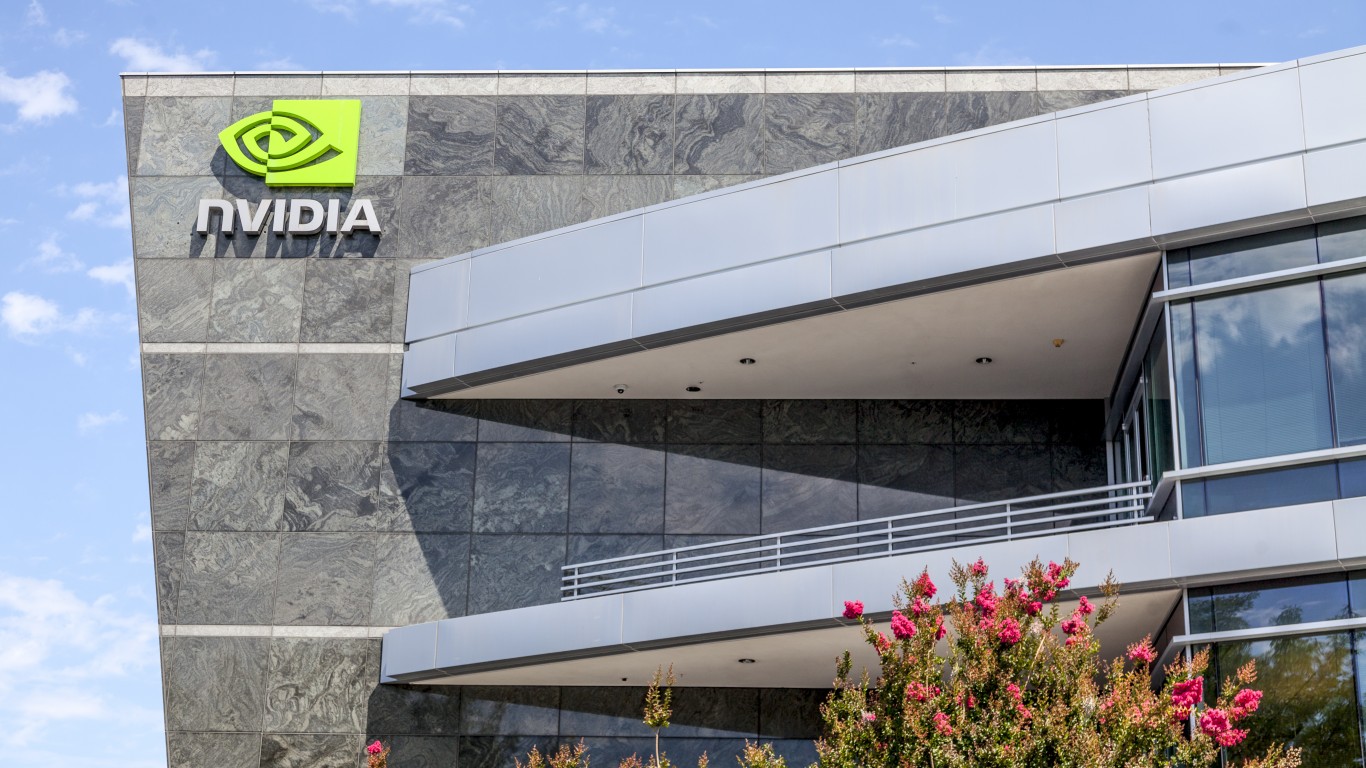
Nvidia’s Margins are Safe This Decade So I Keep Loading Up as Fear Resonates
Every DeepSeek headline and server delay rumor triggers a fresh wave of fear around Nvidia, yet one stubborn number on the income statement keeps pulling a contrarian investor back to the buy button.


I keep buying NVIDIA (NASDAQ:NVDA | NVDA Price Prediction) because the loudest fears on my feed are about a demand cliff that the company’s own income statement refuses to confirm. Every dip fed by a DeepSeek headline or a delayed server rumor sends me back to the buy button, and after this last quarter I stopped apologizing for it.
The Thesis I Keep Coming Back To
My conviction rests on software gravity, not the next GPU cycle. Even if hyperscalers slow raw GPU procurement, the installed base of enterprise applications built on the NVIDIA runtime keeps generating high-margin utility billing, which is what allows a 74% to 75% gross margin profile to hold through the late 2020s and avoid the 20% to 30% margin collapses that usually gut chip valuations during capital digestion phases. That is the sentence I underline. Silicon revenue is cyclical. CUDA rent is not.
The Receipts
Start with margins, because that is the whole ballgame. Non-GAAP gross margin printed 75.0% in Q1 FY2027, and management guided 75.0% ± 50 bps for Q2 on $91.0 billion ± 2% of revenue. That is a chipmaker guiding software-company gross margins on a top line growing 85.23% year over year. Operating margin sits at 65.6% and return on equity at 114.3%. Numbers like that do not describe a commoditized business.
Then the cash. Free cash flow was $48.554 billion in the quarter and $96.575 billion for FY2026. The board added $80.0 billion to the buyback authorization in May and raised the quarterly dividend from $0.01 to $0.25. About $20.0 billion already came back to shareholders in a single quarter.
Finally, valuation. Forward P/E is 23x against a PEG of 0.559. For a business compounding data center revenue at 92% year over year, that is not a demanding number.
Why Not the Obvious Alternatives
Friends ask why I do not rotate into Advanced Micro Devices (NASDAQ:AMD) or Broadcom (NASDAQ:AVGO) for AI exposure. My answer is the margin bar. NVIDIA’s 75% non-GAAP gross margin and 65.6% operating margin are the profile the software-gravity thesis depends on. Until a rival ships a stack that customers rebuild their MLOps pipelines around, my capital compounds fastest at the runtime layer, and that runtime is CUDA. Jensen Huang put it plainly on the last call: “The AI race is not just about chips. It’s about which stack the world runs on.”
The Risk I Own
The real risk is a hyperscaler capex pause colliding with $119.0 billion in total supply-related commitments. If AI infrastructure spend digests for a few quarters, that commitment turns into inventory pain. I own that risk. What keeps me buying is that Microsoft processed over 100 trillion tokens in Q1, a fivefold increase year over year, and reasoning workloads consume hundreds to thousands more tokens per task than one-shot inference. Utilization of the installed base is climbing faster than fresh capex, which is exactly what the margin thesis needs.
Forward Conviction
Reddit sentiment during the last two weeks ran bearish on DeepSeek, server delays, and customer diversification fears, and shares are down 3.86% on the week. That is the setup I keep showing up for. The margins are guided flat at software levels, the cash is being handed back in $80 billion tranches, and the runtime the industry rents is still ours. As long as those three sentences stay true, my buy button stays warm.
Contact [email protected] for any questions or corrections.
Alex Sirois is a financial writer with experience spanning both retail and institutional investing. He has written for InvestorPlace and held roles at BNY Mellon and Bernstein, giving him a perspective that bridges Main Street portfolios and Wall Street analysis.
Alex holds an MBA from George Washington University and has built his career across multiple industries, including e-commerce, education, and translation — a breadth of experience that informs how he breaks down complex financial topics for everyday investors. His writing is conversational, actionable, and grounded in long-term, buy-and-hold investing principles.
At 247 Wall St., Alex focuses on delivering analysis that is both accessible and useful, with a clear emphasis on helping readers make more informed decisions with their money.