The Hyperscaler Guarantee Keeps Me Buying Nvidia Before Aug. 26 Earnings
Every quarter, Amazon, Microsoft, and Alphabet publicly announce they cannot buy fast enough from one company, and that paper trail shapes every investment decision I make heading into a critical August earnings date.

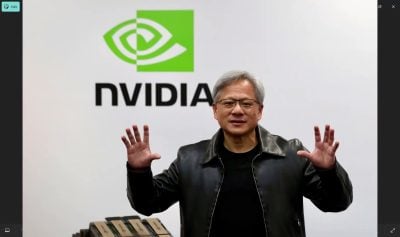
I keep buying NVIDIA (NASDAQ:NVDA | NVDA Price Prediction), and the reason is straightforward: every quarter, the companies that spend money on my behalf tell me they cannot get enough of what NVIDIA sells.
My latest add went in at $211.94, with the shares up 13.78% year to date and 930.5% over five years. My conviction lives in the next five, because the customer receipts for those years are already public.
The Hyperscaler Guarantee
Amazon (NASDAQ:AMZN) just guided to $220B in 2026 capex and said AWS is capacity-constrained through 2027. Microsoft (NASDAQ:MSFT) posted 43% Azure growth on a $678B backlog. Alphabet (NASDAQ:GOOGL) raised full-year capex guidance to $195 billion to $205 billion and reported a $514 billion cloud backlog. Alphabet’s CFO says Google is “still in a supply-constrained environment”. That is my thesis in one sentence.
The Numbers That Keep Me Coming Back
NVIDIA’s Q1 FY27 (reported May 20, 2026) put up $81.61 billion in revenue, up 85.23% year over year, with non-GAAP EPS of $1.87 topping consensus by 5.42%. Data Center revenue hit $75.25 billion, up 92%. Networking alone grew 199%, which tells me the moat now covers the interconnect fabric, not just the accelerator.
The margin picture closes the argument. Non-GAAP gross margin sits at 75.0%, operating margin at 60.4%, net margin at 55.6%, and ROE at 101.5%. Debt-to-equity is 0.073 with interest coverage of 503x. This company earns more than a dollar back on every dollar of equity while carrying almost no leverage.
Capital return matched the operating result. The board authorized $80.0 billion in fresh buybacks and raised the dividend from $0.01 to $0.25 per share. About $20.0 billion went back to shareholders in the quarter.
Why Not Just Buy the Customers?
I own some of them. I still keep coming back to NVIDIA because the arms dealer earns the better spread. NVIDIA’s 75% gross margin compares to Microsoft’s 67.9%, Alphabet’s 59.7%, and Amazon’s 50.3%. Alphabet trades at a P/E of 17, which looks cheap until you notice Q2 free cash flow at negative $5.86 billion after capex doubled year over year. Amazon’s trailing free cash flow flipped to negative $7.6 billion as AWS capex jumped to $54.21 billion in one quarter. Microsoft carries a P/E of 27 while writing $115.95 billion in FY26 capex checks, much of which lands on NVIDIA’s revenue line. I would rather own the invoice than the customer paying it.
The Real Risk
China. NVIDIA shipped zero H20 units to China in Q1 against $4.6 billion in the year-ago quarter, and Q2 guidance excludes China Data Center compute entirely. Supply commitments of $119.0 billion represent real forward inventory risk if demand ever softens. My thesis holds because management guided Q2 revenue to $91.0 billion anyway, with China stripped out.
Why I Keep Buying Into Aug. 26
On August 26, NVIDIA reports Q2 FY27. Sell-side analysts carry an average target of $302.83 with 58 Buys against 1 Sell. The single day matters less to me than the capex book behind it: the commitments from Amazon, Microsoft, and Alphabet are contractual, visible, and still expanding. Until the customers stop signing checks, I keep hitting buy.
Contact [email protected] for any questions or corrections.
Alex Sirois is a financial writer with experience spanning both retail and institutional investing. He has written for InvestorPlace and held roles at BNY Mellon and Bernstein, giving him a perspective that bridges Main Street portfolios and Wall Street analysis.
Alex holds an MBA from George Washington University and has built his career across multiple industries, including e-commerce, education, and translation — a breadth of experience that informs how he breaks down complex financial topics for everyday investors. His writing is conversational, actionable, and grounded in long-term, buy-and-hold investing principles.
At 247 Wall St., Alex focuses on delivering analysis that is both accessible and useful, with a clear emphasis on helping readers make more informed decisions with their money.