Microsoft vs Palantir: Which AI Stock Has More Upside in 2026?
Azure is printing billions at scale while a much smaller rival claims it shattered every profitability benchmark that matters. One of these AI stocks is quietly set up for the bigger surprise, and the answer is not obvious.


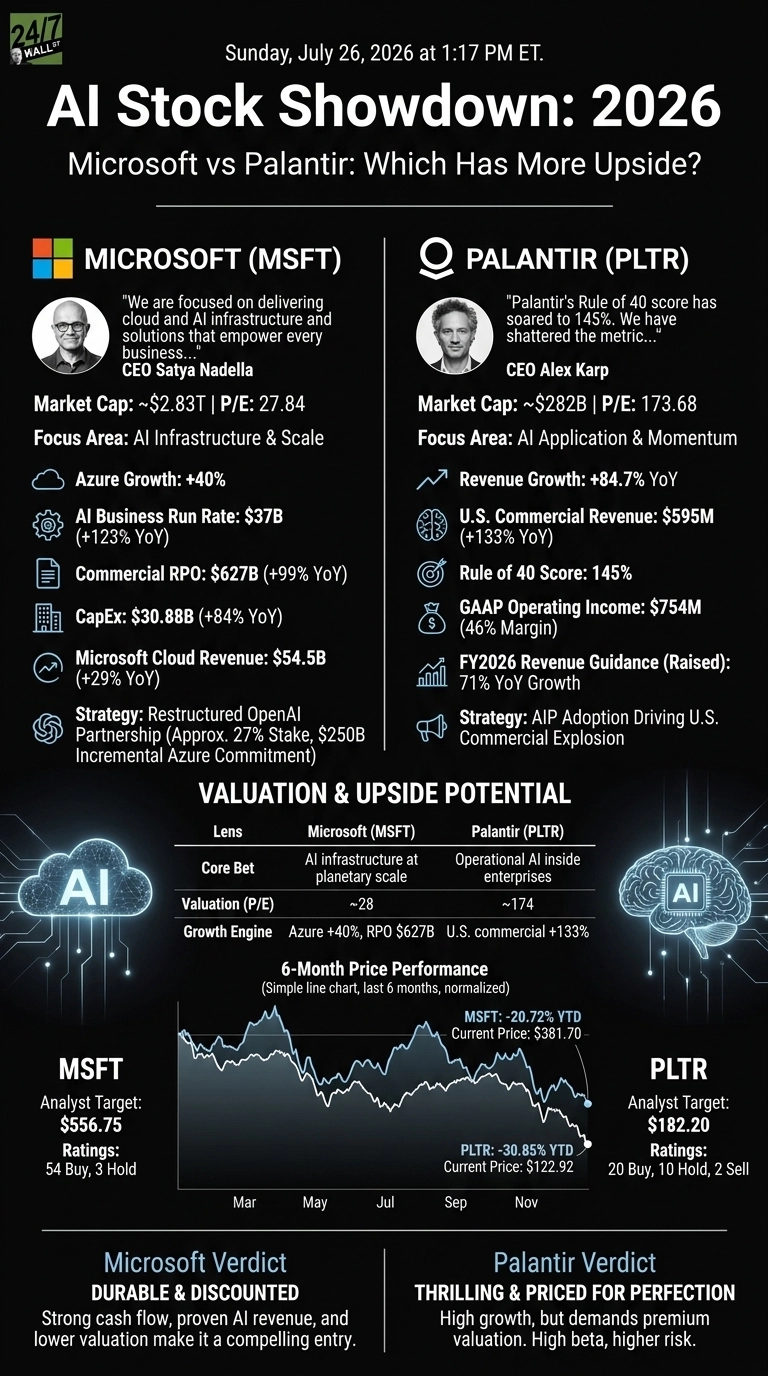
Microsoft (NASDAQ: MSFT | MSFT Price Prediction) and Palantir (NASDAQ: PLTR) both just delivered earnings that put the AI trade on trial. Microsoft posted $82.89 billion in Q3 FY2026 revenue with an AI run rate of $37 billion. Palantir grew 84.7% to $1.63 billion. Both are AI-native, yet they sit on opposite ends of scale, valuation, and business model.
Azure Powers One Giant. AIP Ignites the Other.
Microsoft’s quarter was a story about the plumbing of AI. Intelligent Cloud landed at $34.68 billion, up 30%, with Azure growing 40%. Commercial remaining performance obligations nearly doubled to $627 billion, which is a stunning book of contracted future work.
Capex hit $30.88 billion, up 84%, and that number is starting to make investors uncomfortable. CEO Satya Nadella framed it plainly: “Our AI business surpassed an annual revenue run rate of $37 billion, up 123% year-over-year.”
Palantir’s story is about the application layer sitting on top. U.S. commercial revenue exploded 133% to $595 million, driven by AIP adoption inside Fortune 500 operations. GAAP operating income reached $754 million at a 46% margin. Alex Karp did not hold back: “Palantir’s Rule of 40 score has soared to 145%. We have shattered the metric.”
Platform Owner vs. Decision Layer
| Lens | Microsoft | Palantir |
| Core Bet | AI infrastructure at planetary scale | Operational AI inside enterprises |
| Valuation | P/E ~28 | P/E ~174 |
| Growth Engine | Azure +40%, RPO $627B | U.S. commercial +133% |
| Key Vulnerability | Capex payoff timing | Multiple compression |
Microsoft is playing the long, capital-heavy game. Nadella wants the tollbooth on agentic computing, and the restructured OpenAI partnership (roughly 27% stake, IP rights through 2032, an incremental $250 billion Azure commitment) locks that thesis in.

Palantir is doing the opposite. Capex was a mere $7.4 million in the quarter. It sells outcomes rather than GPUs, and management raised FY26 guidance to 71% revenue growth, ten points above the prior forecast.

The Next Test Is Whether AI Spend Actually Compounds
For Microsoft, I am watching two lines: Azure’s constant-currency growth and how quickly that $627B backlog converts into billed revenue. Prediction markets currently give a 90.5% probability of another earnings beat, and Azure growth is expected in the 40% to 42% range.
For Palantir, you should keep an eye on U.S. commercial deal count. Remaining deal value hit $4.92 billion, up 112%. Any deceleration and the multiple unwinds fast.
Why Microsoft Looks Compelling While Palantir Still Has a Case
If I had to pick one today, I lean Microsoft. Shares are down 20.72% YTD to $381.70, and analysts still carry a $556.75 target. That mix of durable cash flow, a real AI revenue line, and a beaten-down entry point fits how I invest.
Palantir is the more thrilling story. Growth is scarce, and Karp is delivering. But at 173x earnings, one soft quarter would sting. If you like turnaround-style upside variance and can stomach beta of 1.56, Palantir still merits attention. If input costs and capex scrutiny worsen, I would prioritize the balance sheet over the multiple.
Contact [email protected] for any questions or corrections.
Vandita Jadeja is a financial publisher with over a decade of experience writing about financial topics, including investment, savings, retirement, insurance and banking. Vandita is a Chartered Accountant who loves to debunk financial concepts for readers.
Her work has appeared on sites that include The Motley Fool, InvestorPlace, and Benzinga. She covers investing and focuses on stock picks and price prediction for 24/7 Wall St.
When not looking for the next stock investment opportunity, she can be found traveling, reading, chasing sunsets and enjoying her iced latte.