Qualcomm Lost a Third of Its Value in 3 Months. One Wall Street Pro Sees 140% Upside From Here
Qualcomm has lost nearly a third of its value while its semiconductor peers surged, leaving one Wall Street analyst staking a reputation on a price target that towers over every other major forecast in the group.

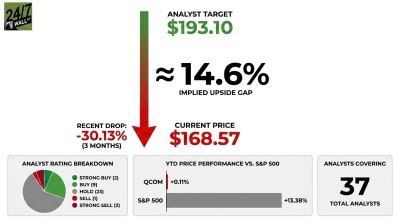
Qualcomm (NASDAQ:QCOM | QCOM Price Prediction) currently trades at $168.57 against an average Wall Street price target of $193.10, an implied gap of roughly 14.6%. That consensus figure hides an outlier bull call from Baird analyst Tristan Gerra, whose $400 price target sits roughly 137% above the current quote.
Qualcomm is the world’s dominant smartphone modem and SoC designer, but Wall Street’s real focus now is the company’s push into automotive silicon and AI data-center compute. The dislocation matters because QCOM has been one of the ugliest large-cap semiconductor charts of the summer, even as most peers ride the AI infrastructure wave.
A 30% Drawdown While Chip Land Kept Ripping
QCOM has shed 30.13% over the past three months, falling from $241.25 to $168.57. The trigger was July’s fiscal Q3 earnings report. Revenue of $9.95 billion beat, but non-GAAP EPS of $2.21 missed the $2.22 estimate and snapped a six-quarter beat streak. Handset revenue fell 20% year over year, operating income dropped 41.1%, and management flagged unprecedented memory and wafer costs squeezing margins.
The overhang worsened when Qualcomm signaled Apple product revenue would fall roughly 50% sequentially into the December quarter, with fiscal 2027 Apple revenue landing below the prior “little over $2 billion” guide. Estimate revisions turned brutal: 26 downward EPS revisions in the trailing 30 days for fiscal 2026 versus one upward.
The move was company-specific. While QCOM cratered, Micron (NASDAQ:MU) has run 235.71% year to date. This was a QCOM-specific move.
Baird’s $400 Bull Case Bets on a Business-Model Re-Rate
Baird’s Tristan Gerra treats the drawdown as a chance to buy Qualcomm’s diversification story on sale. The $400 Street-high target assumes Qualcomm’s custom Oryon-based server processors capture share in AI data-center CPUs. That thesis got real air cover on the last call: CEO Cristiano Amon disclosed two hyperscaler custom silicon engagements with wafer production underway and revenue starting in the December quarter.
The second leg is diversification away from Apple. Management now targets $40 billion in non-handset revenue by fiscal 2029, nearly double the November 2024 goal, with non-handset growth accelerating from 24% in fiscal 2026 to greater than 60% in fiscal 2027. Automotive already grew 61% year over year on a new multi-generation BMW ADAS win. The third pillar is on-device AI monetization across Snapdragon X Elite Copilot+ PCs and premium smartphones, which Baird believes lifts blended ASPs as double-digit pricing actions phase in.
Consensus is nowhere near Baird. Of the 37 analysts covering QCOM, 2 rate it Strong Buy, 9 Buy, 23 Hold, 1 Sell, and 2 Strong Sell. Recent revisions skew negative. Baird is the outlier, and the $400 target implies a roughly 137% return that no other major shop underwrites.
Peers Ripped Higher While QCOM Sat Out
Broadcom (NASDAQ:AVGO) trades at $357.16 against a $525.97 average target, roughly 47% upside. It slipped 14.59% over the past month on AI-spend jitters, but 44 of 48 analysts rate it Buy or Strong Buy.
Marvell Technology (NASDAQ:MRVL) trades at $208.83 against a $284.80 target for roughly 36% upside; the stock is up 145.74% YTD on custom-silicon momentum, with 39 of 44 analysts at Buy or Strong Buy.
Micron sits at $958.16 versus a $1,513.11 target, roughly 58% implied upside, with 44 of 48 ratings at Buy or Strong Buy after fiscal Q3 revenue rose 345.7%. Baird’s $400 QCOM call is the highest single-analyst upside in the group. On consensus, Micron carries the largest implied return, followed by AVGO, then MRVL. QCOM’s 14.6% consensus upside is the smallest, meaning the crowd is treating this dislocation with real skepticism.
Numbers Behind the QCOM Dislocation
Currently, QCOM trades at $168.57 with an average target of $193.10 across 37 covering analysts, implying roughly 14.6% upside. The stock is essentially flat YTD at +0.11% versus the S&P 500’s +13.38%, and the three-month drawdown of 30.13% stands against a 52-week range of $120.88 to $257.56.
Analyst posture skews cautious: 2 Strong Buy, 9 Buy, 23 Hold, 1 Sell, 2 Strong Sell. Forward EPS estimates tell the same story. Fiscal 2026 consensus has been trimmed to $10.52 from $10.81 a month ago. QCOM trades at roughly 16x forward earnings, well below the diversified-semi peer group. Analyst targets are one data point among many, and this group’s targets have been late to move in both directions this cycle.
My Real Take on QCOM at $168
Qualcomm looks compelling here if you believe the two hyperscaler custom silicon engagements ramp on schedule and data center scales toward management’s $15 billion fiscal 2029 target. In that world, the Apple headwind gets absorbed, non-handset growth compounds above 60%, pricing actions restore 48% to 50% gross margins, and the multiple re-rates. That path narrows the gap to Baird’s $400 meaningfully, even if it does not close it.
The bear case holds if handset revenue keeps bleeding, Apple accelerates its modem transition, memory costs stay elevated, and the hyperscaler engagements slip. In that scenario, QCOM is a value trap with a decent 7.12% FCF yield but no re-rating catalyst.
I lean cautiously long. The consensus $193 target is achievable without hero assumptions, and a mid-teens forward multiple for a business with $40 billion of non-handset revenue in the pipeline offers real optionality on Baird’s upside case.
Contact [email protected] for any questions or corrections.
Alex Sirois is a financial writer with experience spanning both retail and institutional investing. He has written for InvestorPlace and held roles at BNY Mellon and Bernstein, giving him a perspective that bridges Main Street portfolios and Wall Street analysis.
Alex holds an MBA from George Washington University and has built his career across multiple industries, including e-commerce, education, and translation — a breadth of experience that informs how he breaks down complex financial topics for everyday investors. His writing is conversational, actionable, and grounded in long-term, buy-and-hold investing principles.
At 247 Wall St., Alex focuses on delivering analysis that is both accessible and useful, with a clear emphasis on helping readers make more informed decisions with their money.