Prediction: This Will be META’s Price in 2027 And Over 50 Analysts Agree
Meta just dropped 18% while spending at a scale that dwarfs most industries, and over 50 analysts think that gap between price and potential closes by 2027. The question is whether three very specific things break right in time.

This post may contain links from our sponsors and affiliates, and Flywheel Publishing may receive compensation for actions taken through them.

Meta Platforms (NASDAQ:META | META Price Prediction) built the most profitable ad engine on the internet and now spends like a utility company laying grid for the AI era.
Q2 revenue hit $60.801 billion, up 27.96% YoY. EPS came in at $6.18 versus $7.2173 estimated. Shares are down 18.2% YTD to $532.52. Can this stock reach $900 by 2027?

The Real Reason Meta Is Down 18% This Year
The Q2 miss cracked the AI narrative. Operating margin compressed to 31% from 43% YoY. Free cash flow collapsed to $784 million from $8.55 billion. Capex jumped 82.1% to $30.116 billion, with full-year guidance narrowed to $130 billion to $145 billion. That is enormous spending for a payoff investors cannot yet see.
JPMorgan cut its target to $640 from $725 and kept a Neutral rating, noting Meta’s visibility into monetizing AI spend beyond advertising remains limited.
Add $2.40 billion in legal charges and $1.18 billion in severance from 8,000 layoffs. Shares fell 11.07% in a week and 4.31% in a month. With a beta of 1.246, Meta swings harder than the market.
Wall Street Sees 55% Upside. Our Model Says 54%
The average analyst target sits at $824.68, roughly 54.9% above today’s quote. Of the analyst pool, 8 rate META Strong Buy, 49 Buy, 6 Hold, and 0 Sell. Our base case lands at $817.47, or 53.51% upside with 90% confidence. Bull case is $867.73, bear case $712.57.
JPMorgan’s $640 reflects concerns about developer APIs and compute monetization. But 90% bullish consensus paired with 62.4% YoY earnings growth suggests analysts closer to the ad engine see something JPMorgan is discounting.

The Path to $900 Per Share
Reaching $900 from today’s price of $532.52 would require a gain of 69%. With forward EPS of $39.95, a price of $900 implies a forward P/E of 23x. Our base case of $817.47 already implies 16x, meaning the bold target requires 6x of additional multiple expansion.
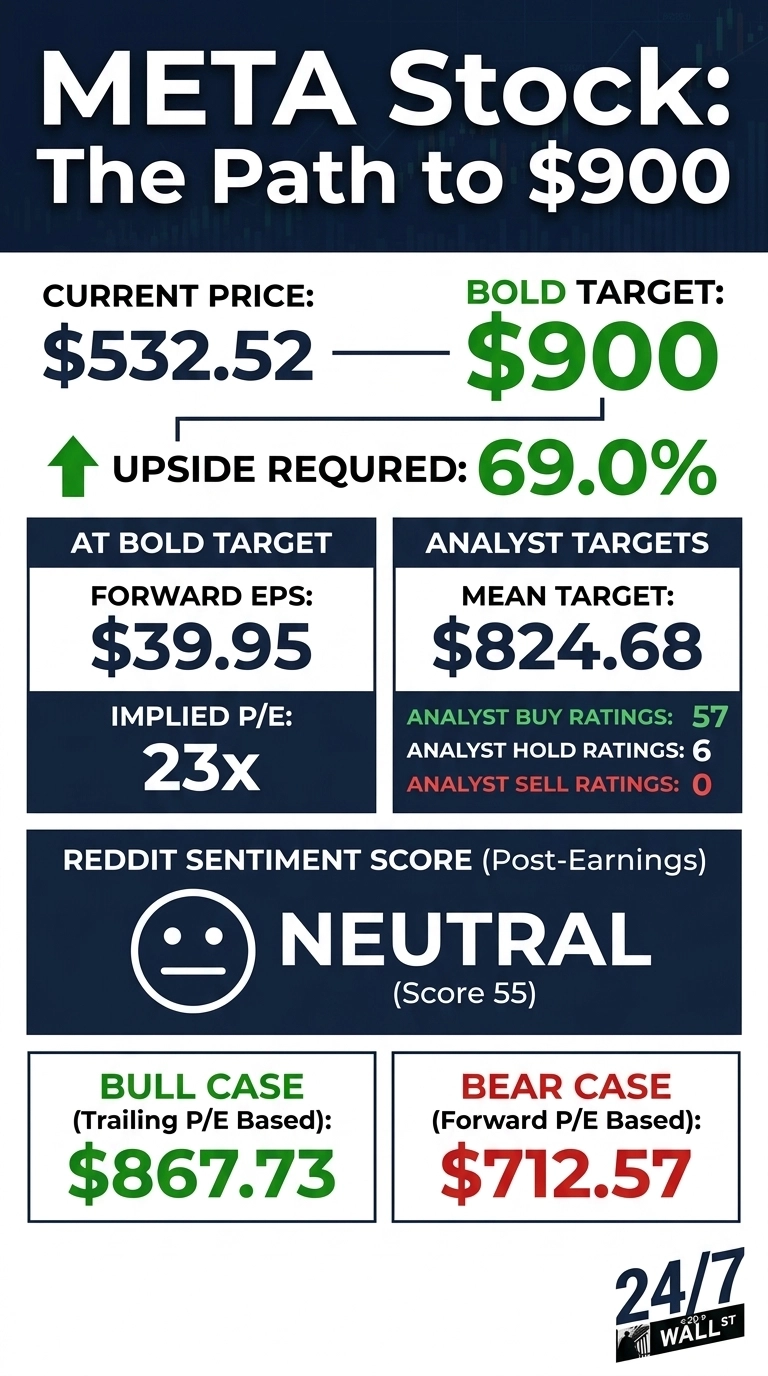
The 247Factor of 1.113 is driven by 90% bullish analyst consensus and 62.4% earnings growth. The multiple expansion story only works if AI capex starts delivering visible revenue. Corning’s up to $6 billion multi-year optical fiber deal signals hyperscaler-scale buildout.
Morningstar called AI infrastructure a “dual asset, driving internal ad engine improvements and potentially opening new revenue streams by selling surplus compute capacity to other AI labs”.
Cathie Wood’s Ark bought $14.3M of META post-selloff. Zuckerberg told investors on the Q2 call, “AI is accelerating our core business today, powering our next generation of products, and opening the door to entirely new enterprise opportunities.”
The risk: if compute monetization stays theoretical through 2027, the multiple stays compressed and $900 does not happen.

Where Meta Trades vs Its Earnings Power
At $532.52, Meta trades at roughly 13x forward earnings against 62.4% YoY earnings growth. Shares sit 4% below the 52-week high of $793.65 and just above the low of $519.78. Over 10 years, META has returned 337.37%.
The current multiple prices permanent capex drag onto a franchise that just grew revenue 28%.
Is $900 Realistic?
The $900 target by 2027 requires a 69% gain from here.
Three things need to break right: AI capex must show measurable ad-revenue lift by early 2027, at least one enterprise compute revenue line must move from theory to disclosure, and operating margin must stabilize above 35%. Another quarter of capex acceleration without revenue attribution would derail it. We’ve outlined the blueprint for how Meta Platforms could reach $900 in 2027.
Contact [email protected] for any questions or corrections.
Vandita Jadeja is a financial publisher with over a decade of experience writing about financial topics, including investment, savings, retirement, insurance and banking. Vandita is a Chartered Accountant who loves to debunk financial concepts for readers.
Her work has appeared on sites that include The Motley Fool, InvestorPlace, and Benzinga. She covers investing and focuses on stock picks and price prediction for 24/7 Wall St.
When not looking for the next stock investment opportunity, she can be found traveling, reading, chasing sunsets and enjoying her iced latte.