What a $101.5 Billion Trade Deficit Really Means for Americans in 2026
America's shrinking trade deficit looks like good news until you trace who is actually winning and who is quietly absorbing the cost, and the answer shows up in steel mill records, empty freight trailers, and a consumer sentiment index near…

The U.S. goods trade deficit narrowed to $101.5 billion in June 2026, down from May’s $105.9 billion. A $4.4 billion improvement sounds like a rounding error in a $30 trillion economy. The pullback follows May’s 28.8% spike and lands inside an earnings cycle that spelled out, company by company, who is paying for the tariff regime and who is cashing the check. American steel mills are winning, American railroads are running the goods that still get through, and American consumers are footing the bill at the register.
The Factory: Nucor Is the Poster Child
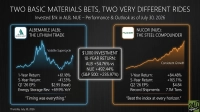
Nucor (NYSE:NUE | NUE Price Prediction) reported Q2 2026 adjusted EPS of $4.84 on revenue of $10.4 billion, up 22.95% year over year, with net income surging 91.71%. The key number is buried in segment data: finished carbon and alloy steel import market share has fallen from 23% in 2024 to roughly 16% in 2026 under Section 232 enforcement. Nucor shipped 7.1 million tons at 91% utilization, a second straight quarterly record.
CEO Leon Topalian credited “supportive federal trade policies” directly. Shares are up nearly 52% year to date and nearly 80% over one year.
The Rails: Imports Are Down, but Boxes Still Move
If tariffs were choking cross-border goods, Union Pacific (NYSE:UNP) would show it first. Instead, intermodal revenue jumped 26% to $1.386 billion in Q2 2026, powering an 11.54% top-line gain to $6.864 billion. Imports have shifted, not stopped. Union Pacific flagged tariff and trade policy uncertainty as a live risk, even as CEO Jim Vena pushed the pending Norfolk Southern merger toward regulators.
The Trucks: The Missing Domestic Boom
If tariffs were rerouting demand to American factories, the last-mile freight bellwether should be busy. It is not. Old Dominion Freight Line (NASDAQ:ODFL) posted a 33.26% year to date stock gain on hope, not haul: Q1 2026 LTL tons per day fell 7.7% and revenue slid 5.2% year over year. Lower imports have not yet translated into more American-made pallets on domestic trailers.
The Register: Walmart and Lowe’s Absorb the Cost
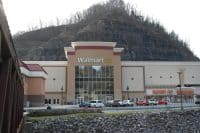
Walmart (NYSE:WMT) spelled out the risk explicitly. Its FY27 guidance “does not assume any impact from IEEPA tariff refunds,” a reference to the International Emergency Economic Powers Act challenge working through the courts. Global inventory sat 8.9% higher, a front-loading tell. The stock is roughly flat on the year, down just 1.66% YTD.
Lowe’s (NYSE:LOW) is the clearer loser. Q1 FY27 gross margin compressed 70 basis points, comparable sales crawled at 0.6%, and CEO Marvin Ellison pointed to a “challenging housing macro.” Shares are down nearly 16% year to date. Trade policy sits atop the company’s risk factors.
What Americans Should Watch Next
The through-line for a household: the deficit is narrowing because imports are falling faster than exports, not because American factories have taken up the slack. Steelmakers benefit. Retailers eat the margin. Consumers are already flinching. The University of Michigan Consumer Sentiment Index sat at 44.8 in May 2026, down from 61.7 a year earlier, well inside pessimistic territory.
The signals that matter over the next two quarters: whether Nucor holds 91% mill utilization in Q3, whether Old Dominion’s tons per day inflect back to positive, whether Walmart’s guidance builds in an IEEPA refund, and whether the Surface Transportation Board green-lights Union Pacific’s Norfolk Southern deal. That is where a $101.5 billion abstraction becomes a paycheck, a receipt, and a job.
Contact [email protected] for any questions or corrections.
Joel South covers large-cap stocks, dividend investing, and major market trends, with a focus on earnings analysis, valuation, and turning complex data into actionable insights for investors.
He brings more than 15 years of experience as an investor and financial journalist, including 12 years at The Motley Fool, where he served as an investment analyst, Bureau Chief, and later led the Fool.com investing news desk. He has also co-hosted an investing podcast and appeared across TV and radio discussing market trends.