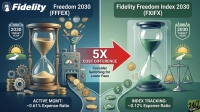
Your Target-Date Fund Charges 6x More Than the Two-ETF Version of Itself
Most investors assume their target-date fund is the simple, low-cost option, but a two-ETF combination quietly does the same job at a fraction of the price, and the gap compounds into real money over a career.


Target-date funds are the reason most 401(k) balances even have a coherent asset allocation. 96% of Vanguard plans offered them at year-end 2024, and 64% of plan contribution dollars went into them. Among Gen Z workers on Fidelity’s platform, 81.0% hold all their 401(k) savings in a single target-date fund.
If you own one, you own it for a good reason: one ticker gives you a diversified glidepath that automatically de-risks as you approach retirement. The alternative worth studying is a two-fund pair, Vanguard Total World Stock ETF (NYSEARCA:VT) alongside Vanguard Total Bond Market ETF (NASDAQ:BND), which replicates most of what an off-the-shelf target-date fund does for a fraction of the fee.
Why the Fee Gap Matters More Than It Looks
The industry-average target-date fund still charges around 0.36% or more, and plenty of non-Vanguard series sit meaningfully above that once you get into American Funds, John Hancock, or Principal share classes offered inside smaller 401(k) plans. The DIY substitute is dramatically cheaper. BND’s fact sheet lists a net expense ratio of 0.03%, and VT runs around 0.06%. Blended in a 90/10 or 80/20 mix, you land near 0.06%, roughly a sixth of what the average target-date fund extracts.
That gap compounds meaningfully. On a $100,000 balance, the difference between paying 0.06% and 0.36% is $300 per year at the start, and because the drag compounds against a growing balance over a 30-year career, the lifetime cost difference reaches five figures before you retire. That is money leaving your account whether the market is up or down.
How VT Plus BND Actually Mirrors a Target-Date Glidepath
A 2055 target-date fund is essentially a global equity sleeve with a small bond allocation that grows over time. VT holds thousands of U.S. and international stocks in one wrapper, and BND holds the U.S. investment-grade bond market. Pair them 90/10, and you have a close approximation of a 2055 fund’s current mix; shift to 80/20 to mimic a 2045 fund; drift toward 60/40 as retirement gets closer.
The historical returns tell the story. VT is up 19.13% over the past year, 63.05% over five years, and 217.13% over the past decade. BND, doing its job as ballast rather than a growth engine, is up 3.11% over the last year and 14.76% over ten years. Those numbers are what a low-cost global glidepath is supposed to produce: equities carry the return, bonds cushion drawdowns.
The One Real Trade-Off
Target-date funds do something the two-fund combo will not: they auto-rebalance and gradually de-risk without you touching anything. If you are the kind of investor who will forget to shift your equity/bond mix as you age, or who will panic and sell bonds during a rally, the target-date fund’s automation is worth the extra basis points. That is the tradeoff, and it is a real one. Vanguard’s own target-date series charges roughly 0.08%, close enough to the DIY blend that the autopilot is essentially free. If your plan uses Vanguard TDFs, the swap is not worth the hassle.
Where the Swap Actually Works
Most 401(k) menus only offer the target-date share class their record-keeper negotiated, so the swap is rarely possible inside the plan itself. Where it is straightforward: rollover IRAs, Roth IRAs, and taxable brokerage accounts, where you control the ticker menu. In a taxable account, be careful selling an existing target-date fund position outright, because capital gains are triggered on the sale; the cleanest path is to redirect new contributions to VT and BND rather than liquidating what you already hold.
What This Means for Your Next Contribution
If you are in a high-fee non-Vanguard target-date fund inside an IRA you control, a VT and BND pair is the cheaper twin of what you already own, and the fee savings are large enough to matter over a career. If you are in a Vanguard target-date fund, or you value the auto-rebalancing enough to pay for it, staying put is a defensible choice. The decision hinges on which account holds the fund, what it actually charges, and whether you will actually rebalance yourself. Check the expense ratio on your current statement before you do anything else.
Contact [email protected] for any questions or corrections.
David Beren has been a Flywheel Publishing contributor since 2022. Writing for 24/7 Wall St. since 2023, David loves to write about topics of all shapes and sizes. As a technology expert, David focuses heavily on consumer electronics brands, automobiles, and general technology. He has previously written for LifeWire, formerly About.com. As a part-time freelance writer, David’s “day job” has been working on and leading social media for multiple Fortune 100 brands. David loves the flexibility of this field and its ability to reach customers exactly where they like to spend their time. Additionally, David previously published his own blog, TmoNews.com, which reached 3 million readers in its first year. In addition to freelance and social media work, David loves to spend time with his family and children and relive the glory days of video game consoles by playing any retro game console he can get his hands on.