Prediction: AbbVie Will End The Year at This Price
AbbVie's blockbuster drugs are surging while a major acquisition looms, but a trailing P/E of 71 and one model pricing the stock nearly $50 below current levels raises a real question about whether the rally has room left to run.

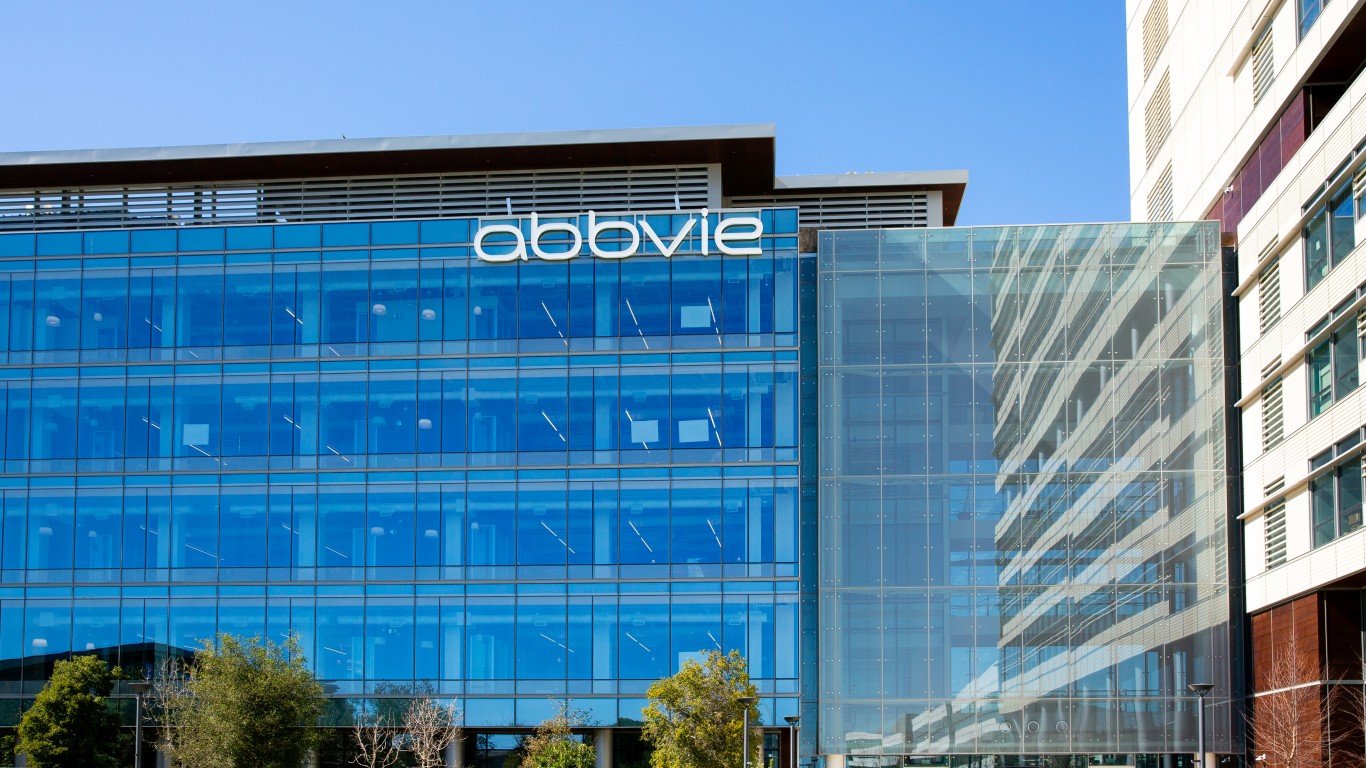
I’m going to put our year-end call on the table before anything else. Our AbbVie (NYSE:ABBV | ABBV Price Prediction) year-end verdict is a buy, and our proprietary model sees more room to run despite the stock already sitting near record highs.
The 24/7 Wall St. price target for AbbVie is $297.71, implying 20.92% upside from the current $246.20 level. We rate ABBV a buy with a 90% confidence level, our highest tier.
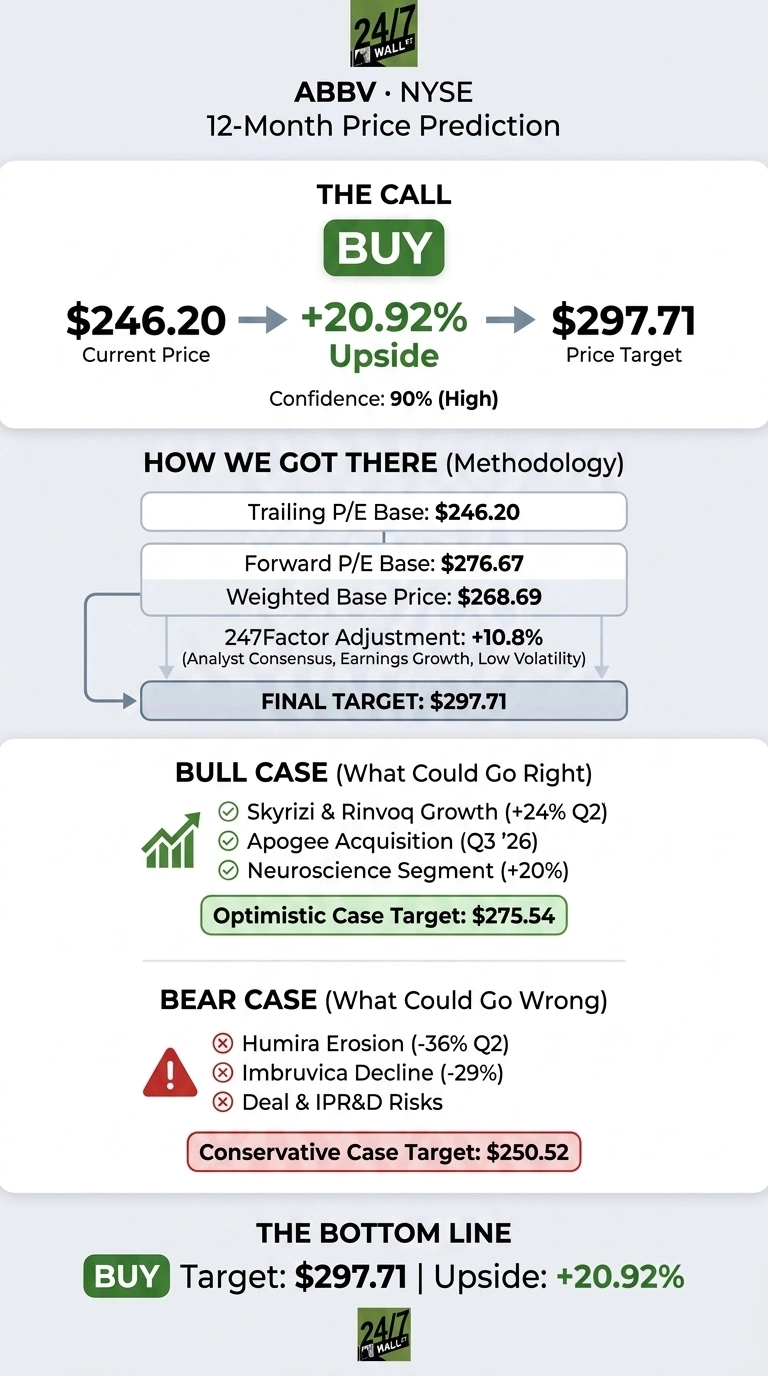
24/7 Wall St. Price Target Summary
| Metric | Value |
|---|---|
| Current Price | $246.20 |
| 24/7 Wall St. Price Target | $297.71 |
| Upside | 20.92% |
| Recommendation | BUY |
| Confidence Level | 90% |
Skyrizi and Rinvoq Are Doing the Heavy Lifting
AbbVie is up 12.42% year to date and 36.88% over the past year, and the July 31 close pushed shares within roughly 1% of the $267.47 52-week high.
Q2 2026 revenue landed at $16.99 billion, up 10.2%, with adjusted EPS of $3.65 beating the $3.08 consensus. Skyrizi generated $5.51 billion (+24.4%) and Rinvoq added $2.53 billion (+24.5%), more than offsetting the 35.9% Humira decline. The pending $10.9 billion Apogee Therapeutics acquisition is expected to close in Q3 2026.

The Case for $300+
Bulls have real fuel here. Immunology revenue grew 15.1% in Q2 while Neuroscience jumped 20.3%, and the Apogee deal adds zumilokibart (anti-IL-13 for atopic dermatitis) to a franchise that is already gaining share against Dupixent.
Wall Street’s consensus target sits at $270.39 with 24 Buy or Strong Buy ratings against just one Strong Sell. If Skyrizi and Rinvoq sustain 20%+ growth into 2027 and Vyalev (Parkinson’s) scales, our bull-case scenario points to a $438.43 five-year target.

What Could Go Wrong
The risks are visible. Humira revenue fell 35.9% and Imbruvica dropped 29.4%, and management trimmed FY26 EPS guidance to $13.87–$14.07 to absorb $0.14 of Apogee dilution. A trailing P/E of 71 looks stretched, and one independent AI model in our data pins fair value at $198.76.
Bears would note aesthetics is flat and shareholders’ equity is negative. In fairness, the elevated multiple reflects sizable IPR&D charges ($0.58 per share YTD) that mask real cash generation, and forward P/E of 18 tells a cleaner story. Our bear-case floor is $250.52.

How AbbVie Stacks Up Against Merck and Bristol Myers Squibb
Merck (NYSE:MRK) is the natural bull-case foil. Merck trades on a forward P/E of 48, more than double AbbVie’s 18, largely because KEYTRUDA’s patent cliff is closer than AbbVie’s next wave. Our target implies AbbVie can hold a premium multiple more comfortably than Merck.
Bristol Myers Squibb (NYSE:BMY) is the value counterpoint, changing hands at a forward P/E of just 10 with a 3.87% dividend yield. BMY’s Growth Portfolio grew 12% in Q1, but heavier generic erosion on Revlimid keeps its multiple compressed. Against that backdrop, AbbVie’s forward multiple looks reasonable by comparison.
| Company | Forward P/E | Analyst Target |
|---|---|---|
| AbbVie | 18 | $270.39 |
| Merck | 48 | $135.19 |
| Bristol Myers Squibb | 10 | $64.91 |
Bottom Line on Our ABBV Target
Our 24/7 Wall St. price target of $297.71 reflects a buy rating with 90% confidence, and the tipping factor is the combined trajectory of Skyrizi and Rinvoq, which continue to expand their combined revenue base.
The bullish scenario strengthens if the Apogee deal closes cleanly in Q3, while the setup weakens if Skyrizi or Rinvoq growth decelerates below 15% in Q3 2026. Our model favors entries on any pullback into the low $240s.
| Year | 24/7 Wall St. Price Target |
|---|---|
| 2026 | $297.71 |
| 2030 | $438.43 |
These projections assume AbbVie continues executing on Skyrizi, Rinvoq, and the Apogee integration. Significant downside would emerge from Skyrizi biosimilar pressure post-2029 or an Apogee pipeline setback.
Contact [email protected] for any questions or corrections.
Vandita Jadeja is a financial publisher with over a decade of experience writing about financial topics, including investment, savings, retirement, insurance and banking. Vandita is a Chartered Accountant who loves to debunk financial concepts for readers.
Her work has appeared on sites that include The Motley Fool, InvestorPlace, and Benzinga. She covers investing and focuses on stock picks and price prediction for 24/7 Wall St.
When not looking for the next stock investment opportunity, she can be found traveling, reading, chasing sunsets and enjoying her iced latte.