BofA Boosts AbbVie and J&J Price Targets on Growth and Pipeline Strength
Bank of America just raised price targets on two pharma giants facing patent cliffs, but its conviction level differs sharply between them, and the valuation gap may explain which one belongs in a long-term portfolio right now.


BofA raised its price target on AbbVie (NYSE:ABBV | ABBV Price Prediction) to $289 from $282 and kept its Buy rating. It also lifted its Johnson & Johnson (NYSE:JNJ) target to $278 from $263 and kept a Neutral rating.
Both targets went up, but the firm’s conviction clearly leans toward AbbVie stock. For dividend-focused investors, the moves point to growing confidence that big pharma can grow through its patent cliffs.
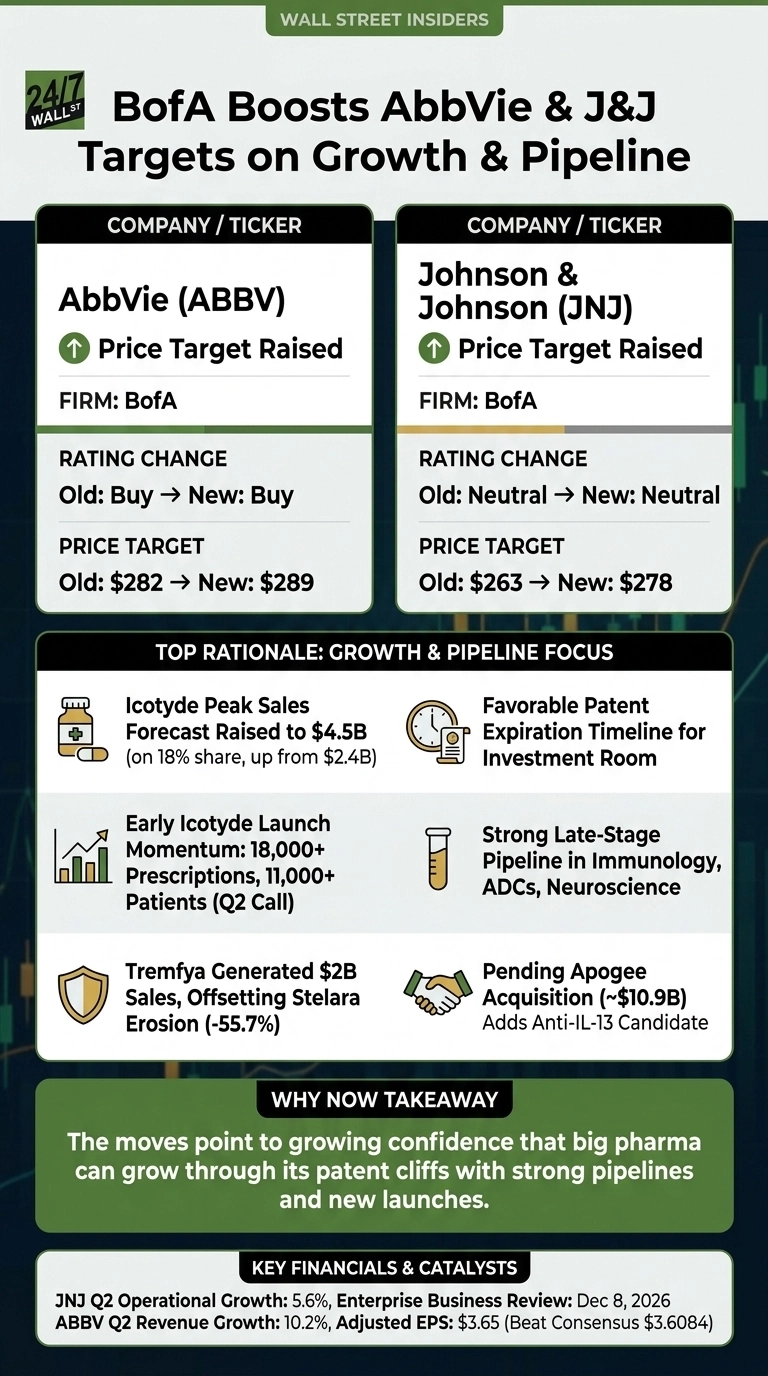
| Ticker | Company | Firm | Action | Old Rating | New Rating | Old Target | New Target |
|---|---|---|---|---|---|---|---|
| ABBV | AbbVie | BofA | Price Target Raised | Buy | Buy | $282 | $289 |
| JNJ | Johnson & Johnson | BofA | Price Target Raised | Neutral | Neutral | $263 | $278 |
BofA’s Case: Patent Flexibility and a Bigger Icotyde Forecast
Analyst Tim Anderson says AbbVie is well positioned for its next decade of growth. In his view, a “favorable” loss of exclusivity profile (the timeline on which patents expire) gives the company room to invest in potentially transformative programs in immunology, antibody-drug conjugates (ADCs) and neuroscience.
He adds that recent M&A has strengthened the late-stage pipeline. The pending Apogee acquisition, valued at about $10.9B, brings in an anti-IL-13 candidate for atopic dermatitis.
The J&J revision came after a physician dermatology survey. BofA raised its peak psoriasis sales forecast for Icotyde to $4.5B on 18% share, up from $2.4B on 10% share. Early demand supports that view. On the second-quarter call, management reported “over 18,000 prescriptions have been written for a total of now 11,000 patients”.
Company Snapshot: Two Pharma Giants Growing Through Patent Losses
J&J’s second-quarter worldwide sales reached $25.3 billion, with operational growth of 5.6%. Tremfya generated $2 billion in sales, helping offset a 55.7% drop in Stelara. The company has raised its dividend for 64 consecutive years, putting it firmly in the rare club we ranked by valuation in a free Dividend Kings report.

AbbVie’s second-quarter revenue grew 10.2% to $16.99B. Adjusted EPS of $3.65 beat the $3.6084 consensus. Skyrizi rose 24.4% to $5.51B and Rinvoq climbed 24.5%, more than offsetting Humira’s slide to $756M.

Why the Move Matters Now for Pharma Investors
Valuations help explain why BofA rates the two stocks differently. AbbVie trades at 16 times forward earnings, compared with 21 times for J&J. J&J stock has also run harder this year, up 31.14% year to date to $267.10. AbbVie is up 18.1% to $263.61.


Several catalysts are coming up. J&J holds an Enterprise Business Review on Dec 8, 2026 while it works on separating its Orthopaedics business. AbbVie expects a U.S. decision this fall on subcutaneous Skyrizi induction dosing in Crohn’s disease.


What It Means for Your Retirement Portfolio
Both companies pay meaningful dividends. J&J pays $5.24 per share a year and AbbVie pays $6.83. Their revenue mixes keep moving away from older blockbusters. Still, biosimilar erosion continues, and AbbVie’s 2026 guidance of $13.87 to $14.07 includes $0.14 of dilution from the Apogee deal.
BofA’s revised outlook is worth a closer look for long-term investors. AbbVie gets the firm’s stronger endorsement. J&J’s Neutral rating suggests much of the Icotyde optimism may already be reflected in the stock.
Contact [email protected] for any questions or corrections.
Vandita Jadeja is a financial publisher with over a decade of experience writing about financial topics, including investment, savings, retirement, insurance and banking. Vandita is a Chartered Accountant who loves to debunk financial concepts for readers.
Her work has appeared on sites that include The Motley Fool, InvestorPlace, and Benzinga. She covers investing and focuses on stock picks and price prediction for 24/7 Wall St.
When not looking for the next stock investment opportunity, she can be found traveling, reading, chasing sunsets and enjoying her iced latte.