3 Major Reasons for Investors to Buy AbbVie Stock Before July 31st

This post may contain links from our sponsors and affiliates, and Flywheel Publishing may receive compensation for actions taken through them.
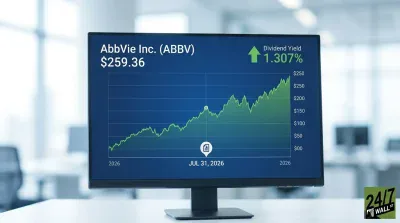
AbbVie (NYSE:ABBV | ABBV Price Prediction) enters its July 31 Q2 earnings report with a 2.62% dividend yield, raised earnings guidance, and two blockbuster drugs growing above 20%. Skyrizi and Rinvoq have already replaced Humira as the company’s growth engines, strengthening AbbVie’s case as a combination of income, growth, and relatively low volatility.
AbbVie Offers Growth at Just 18x Forward Earnings
ABBV changes hands at $265.52 with a forward P/E of 18x and a PEG of 0.43, with a beta of 0.28. Wall Street’s consensus target sits at $267.79 across 16 Buy and 8 Strong Buy ratings. AbbVie trades at a multiple below the S&P 500 average paired with growth prospects and roughly a quarter of the market’s volatility.

A 5.5% Dividend Increase Strengthens the Income Case
AbbVie’s annualized dividend of $6.74 per share means the stock offers a 2.62% yield. The most recent quarterly hike lifted the payout to $1.73 from $1.64, a 5.5% raise. Management raised full-year adjusted EPS guidance to $14.08 to $14.28 and pointed to Q2 EPS of $3.74 to $3.78 on roughly $16.7 billion in revenue.
Skyrizi and Rinvoq Have Become $32 Billion Growth Engines
Skyrizi hit $4.48 billion in Q1 2026 (up 30.9% YoY) and Rinvoq added $2.12 billion (up 23.3%). Management raised full-year Skyrizi guidance to $21.6 billion and Rinvoq to $10.2 billion. CEO Rob Michael said flatly, “We expect to exceed the peak consensus that’s in those models.”

AbbVie Has Already Crossed the Patent Cliff Facing Merck
Pfizer (NYSE:PFE) has returned -22.52% over five years and is up just 3.67% year-to-date, versus ABBV’s 163.87% five-year and 16.19% YTD return, with far weaker top-line momentum.
Merck (NYSE:MRK) has rallied hard (61.08% in one year), but it carries a Keytruda concentration problem and a 2028 patent cliff. ABBV has already crossed the biosimilar valley Merck is walking toward.
The Bottom Line: AbbVie Has Successfully Rebuilt Its Growth Engine
Humira revenue continues to decline as biosimilar competition intensifies, but that erosion no longer defines AbbVie’s overall trajectory. Skyrizi and Rinvoq generated a combined $6.60 billion last quarter, helping total immunology revenue grow 16.4%.
AbbVie now expects the two drugs to generate nearly $32 billion in annual sales, while its dividend continues to rise. The July 31 report will show whether those newer products can keep driving growth and support another increase to full-year guidance.
Contact [email protected] for any questions or corrections.
Thomas Richmond is a financial writer and content strategist with 5+ years of experience covering stocks and financial markets. He has published over 500 articles focused on individual stock analysis, helping investors better understand business fundamentals, stock valuations, and long-term opportunities.
Thomas previously served as a Content Lead at TIKR, a stock research platform, where he helped scale the company’s blog to hundreds of articles per month and contributed to a weekly newsletter reaching more than 100,000 investors.
Outside of work, Thomas enjoys weight lifting and soccer.