Trump Said He’d Rebuild America’s Factories. Construction Is Now Down 32% Since Biden Left Office.
Trump promised to bring factory construction roaring back, but the numbers heading into 2027 tell a story his campaign rallies never did, and current production data makes the picture even more complicated.


Donald Trump ran on rebuilding American factories. The building part is going the wrong way. Manufacturing construction spending in the United States is now down roughly 32% from its 2024 peak, reached in the final months of the Biden administration, according to a chart circulated this week by economist Joey Politano. The federal data behind it is stark: real dollars poured into new factory shells, chip fabs, and battery plants have slid from $211,142 million in August 2025 to $172,674 million in June 2026, a downward trajectory every month in between.
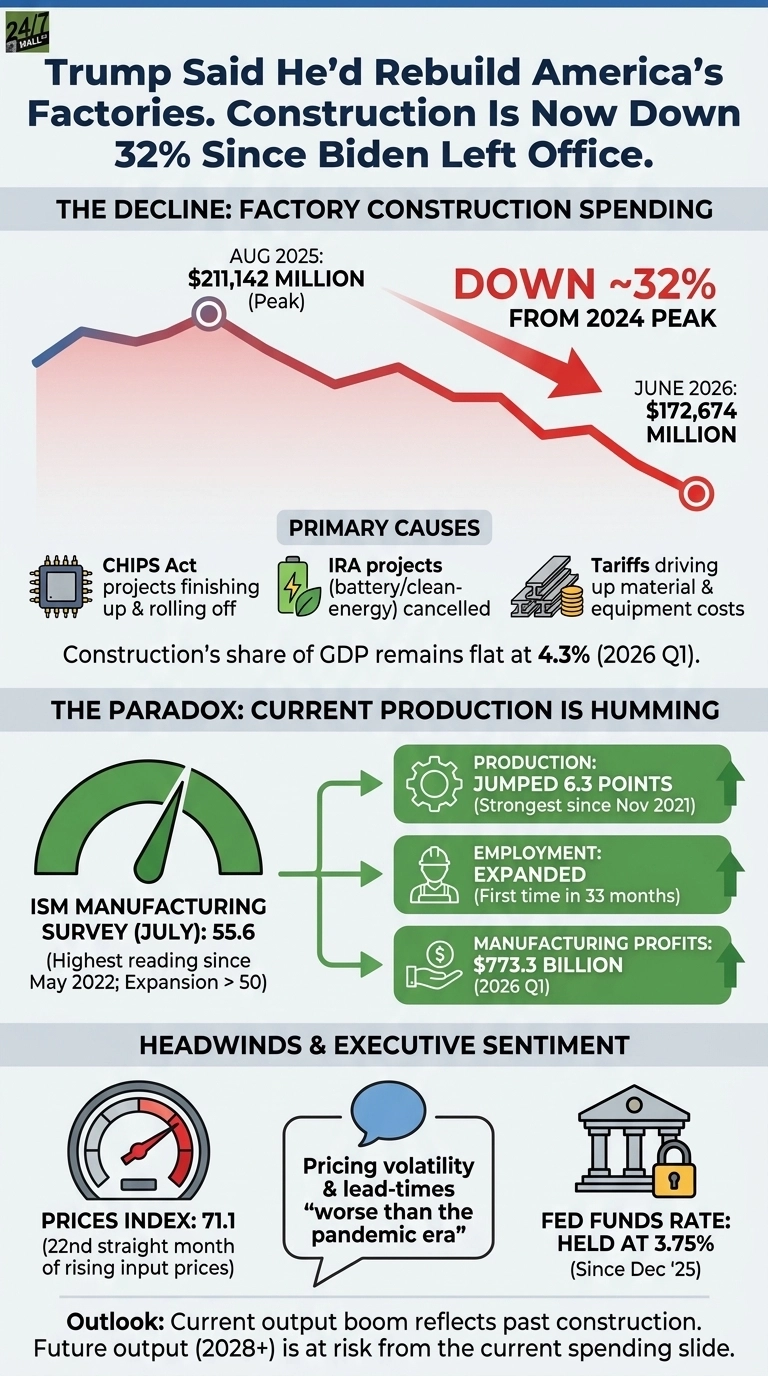
The causes are clear. CHIPS Act megaprojects are finishing up and rolling off, with no comparable wave of new mega-fabs breaking ground behind them. Inflation Reduction Act projects, particularly battery and clean-energy plants, have been cancelled as subsidies came under political attack. And tariffs continue to act as a headwind, driving up the cost of the steel, aluminum, and imported equipment needed to actually pour concrete and stand up a plant.
The Counter-Signal: Factories Already Built Are Humming
Even as the construction pipeline shrinks, the factories already running are having their best month in years. The Institute for Supply Management’s July manufacturing survey came in at 55.6, its highest reading since May 2022, and comfortably above the Wall Street consensus of 54.0. Anything above 50 signals expansion.
The internals were louder than the headline. Production jumped 6.3 points, the strongest reading since November 2021. New export orders and order backlogs firmed. Most striking, the employment gauge expanded for the first time in 33 months, its highest reading since August 2022. Corporate profits back that up: manufacturing profits reached $773.3 billion in the first quarter of 2026, up sharply from a year earlier.
Why Executives Say It Still Feels Terrible
Survey respondents voiced clear frustration. Several told ISM that pricing volatility and lead-time extensions are “worse than the pandemic era,” with one saying the environment made them “yearn for the coronavirus pandemic chaos, which was more manageable.” The prices index sat at 71.1, marking the 22nd straight month of rising input prices. That is now adding pressure on the Kevin Warsh-led Federal Reserve, which has held the funds rate at 3.75% since December, toward a possible September rate hike.
Can Manufacturing Bounce Back Under Trump?
The answer requires separating two things Americans tend to lump together: what gets built and what gets produced. Output is booming right now because the Biden-era construction boom already delivered its factories. The lag between breaking ground and shipping product is years. So a falling construction pipeline in 2026 can coexist with a red-hot production reading. It is the 2028 and 2029 output that should worry the White House.
For construction to reaccelerate, three things need to change: tariff and input-price volatility has to settle so builders can price a project, the IRA project cancellations need a replacement pipeline of new commitments, and geopolitical uncertainty (which respondents flagged as worse than Covid) has to ease. The signal to watch is next month’s manufacturing construction spending report from the Census Bureau. If the line keeps sliding while construction’s share of GDP stays flat at 4.3%, the “rebuild” promise is running on borrowed factories.
Contact [email protected] for any questions or corrections.
After two decades of patrolling the dark corners of suburbia as a police officer, Rich Duprey hung up his badge and gun to begin writing full time about stocks and investing. For the past 20 years, he’s been cruising the markets looking for companies to lock up as long-term holdings in a portfolio while writing extensively on the broad sectors of consumer goods, technology, and industrials. Because his experience isn’t from the typical financial analyst track, Rich is able to break down complex topics into understandable and useful action points for the average investor. His writings have appeared on The Motley Fool, InvestorPlace, Yahoo! Finance, Money Morning, and, of course, 24/7 Wall St. He has been featured in both U.S. and international publications, including MarketWatch, Financial Times, Forbes, Fast Company, and USA Today.