I’m Buying Nvidia Ahead of Aug. 26 Earnings Exactly For The Reason You Think
Every hyperscaler on the planet just committed to a spending spree that funnels through one chokepoint, and the Aug. 26 earnings report will either validate the conviction or expose the cracks in it.

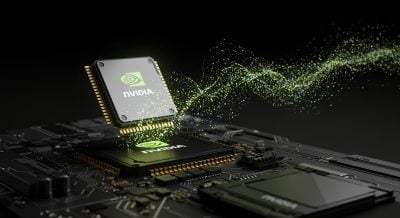
I keep buying NVIDIA (NASDAQ:NVDA | NVDA Price Prediction) shares, and the Aug. 26 earnings report is another reason to keep going.
Here is the plain version of what pulls me back to the buy button. Jensen Huang calls this “the largest infrastructure expansion in human history”, and every hyperscaler earnings report this cycle backed him up. Microsoft, Meta, Alphabet, and Amazon collectively guided to over $200 billion in AI infrastructure spend, and Nvidia commands over 80% market share in high-end AI accelerators. When the four biggest customers on the planet all commit to spending more, and one vendor sits in the middle of that check, I keep writing my own smaller checks into the same name.
The Numbers That Keep My Hand on the Buy Button
Start with the growth. Q1 FY27 revenue landed at $81.615 billion, up 85.23% year over year, beating estimates by 3.16%. Non-GAAP EPS came in at $1.87 versus a $1.7738 estimate, the fourth consecutive beat. Data Center revenue alone was $75.246 billion, up 92% YoY, with networking up 199%. Management guided Q2 FY27 to $91 billion, sequential acceleration on a base that already dwarfs the industry.
Then the moat. Nvidia carries $119.0 billion of supply commitments and $30.0 billion of multi-year cloud service commitments. That is visibility. OpenAI committed to 10 gigawatts of Nvidia systems, Meta signed a multigenerational deal across millions of Blackwell and Rubin GPUs, and CoreWeave is targeting 5+ gigawatts of AI factories by 2030.
Then the balance sheet. Return on equity sits at 101.5%, net margin at 55.60%, debt to equity at 0.073, and interest coverage at 503x. The board raised the dividend from $0.01 to $0.25 per share and authorized an additional $80.0 billion buyback. That is what management confidence looks like on paper.
Why Not the Obvious Alternatives
The two names I hear most from friends are AMD (NASDAQ:AMD) and Broadcom (NASDAQ:AVGO). AMD’s MI-series is a real product, and it competes without the CUDA software lock-in or NVLink networking that let Nvidia’s Data Center Compute grow 77% YoY. Broadcom’s custom silicon business is strong, and it is a components play into a few customers rather than a full-stack platform running a 71.07% gross margin. Amazon (NASDAQ:AMZN) has Trainium as a multibillion-dollar business now, and Nvidia’s Data Center Compute still grew 77% YoY right through it.
The Risk I Am Not Ignoring
China is the real one. Nvidia’s Q2 guide excludes any Data Center compute revenue from China, erasing what used to be roughly $4.6 billion per quarter in H20 sales. That is real lost revenue. The thesis holds because non-China demand is more than offsetting the shortfall, and management still guided $91 billion in the same breath.
Where My Conviction Goes From Here
Shares closed at $217.55, up 16.79% year to date, on a P/E of 44. For a business generating $48.554 billion of free cash flow in a single quarter, with a 75% gross margin and a product roadmap that already extends through Rubin, I will keep clicking buy into Aug. 26 and after it settles.
Contact [email protected] for any questions or corrections.
Alex Sirois is a financial writer with experience spanning both retail and institutional investing. He has written for InvestorPlace and held roles at BNY Mellon and Bernstein, giving him a perspective that bridges Main Street portfolios and Wall Street analysis.
Alex holds an MBA from George Washington University and has built his career across multiple industries, including e-commerce, education, and translation — a breadth of experience that informs how he breaks down complex financial topics for everyday investors. His writing is conversational, actionable, and grounded in long-term, buy-and-hold investing principles.
At 247 Wall St., Alex focuses on delivering analysis that is both accessible and useful, with a clear emphasis on helping readers make more informed decisions with their money.