Oklo vs AST SpaceMobile: Two Pre-Revenue Moonshots Powering the AI-and-Space Trade
Oklo just hit a nuclear milestone that took under a year to achieve, while AST SpaceMobile absorbed a nine-figure launch loss and kept building anyway. One bet runs on atoms, the other on orbits, and only one of them makes…


Oklo (NYSE: OKLO | OKLO Price Prediction) and AST SpaceMobile (NASDAQ: ASTS) just gave investors two very different views of what an early-stage AI infrastructure bet looks like.
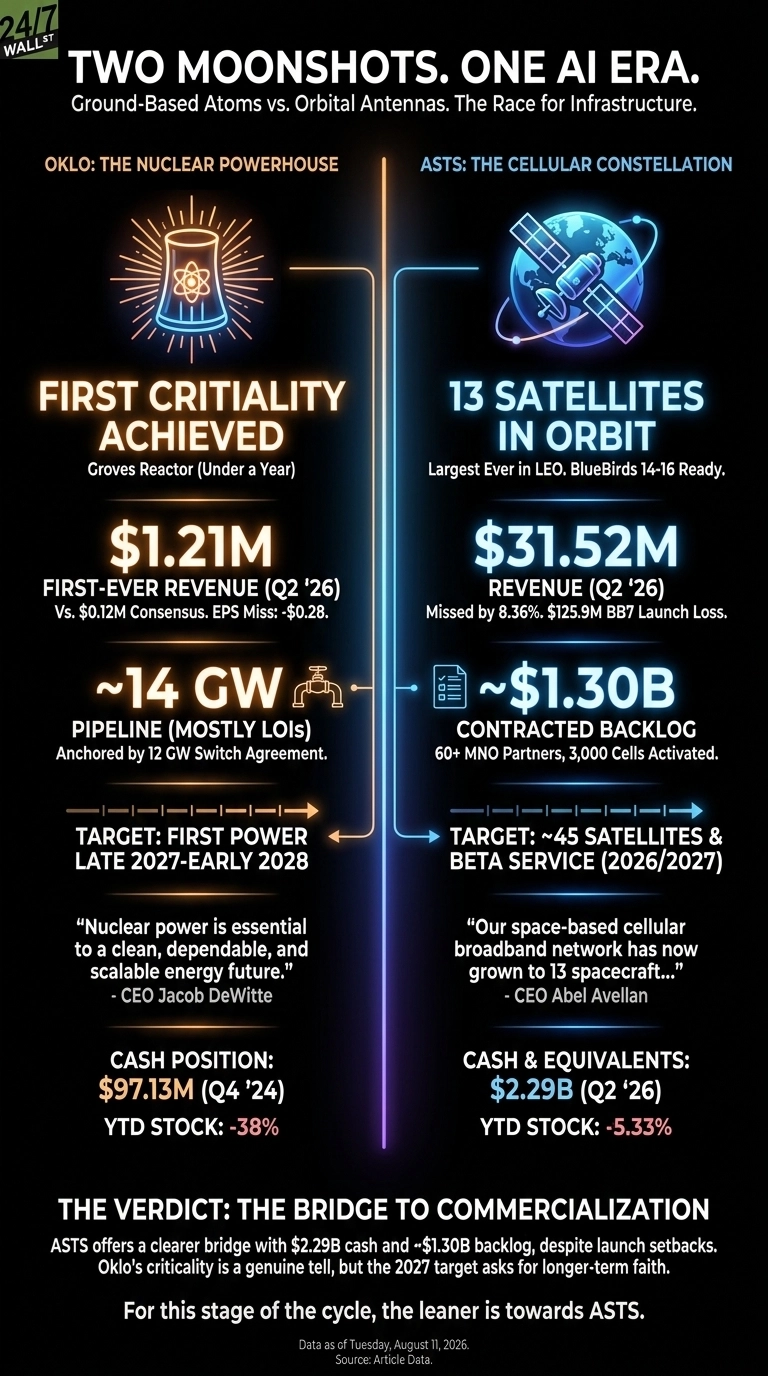
Oklo posted its first-ever quarterly revenue of $1.21 million. AST SpaceMobile printed $31.52 million alongside a nine-figure launch loss. Both stories are about building infrastructure the AI era needs, but the pacing could not be more different.
Groves Goes Critical While BB7 Weighs on the Sky
Oklo’s quarter was defined by an operational milestone, not the income statement. The Groves reactor achieved first criticality in under a year, a moment retail investors amplified across r/stocks, r/stockmarket, and r/investing at a bullish sentiment score of 72.
The revenue beat versus a $0.12 million consensus mattered less than proof the Aurora program is moving from paper to power. The EPS miss of -$0.28 against a -$0.16 estimate did dampen enthusiasm, though.
AST SpaceMobile’s quarter looked heavier. Revenue missed by 8.36% and the GAAP loss came in at -$0.77 versus a -$0.29 consensus, a 168.01% shortfall driven by a $125.9 million loss on involuntary conversion tied to the BB7 launch incident. Yet the network keeps expanding.
CEO Abel Avellan told investors, “our space-based cellular broadband network has now grown to 13 spacecraft in orbit, each the largest ever in low Earth orbit”, with BlueBirds 14, 15, and 16 ready to ship.
| Business Driver | OKLO | ASTS |
| Latest Quarter Revenue | $1.21M (first ever) | $31.52M |
| Cash Position | $97.13M | $2.29B |
| Contracted Backlog | ~14 GW pipeline (mostly LOIs) | ~$1.30B |
Ground-Based Atoms vs. Orbital Antennas
Oklo sells electrons. Its Aurora powerhouse design expanded from 50 MW to 75 MW to court hyperscalers, and the anchor deal is a 12 GW master power agreement with Switch.
CEO Jacob DeWitte framed the moment plainly: “The world is catching up to what we’ve known all along: nuclear power is essential to a clean, dependable, and scalable energy future.” Oklo builds, owns, and operates the reactors, which lengthens the cash-out cycle but keeps long-term economics inside the house.
AST SpaceMobile sells connectivity minutes, or eventually will. Its 60+ MNO partners cover 3+ billion mobile subscribers, with 3,000 digital cells activated across Continental United States from seven gateways.
The Block 2 satellite roadmap targets peak data rates approaching 200 Mbps. Government work also matters here, with aggregate awards exceeding $125 million for national security applications.
The Real Test Sits in 2027
For Oklo, I am watching whether the NRC’s combined license application stays on schedule and whether the late 2027 to early 2028 first-power target holds. The stock is down 38% year to date, so patience is being tested.
For ASTS, the beta service launch and the pace toward 45 satellites in orbit by early 2027 will decide whether the $150 million to $200 million full-year revenue guide is a floor or a ceiling.
Why I Lean Toward ASTS for This Stage of the Cycle
If I have to pick one today, I lean ASTS. The $2.29 billion cash pile and $1.30 billion backlog give me a clearer bridge to commercialization, and the BB7 charge is a one-time bruise rather than a broken thesis.
Oklo interests me more as a longer-dated option. The Groves criticality was a genuine tell, but zero commercial revenue and a 2027 first-power target ask for a lot of faith. For a defensive investor, neither fits. For someone willing to underwrite hardware risk on a multi-year horizon, both can work, just not with the same conviction.
Contact [email protected] for any questions or corrections.
Vandita Jadeja is a financial publisher with over a decade of experience writing about financial topics, including investment, savings, retirement, insurance and banking. Vandita is a Chartered Accountant who loves to debunk financial concepts for readers.
Her work has appeared on sites that include The Motley Fool, InvestorPlace, and Benzinga. She covers investing and focuses on stock picks and price prediction for 24/7 Wall St.
When not looking for the next stock investment opportunity, she can be found traveling, reading, chasing sunsets and enjoying her iced latte.