What the Coming 6G Trials With Nvidia, T-Mobile Could Mean for Nokia Investors
Nokia stock has surged nearly 150% over the past year on the promise of AI-powered 6G, and now Nvidia and T-Mobile are putting that promise to a real-world test. What the trial results could mean for shareholders depends on a…


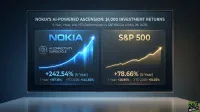
The artificial intelligence-radio access network (AI-RAN) thesis is moving from presentations to real-world implementation, and Nokia (NYSE:NOK | NOK Price Prediction) is now at the center of this development. With Nvidia (NASDAQ:NVDA) Aerial platform pairing with Nokia radio software and T-Mobile (NASDAQ:TMUS) serving as a marquee field-trial partner, investors are trying to price a technology transition that has already lifted Nokia stock 149.3% over the past year.
Why the Nvidia and T-Mobile Trials Matter
Nokia’s tie-up with Nvidia, anchored by Nvidia’s roughly $1 billion investment and about a 2.9% stake, integrates Nvidia’s AI compute into Nokia’s radio access portfolio for AI-native 6G. T-Mobile is a lead trial partner, with work extending through Nokia’s AI-RAN Center in Dallas. Commercial availability is targeted for late 2027, so this is a multiyear build, not a next-quarter catalyst.
CEO Justin Hotard framed the launch pointedly on the Q2 call: “Last week we launched the industry’s first commercial AI-RAN platform, which will help customers unlock more from their networks, including more than 100% spectral efficiency gains by 2028.” A GPU-based AI-RAN targeting double spectrum capacity is the pitch operators like T-Mobile are stress-testing.
The Numbers Behind the Narrative
Q2 2026 results gave the thesis fundamental support. Nokia posted revenue of $5.48 billion (approx. €4.8 billion), up 5.92% year over year, and EPS of $0.08 versus $0.07 expected. The AI & Cloud line more than doubled, reaching €446 million ($508.96 million), with Q2 order intake of roughly $3.2 billion (€2.8 billion).
Hotard added: “Demand remains strong, while supply continues to be the main industry constraint, prompting our customers to place longer-term orders.” Optical Networks grew 19% and IP Networks 15%, both fueled by hyperscaler and telco buildouts adjacent to the AI-RAN story.
What Investors Are Paying For

At $10.32 a share, Nokia trades at roughly 24x forward earnings, with an analyst target price of $15.02. Full-year 2026 guidance calls for comparable operating profit of €2.1 billion to €2.6 billion, tracking above the midpoint.
The Risks
The bull case has some caveats. Ericsson (NASDAQ:ERIC) is running its own AI-in-RAN pilots with AT&T (NYSE:T) and T-Mobile, some without GPUs at all, which challenges Nokia’s compute-heavy architecture. Retail enthusiasm is already cooling, with Reddit sentiment sliding from 78 bullish on earnings day to 52 neutral this week. Free cash flow swung to negative €732 million ($835 million) in the quarter on restructuring charges. Shares are down 17.0% over the past month.
What to Watch Next
The signal for investors is order conversion. Hotard expects about half of Q2 orders to convert to revenue over the next 12 months. If the Nvidia and T-Mobile trials produce measurable spectral efficiency gains, Nokia’s AI-RAN pitch will gain proof points ahead of the commercialization window.

Contact [email protected] for any questions or corrections.
Trey has been an editor and author at 24/7 Wall St. for more than a decade, where he has published thousands of articles analyzing corporate earnings, dividend stocks, short interest, insider buying, private equity, and market trends. His comprehensive coverage spans the full spectrum of financial markets, from blue-chip stalwarts to emerging growth companies.
Beyond 24/7 Wall St., Trey has created and edited financial content for Benzinga and AOL's BloggingStocks, contributing additional hundreds of articles to the investment community.
Trey's editorial expertise extends across multiple publishing environments. He served as production editor at Dearborn Financial Publishing and development editor at Kaplan, where he helped shape financial education materials. Earlier in his career, he worked as a writer-producer at SVE. His freelance editing portfolio includes work for prestigious clients such as Sage Publications, Rand McNally, the Institute for Supply Management, the American Library Association, Eggplant Literary Productions, and Spiegel.
Outside of financial journalism, Trey writes fiction and has been an active member of the writing community for years, moderating workshop sessions at regional conventions.