Only a Handful of ETFs Own Nothing but Dividend Aristocrats and These 3 Are Worth Buying in 2026
Almost every ETF claiming to own Dividend Aristocrats actually mixes in other holdings, but a small group of funds holds nothing but these elite dividend growers. Choosing the wrong one in 2026 could cost you years of compounding.

This post may contain links from our sponsors and affiliates, and Flywheel Publishing may receive compensation for actions taken through them.

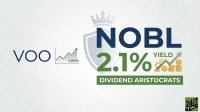
The Dividend Aristocrats index has always been a narrow club. Companies need at least 25 consecutive years of dividend increases to qualify for the S&P 500 version, and the roster of ETFs built to own only these stocks is even shorter. Three funds handle almost all the flows: ProShares S&P 500 Dividend Aristocrats ETF (NYSEARCA:NOBL), ProShares S&P MidCap 400 Dividend Aristocrats ETF (NYSEARCA:REGL), and First Trust S&P 500 Dividend Aristocrats Target Income ETF (NYSEARCA:KNG).
Each of the three approaches the same universe from a different angle: NOBL as the equal-weighted large-cap flagship, REGL as the overlooked mid-cap sibling, and KNG as the covered-call income variant. With the Fed Funds Target Rate sitting at 3.75% after 0.75% of cuts over the past year, and the 10-year Treasury at 4.69%, the case for owning quality dividend growers has to compete with a still-elevated risk-free rate. That competitive backdrop is what makes fund selection matter more than usual in 2026.
NOBL: The Core Large-Cap Aristocrat Vehicle
Assets have grown to $11.07 billion, making NOBL the largest fund in the category and generally the most liquid. The expense ratio comes in at 0.35%, which is competitive with broad dividend funds. The trailing dividend yield is roughly 2%, with a trailing 12-month distribution of $2.03 per share.
REGL: The Mid-Cap Cousin Most Investors Skip
Holdings look nothing like the large-cap version. The portfolio owns 65 equity positions, with top weights in Littelfuse at 1.85%, Cabot Corp., Polaris, and Chemed. Regional banks, specialty industrials, mid-cap utilities, and niche REITs such as CubeSmart and STAG Industrial round out the roster. That gives REGL a very different sector fingerprint from any large-cap dividend product: heavier on financials and industrials, lighter on consumer staples and healthcare.
Assets are $1.68 billion, a fraction of NOBL’s size. The expense ratio is 0.40%, five basis points higher than the large-cap fund but reasonable for mid-cap access. Yield sits at 2.13%, and returns have edged higher: NOBL is up both year-to-date at 15% and over the past year at 18%. Beta of 0.72 is lower than the market, which is unusual for a mid-cap product. The tradeoff is liquidity. REGL trades in smaller volumes than NOBL, and mid-cap dividend growers can lag badly when small- and mid-cap breadth deteriorates.
KNG: Dividend Aristocrats With an Income Overlay
The result is a very different income profile. KNG’s trailing 12-month distribution totals $4.21 per share, and the fund yields around 6.1%. That comes at a cost. The expense ratio is 0.76%, more than double NOBL’s, and the covered-call overlay caps upside when Aristocrats rally hard. That shows up in the numbers: KNG is up 11% year-to-date and 14% over the past year, trailing both NOBL and REGL because gains above the strike price flow to the option buyer, not the fund.
Assets have grown to $3.37 billion, and the switch from quarterly to monthly distributions in 2024 aligned the payout cadence with what retirees actually want. Beta of 0.73 is comparable to REGL. KNG will lag in strong bull markets by design. The premium from covered calls compensates for capped participation, and in flat or choppy tape, the strategy pulls ahead. It is a total-return give-up in exchange for a substantially higher current cash yield.
Which Aristocrats Fund Fits Which Investor
Contact [email protected] for any questions or corrections.
David Beren has been a Flywheel Publishing contributor since 2022. Writing for 24/7 Wall St. since 2023, David loves to write about topics of all shapes and sizes. As a technology expert, David focuses heavily on consumer electronics brands, automobiles, and general technology. He has previously written for LifeWire, formerly About.com. As a part-time freelance writer, David’s “day job” has been working on and leading social media for multiple Fortune 100 brands. David loves the flexibility of this field and its ability to reach customers exactly where they like to spend their time. Additionally, David previously published his own blog, TmoNews.com, which reached 3 million readers in its first year. In addition to freelance and social media work, David loves to spend time with his family and children and relive the glory days of video game consoles by playing any retro game console he can get his hands on.