Nvidia’s Circular Financing Web Gets Even Wider
Nvidia just cut a $1.5 billion check to fund the very data center that will buy its own chips, and that circular loop is getting harder to ignore as off-balance-sheet obligations across Big Tech quietly balloon toward $3 trillion.

This post may contain links from our sponsors and affiliates, and Flywheel Publishing may receive compensation for actions taken through them.
Wall Street spent most of 2026 debating whether Big Tech’s AI spending was real demand or a financing trick dressed up as a boom. The $1.65 trillion in Big Tech off-balance-sheet obligations that Nikkei tallied in July gave that debate teeth.
Investors want to know who’s actually paying for the data centers powering the AI trade, and increasingly, the answer traces back to the same company selling the chips inside them. Nvidia (NASDAQ:NVDA | NVDA Price Prediction) has spent this year positioning itself not just as AI’s arms dealer but as its banker, landlord, and now equity partner.
This morning, that strategy got another data point: a $1.5 billion investment in SB Energy, the SoftBank-backed developer building OpenAI’s newest data center campus in Ohio. It’s a small check by Nvidia’s standards, but what it reveals about the company’s financing playbook is not.
The Ohio Deal, Line By Line
Nvidia will invest $1.5 billion in SB Energy and lock in up to 8 gigawatts of AI computing capacity at the PORTS-Pike Technology Campus in Pike County, Ohio. The initial phase covers 4.25 GW, with SB Energy building, owning, and operating the facility under a 20-year lease to OpenAI. SB Energy and SoftBank are also committing $4.2 billion to regional grid infrastructure, part of a plan for at least 10 GW of new power generation.
That number is smaller than it first appeared. The Wall Street Journal reported on Friday that Nvidia trimmed its financial backstop for the project from $250 billion to less than $120 billion, and that the guarantee now covers only the buildout’s first phase. Investors had pushed back hard on the original figure — Nvidia shares fell 5% when it first surfaced — and management listened.
Separately, Nvidia and OpenAI are negotiating up to $100 billion in credit support and as much as $350 billion in GPU financing for the broader project. In short, Nvidia scaled back the riskiest number while leaving the chip-financing pipeline intact.
Money In, Chips Out
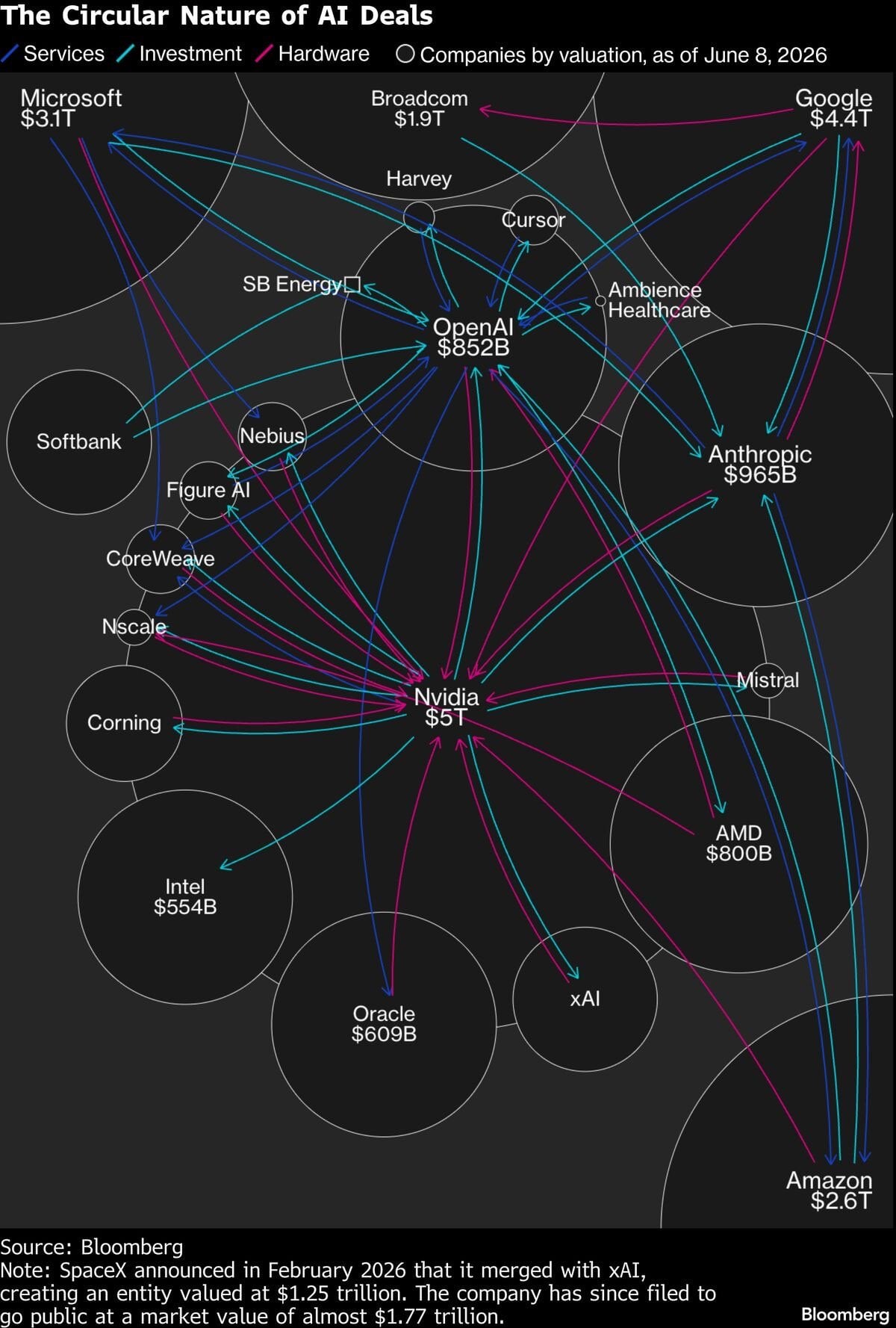
It is also another brick in the circular financing wall that Nvidia has been building.
- Nvidia funds SB Energy.
- SB Energy builds the data center and leases it to OpenAI.
- OpenAI fills that data center with Nvidia GPUs, purchased in part through financing Nvidia itself arranged.
- Nvidia’s revenue shows up twice: once as an investment return, once as a chip sale.
SB Energy is reportedly targeting an IPO as early as next month, seeking to raise at least $5 billion — and Nvidia’s second $1.5 billion tranche is expected to land there, putting Nvidia, OpenAI, and SoftBank all on the cap table of a newly public AI power company.
Nvidia can afford the exposure. The numbers back that up:
| Metric | Nvidia |
| Market cap | $5.5 trillion |
| Trailing P/E | 34.3 |
| Forward P/E | 22.6 |
| TTM revenue | $253.5 billion |
| TTM net income | $159.6 billion |
| Debt/equity | 0.07 |
| Return on equity | 114% |
A debt-to-equity ratio of 0.07 means Nvidia is financing this ecosystem almost entirely with cash it already has, not borrowed money — a meaningfully different risk profile than hyperscalers or OpenAI, which remains unprofitable despite an $852 billion valuation.
The Debt Nobody Sees on the Balance Sheet
That said, Nvidia’s balance sheet strength doesn’t erase the risk sitting one layer downstream. The $1.65 trillion in off-balance-sheet obligations Nikkei identified across the five largest hyperscalers rests on an assumption: that OpenAI and Anthropic keep growing and keep raising what they charge per token. The Wall Street Journal yesterday raised the tally to $3 trillion.
Ironically, the thing that makes this financing web workable — rising AI revenue — is the same thing markets have no reliable way to verify yet. If enterprises pivot toward cheaper open-source or in-house models, the lease payments, credit guarantees, and chip financing tied to today’s assumptions don’t just slow. They come due against revenue that never showed up, potentially unraveling the whole.
Key Takeaway
Nvidia’s scaled-back $120 billion guarantee shows the company responding to shareholder pressure rather than ignoring it, but it continues to enmesh itself in financing deals that require the music to keep playing. Slowing demand, companies searching out cheaper alternatives, or the eventual closing of a euphoric financing window for these deals could make the rapidly expanding debt load quickly crush some of its biggest players.
For Nvidia, smart investors should continue watching whether OpenAI’s revenue growth actually justifies the token pricing this entire structure depends on.
Contact [email protected] for any questions or corrections.
After two decades of patrolling the dark corners of suburbia as a police officer, Rich Duprey hung up his badge and gun to begin writing full time about stocks and investing. For the past 20 years, he’s been cruising the markets looking for companies to lock up as long-term holdings in a portfolio while writing extensively on the broad sectors of consumer goods, technology, and industrials. Because his experience isn’t from the typical financial analyst track, Rich is able to break down complex topics into understandable and useful action points for the average investor. His writings have appeared on The Motley Fool, InvestorPlace, Yahoo! Finance, Money Morning, and, of course, 24/7 Wall St. He has been featured in both U.S. and international publications, including MarketWatch, Financial Times, Forbes, Fast Company, and USA Today.