NVIDIA’s $500 Billion AI Bet Is ‘Almost Like a Digital Infrastructure Bill’
When Apollo, BlackRock, and KKR each commit $50 billion to a single chipmaker's buildout, the Earn Your Leisure hosts argue it stops being a tech trade and starts resembling something closer to national infrastructure with private money behind it.

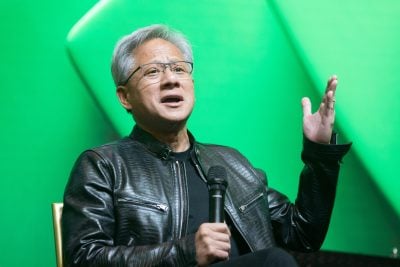
The hosts of Earn Your Leisure, Rashad Bilal and Troy Millings, framed NVIDIA (NASDAQ:NVDA | NVDA Price Prediction) as a national infrastructure story with the weight of a public works program. On their episode “Are We Building a Permanent Tech Prison? NVIDIA’s $500B Plan Explained,” they broke down the chipmaker’s $500 billion AI investment partnership with Apollo, Blackstone, BlackRock, Brookfield, Goldman Sachs and KKR, arriving at a bullish conclusion that hinges on who is now writing the checks.
Why the Hosts See a “Digital Infrastructure Bill”
Bilal’s framing was blunt: “When the big boys get together and they’re putting in $50 billion at a time for a project, they’re going to ensure that it works. This is almost like a digital infrastructure bill.” That analogy matters because it reframes NVIDIA’s capex cycle as something closer to a public works program with private balance sheets behind it.
Millings added the structural point that carries the bull case forward: “That means that institutions are now putting money in here, and it won’t solely be hyperscalers.” Both hosts acknowledged a circular investment concern before landing bullish. Bilal made a separate point about AMD that is worth quoting verbatim: these institutions “are not investing in this and shorting AMD. They’re positive on the stock and then positive on the development of it.”
The Bear Case Bilal Flagged
Even inside the bullish take, Bilal named the math problem. On a $500 billion investment, a 5x or 7x return implies a $2.5 trillion outcome, which he called “scary” without a clear pathway. His stated preferred entry on NVDA is $190.19, a level well below where the stock trades today. Asked when tech falls apart, his answer was “never,” and he suggested tech has “like another 60 years to run” in a worst case.
What NVIDIA’s Own Numbers Say
Jensen Huang’s most recent conference call reinforced the infrastructure framing. On the May 20, 2026 Q1 FY27 call, Huang said “AI infrastructure spending is on track to reach 3 to 4 trillion annually by the end of this decade” and added that “Compute is revenues. Compute is profit.” He also anchored management’s revenue visibility, citing “1 trillion in Blackwell and Rubin revenue we foresee from 2025 through calendar 2027.”
The quarter itself delivered $82 billion in revenue, up 85% year over year, with Data Center revenue of $75 billion and a 75% non-GAAP gross margin. Total supply commitments climbed to $145 billion, and Q2 revenue guidance sits at $91 billion ± 2%. Investors can pull the underlying Q1 FY27 8-K for the full disclosure.
Where the Stock Sits vs. Bilal’s $190 Preference

NVDA last traded around $226.37 on Monday, Aug. 17, with the stock up nearly 20% year to date and 24.37% over the past year. Market cap stands at $5.48 trillion on a forward P/E of 25. Analyst consensus target is $302.83, backed by 48 Buy ratings and 10 Strong Buy ratings against one Sell rating.
Prediction markets echo the setup. Polymarket traders assign a 97.5% probability that NVIDIA beats its next quarterly earnings report, a 94.2% probability that Data Center revenue clears $80 billion, and an 85.5% probability that NVDA prints a new all-time high before year end. Composite sentiment sits at 71.87, with a +26.26 shift over the past 30 days.
The Read-Through for Investors
Bilal’s $190 preference implies patience on entry rather than skepticism on thesis. Millings’ point about compute becoming a tradable asset class aligns with what management now describes as a $200 billion TAM just for the Vera CPU line. Readers looking for how this coalition of hyperscalers and private-market giants reshapes the next leg of AI winners can find a deeper breakdown in our Next Nvidia Playbook. One flag worth monitoring: insider activity shows 27 recent transactions with a net selling direction, a quiet counterpoint to the institutional bull case the Earn Your Leisure hosts laid out.
Contact [email protected] for any questions or corrections.
Joel South covers large-cap stocks, dividend investing, and major market trends, with a focus on earnings analysis, valuation, and turning complex data into actionable insights for investors.
He brings more than 15 years of experience as an investor and financial journalist, including 12 years at The Motley Fool, where he served as an investment analyst, Bureau Chief, and later led the Fool.com investing news desk. He has also co-hosted an investing podcast and appeared across TV and radio discussing market trends.