This Politician on the House Intelligence Committee’s Cyber Panel Just Bought Three Cybersecurity Stocks
A senior member of the House Intelligence Committee's cyber subcommittee just disclosed purchases of three pure-play cybersecurity stocks, and whether that filing reveals anything worth acting on depends entirely on a structural question the STOCK Act never resolved.


Rep. Josh Gottheimer, the New Jersey Democrat who serves as Ranking Member of the House Intelligence Committee’s National Security Agency and Cyber Subcommittee, disclosed purchases of three pure-play cybersecurity stocks in a periodic transaction report filed August 10, 2026.
He bought shares of CrowdStrike (NASDAQ:CRWD | CRWD Price Prediction) on July 15, Palo Alto Networks (NASDAQ:PANW) on July 16, and SailPoint (NASDAQ:SAIL) on July 20, each in the $1,001 to $15,000 band. The trades sit inside a Morgan Stanley Select UMA account, a professionally managed vehicle, and the same filing shows roughly a dozen other transactions during the same window, including Alphabet (NASDAQ:GOOG, NASDAQ:GOOGL) preferred shares and several sales. That pattern looks like an advisor rebalancing a managed account rather than a member of Congress hand-picking names, and you should carry that fact into everything below.
Regardless, let’s take a look.
The Structural Question the Filing Raises
The question worth asking is whether a lawmaker who receives classified briefings on the cyber threat landscape should hold equity in the companies whose commercial fortunes ride on that landscape, regardless of who executes the trades. Gottheimer’s subcommittee has oversight of the government’s cyber apparatus, and the three companies he now owns sell endpoint protection, network security platforms, and identity governance to federal agencies and the private enterprises the government is charged with defending. The financial exposure exists whether the account is managed or self-directed, and current STOCK Act disclosure rules do not distinguish between the two.
The managed-account explanation resolves intent while leaving the conflict in place. A member of Congress who reads intelligence products on adversary tradecraft cannot unread them when reviewing quarterly statements, and reasonable observers can disagree about whether that matters more or less than a self-directed trade. Anyone trying to treat a periodic transaction report as a market signal still has to decide what a small purchase inside a rebalanced UMA actually tells them.
Reading This as an Investment Signal?
The signal is weak at best. A four-figure purchase inside a managed account reflects an advisor’s model rather than a considered judgment about a specific company’s prospects. Anyone building a thesis on these names should do so on the underlying business, which is coherent enough on its own terms.
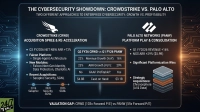
CrowdStrike grew revenue 25.6% year over year last quarter and trades at a forward earnings multiple of 175x. Palo Alto’s Next-Generation Security ARR reached $8.13 billion, up 60% year over year, and CEO Nikesh Arora told analysts in June that frontier AI models have entered an era where they can “identify and weaponize vulnerabilities in mere minutes, a process that previously required months of manual effort.”
SailPoint, at a market cap of roughly $11 billion, is building identity governance for machine and AI-agent identities, a category regulators are pushing enterprises to control.
The basket is a coherent bet that AI adoption will force new cybersecurity spending, and the market has already made that bet loudly. CrowdStrike is up 104.26% over the past year, and Palo Alto is up 121.42%. Following Gottheimer into these names because he owns them is following a signal that carries almost no information.
Studying the AI-security thesis on its merits is a better use of your attention, and that thesis is intact regardless of what any managed account decided to buy in July.
All that said, if you are still confident that this politician will end up winning big, it’s not a terrible idea to take inspiration from some of these trades. Cybersecurity stocks remain hot and have been hot for a long time.
Contact [email protected] for any questions or corrections.
Omor Ibne Ehsan is a writer at 24/7 Wall St. He is a self-taught investor with a focus on growth, cyclical, and dividend equities that have strong fundamentals, value, and long-term potential. He also has an interest in high-risk, high-reward investments such as penny stocks.