Broadcom Shareholders Should Be Paying Attention to What Just Happened With Marvell and Google
Google just handed Marvell something Broadcom should have seen coming, and the terms of the deal reveal exactly who benefits when a hyperscaler decides it needs more than one custom silicon partner.

CNBC’s Kristina Partsinevelos walked viewers through a striking piece of dealmaking on August 19, describing an agreement in which Marvell Technology (NASDAQ:MRVL | MRVL Price Prediction) will develop custom silicon that plugs directly into Google’s TPU ecosystem. In her words, the two signed “a commercial agreement for Marvell to develop custom silicon that attaches specifically to Google’s TPU ecosystem”, and she said to think of it as its own custom chip system.
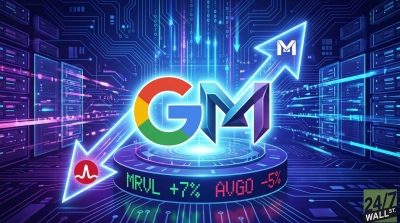
The commercial terms are the interesting part. Alphabet (NASDAQ:GOOG, NASDAQ:GOOGL) received a warrant to buy up to 59 million shares at $206.58, which Partsinevelos characterized as “roughly 7% dilution, a notional $12 billion if fully exercised.” Marvell rose 7% on the news and Broadcom (NASDAQ:AVGO) fell 5%.
Marvell paid for its diversification with shareholder equity, and the market applauded the trade within hours. Whether that applause holds up depends on what escaping Amazon concentration is actually worth, relative to the cost of handing a customer a fixed claim on the upside that its own orders will help create.
What Marvell Actually Gave Google
The scope caught the market off guard. Partsinevelos said, “the scope is definitely wider than the street was expecting, so it includes custom accelerators, storage chips, networking, and memory chips.” That is a full-stack engagement.
The warrant strike sits well below where the stock trades today. Marvell closed at $237.27 on August 19, with the shares up 179.61% year to date and 229.93% over the past year.

Google is holding an option to buy a chunk of Marvell at a price the stock has already blown past. Every purchase order that lifts Marvell’s growth also lifts the value of that warrant, which is unusual generosity for a customer already receiving a strategic supply arrangement.
Management can point to the size of the prize as justification. CEO Matt Murphy told investors during the Q1 fiscal 2027 call that “we are seeing strong demand and exceptional bookings across our entire data center portfolio” and guided custom revenue to more than double in fiscal 2028.
The Diversification Case, Plainly Argued
Marvell’s ASIC franchise has leaned heavily on Amazon (NASDAQ:AMZN) for years, and that concentration has been the most persistent bear case on the stock. Partsinevelos framed the shift plainly: “Google just rounds out all of the four top U.S. hyperscalers for Marvell.”
Concentration risk is a concrete problem in custom silicon. A single customer controls roadmap decisions, renegotiation leverage, and the pace at which second sources are brought in. Adding Google as a committed multi-product partner changes the shape of that risk.
The counterargument is that dilution is permanent. The strike locks in a discount that Marvell shareholders effectively subsidize forever, and if the fiscal 2029 custom revenue target of over $10 billion was reachable anyway, the warrant was expensive insurance.
I think the trade was worth making, although only barely. Escaping single-customer dependency reprices a company’s multiple, and Marvell’s 9.85% jump on the day suggests investors reached the same conclusion in real time.
What Broadcom Holders Should Take From This
Broadcom’s Google relationship remains intact. On the fiscal Q2 2026 call, CEO Hock Tan said the company signed a long-term agreement in April to develop and supply multiple generations of TPUs and AI networking, describing the commitment as “a very substantial dollar amount.”
Tan also acknowledged that a customer of Google’s scale would use multiple suppliers, telling analysts “we fully expect that there will be some diversity of sources for them.” Wednesday’s news is that prediction arriving on schedule.
Bernstein pushed back on the panic in a morning note, arguing, as Partsinevelos summarized, that “there’s plenty to go around. The pie just keeps getting bigger.” The math supports the view: Broadcom guided fiscal 2027 AI semiconductor revenue to exceed $100 billion, and Q2 AI semiconductor bookings alone reached over $30 billion, per its latest 8-K. A buildout on that scale pulls in far more than the chipmakers themselves, which is why we profiled seven of the power, cooling, and networking suppliers riding the same wave in a free report.
Broadcom likely gives up some wallet share at Google while total Google dollars keep rising, and the stock’s 12.88% weekly slide reflects sentiment about the shift. Marvell has genuinely improved its position. Broadcom shareholders should be paying attention, and the correct posture is watchfulness.
Contact [email protected] for any questions or corrections.
Omor Ibne Ehsan is a writer at 24/7 Wall St. He is a self-taught investor with a focus on growth, cyclical, and dividend equities that have strong fundamentals, value, and long-term potential. He also has an interest in high-risk, high-reward investments such as penny stocks.