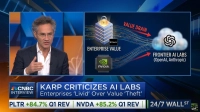
Six Days Before Nvidia Reports, a Billionaire Says AI Adds ‘Literally Zero’
A billionaire investor says AI contributes nothing to corporate earnings growth, but Microsoft just filed numbers that tell a very different story. With Nvidia reporting in six days, the tension between trillion-dollar infrastructure bets and real-world returns is about to…


On August 20,Microsoft’s startups blog published “Resolution, not deflection: how Maven uses AI agents to transform the enterprise customer journey”, another marquee enterprise AI customer story from the world’s largest seller of AI capacity. Hours later, billionaire investor Chamath Palihapitiya posted that for the Global 2000, “Their earnings growth has literally zero to do with AI or anything remotely close”. That same morning he asked, “Yet, high value tasks don’t seem to be increasing…so where are all these tokens going??”
The split screen matters because Microsoft (NASDAQ:MSFT | MSFT Price Prediction) is the cleanest scoreboard for whether enterprise AI is monetizing. The scoreboard is mixed. Shares closed at $481.15 on August 20, up just 0.12% year to date, down 3.91% over one year, but up 21.2% in the last month after a record fiscal year.
Six Days Until NVIDIA Sets the Tone
NVIDIA (NASDAQ:NVDA) reports fiscal Q3 after the close on August 26, 2026, and Palihapitiya’s timing is pointed. Two days before his skepticism blast, on August 18, he posted the All-In Summit 2026 speaker lineup tagged to Jensen Huang, CEO of NVIDIA. He also called political blowback against AI data centers in Texas, Pennsylvania and Ohio “a powder keg” capable of unwinding 200 to 300 basis points of annual GDP, adding that “The collective leadership of frontier AI has failed miserably in doing the basics”.
Microsoft’s Counter-Evidence Is Numeric
Microsoft’s Q4 FY26 earnings report, filed July 29, 2026, is the strongest rebuttal. Revenue reached $90.01 billion, up 17.75%. Azure surpassed $100 billion, up 41% for the full year. Commercial remaining performance obligations hit $678 billion, up 84%. Microsoft 365 Copilot passed 30 million paid seats, and by Q3 the AI business was already at a $37 billion annual run rate, up 123%.

CEO Satya Nadella framed the monetization story directly:
“We are advancing the frontier on the cost-to-outcome curve, ensuring every customer can turn tokens into business results.”
CFO Amy Hood was blunter on returns: “All of these things contribute, obviously, to your point of increased confidence in ROIC, frankly, of the dollars that we’re investing.” She also said “demand continues to exceed available supply.”

Where the Skeptic Has a Point
The cost side is real. Q4 capex was $35.8 billion, up 109.63%, and full-year capex hit $115.95 billion, up 79.62%. Free cash flow fell to $19.64 billion, down 23.19%. EPS of $4.74 was aided by a $3.2 billion Anthropic gain. With the stock essentially flat YTD, the market is still adjudicating whether tokens become durable earnings.
NVIDIA’s August 26 print will reset that debate. If Huang guides in line with Microsoft’s contracted backlog, Palihapitiya’s “literally zero” framing gets tested against $678 billion of signed commitments. If not, the skeptics own the narrative, and the buildout question shifts to the companies powering and cooling the racks (we profiled seven of those suppliers in a free AI infrastructure report).
Contact [email protected] for any questions or corrections.
Joel South covers large-cap stocks, dividend investing, and major market trends, with a focus on earnings analysis, valuation, and turning complex data into actionable insights for investors.
He brings more than 15 years of experience as an investor and financial journalist, including 12 years at The Motley Fool, where he served as an investment analyst, Bureau Chief, and later led the Fool.com investing news desk. He has also co-hosted an investing podcast and appeared across TV and radio discussing market trends.