Microsoft vs. Broadcom: Two AI Powerhouses, One Better Investment
Microsoft and Broadcom are both winning the AI trade, but they are winning it in completely different ways, and betting on the wrong one right now carries very different risks.


Microsoft (NASDAQ: MSFT | MSFT Price Prediction) and Broadcom (NASDAQ: AVGO) sit on opposite sides of the same AI trade.
Microsoft just closed Q4 FY2026 with $90.01 billion in revenue, while Broadcom posted Q2 FY2026 revenue of $22.187 billion. One rents the AI factory. The other sells the picks. Comparing them right now tells you where enterprise spending is actually landing.
Copilot Seats Carry Microsoft. Custom Silicon Carries Broadcom.
Microsoft’s quarter was a software story wearing an infrastructure suit. Intelligent Cloud jumped 32% to $39.31 billion, Azure grew 43% year over year, and full-year Azure revenue crossed $100 billion for the first time. Microsoft 365 Copilot hit over 30 million paid seats, and commercial RPO of $678 billion, up 84%, is the number I keep circling. That is contracted work, not hope.
CEO Satya Nadella framed it plainly: “We are advancing the frontier on the cost-to-outcome curve, ensuring every customer can turn tokens into business results.” Reported non-GAAP EPS came in at $4.74, topping the $4.2397 consensus estimate.

Broadcom’s quarter was pure silicon leverage. AI semiconductor revenue reached $10.80 billion, up 143% year over year, and Hock Tan guided Q3 AI semis to $16 billion, growth over 200%. Operating income more than doubled to $10.788 billion, up 85.07%. EPS of $2.44 topped the $2.3972 estimate, extending an eight-quarter beat streak.
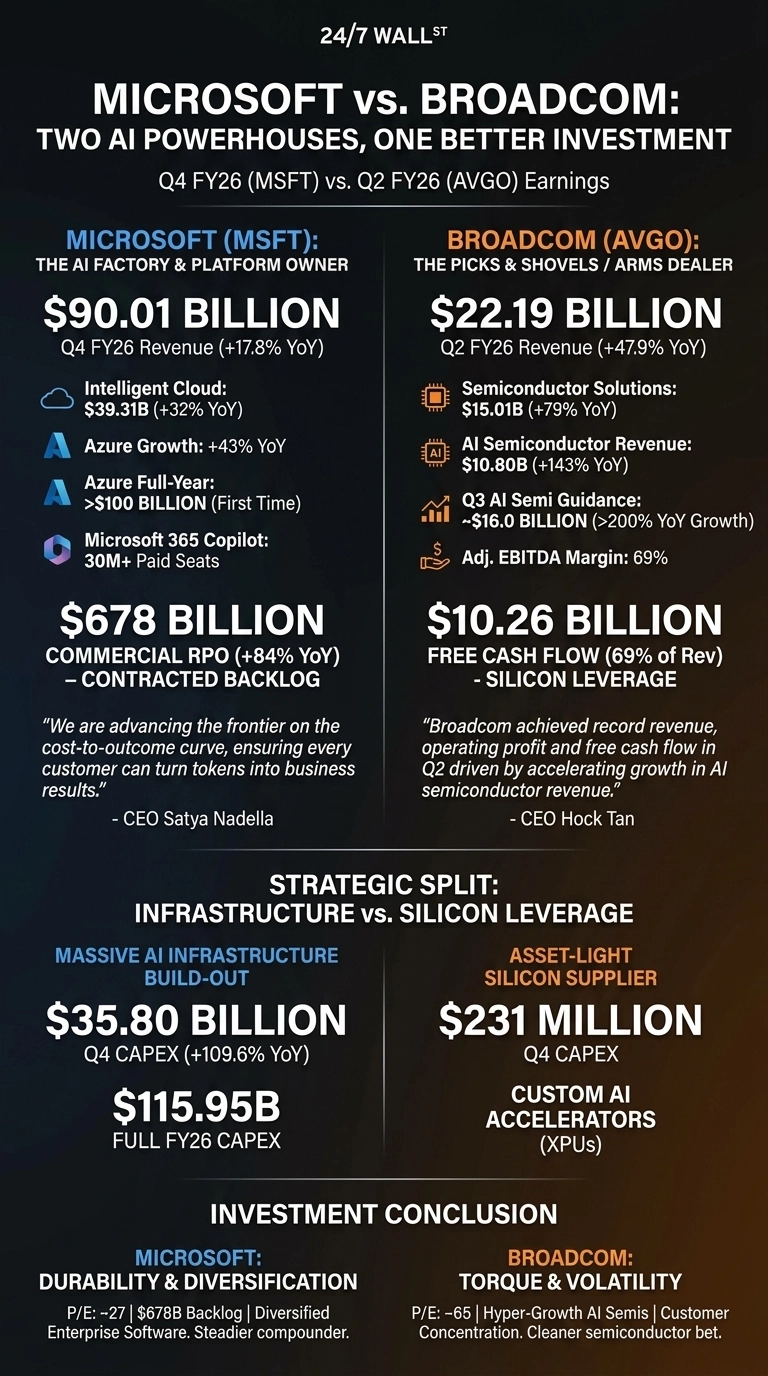
| Business Driver | Microsoft | Broadcom |
| Main Growth Engine | Azure + Copilot seats | Custom XPUs + AI networking |
| Quarterly Revenue Growth | +17.75% | +47.87% |
| Quarterly CapEx | $35.80 billion | $231 million |
Platform Owner vs. Arms Dealer
The strategic split is architectural. Microsoft is spending like a utility: full-year CapEx of $115.95 billion pushed free cash flow down to $19.639 billion, a 23.19% decline. That is the price of owning the AI stack from data center to Copilot license.
Broadcom took the opposite route. Fabless, asset-light, and shipping to a short list of hyperscalers, it turned $22.187 billion in revenue into $10.262 billion in free cash flow.
The 69% adjusted EBITDA margin is what happens when you sell scarce silicon to buyers who cannot switch quickly. The catch: customer concentration is real, and insider activity shows 62 recent transactions with net selling direction.
The Next Test Is Whether Guidance Holds
For Broadcom, the $29.4 billion Q3 revenue guide is the ballgame. Miss the $16 billion AI number and the P/E of 65 gets ugly fast. Shares are already down 18.02% since the June 3 earnings report.
For Microsoft, I am watching Copilot attach rates and whether that $678 billion RPO converts on schedule. Post-earnings, shares ran 24.87% higher through August 3, and Reddit’s wallstreetbets crowd hit a very bullish 94 sentiment score on July 31. That level of sentiment typically cools.
Why I Lean Microsoft for Durability, Broadcom for Torque
On the current data, Microsoft looks like the steadier name. The 27 P/E, the $678 billion backlog, and the diversification across enterprise software make it the steadier compounder. Copilot monetization is real, and Azure at $100 billion annualized gives Nadella pricing power that Broadcom cannot replicate.
That said, if you want maximum AI torque and can stomach the volatility, Broadcom is the cleaner semiconductor bet. A 143% growth engine trading below its $527.88 analyst target after an 18% pullback is interesting. It carries more concentration risk. Hock Tan’s $100 billion AI sales goal by 2027 is aggressive, and hyperscaler order patterns can turn quickly. Both work. Microsoft just sleeps better.
Contact [email protected] for any questions or corrections.
Vandita Jadeja is a financial publisher with over a decade of experience writing about financial topics, including investment, savings, retirement, insurance and banking. Vandita is a Chartered Accountant who loves to debunk financial concepts for readers.
Her work has appeared on sites that include The Motley Fool, InvestorPlace, and Benzinga. She covers investing and focuses on stock picks and price prediction for 24/7 Wall St.
When not looking for the next stock investment opportunity, she can be found traveling, reading, chasing sunsets and enjoying her iced latte.