Trump Continues Trading Stocks at Warp Speed: Berkshire Bought, Meta Sold
President Trump's accounts executed more than 1,000 trades in a single month, including moves in a major defense contractor timed suspiciously close to a surprise geopolitical agreement, and Congress just passed a fix that deliberately leaves him out.

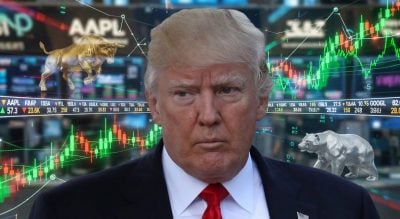
The stock market has given investors plenty of reasons to stay invested during President Trump’s second term. Since Jan. 20, 2025, the S&P 500 has gained roughly 28%, according to market data, despite a stomach-churning detour in April 2025. After Trump unveiled sweeping tariffs on April 2, the index fell more than 12% in just four trading days, before recovering as the administration paused many of the levies.
That rebound has helped produce a steady stream of new highs — and Trump’s portfolio has been busy along the way too. After executing 3,642 transactions in the first quarter, his latest disclosure shows another 1,000-plus trades in June.
Trump Keeps Trading While Markets Keep Climbing
The latest OGE Form 278-T shows 1,051 securities transactions during June, worth between $78.1 million and $263.1 million. More than 550 were purchases and more than 450 were sales.
Some of the larger disclosed moves included:
| Company | Notable Q2 Move |
| Berkshire Hathaway (NYSE:BRK-B | BRK-B Price Prediction) | Bought $1 million to $5 million |
| Visa (NYSE:V) | Bought $1 million to $5 million |
| Mastercard (NYSE:MA) | Bought $1 million to $5 million |
| Cintas (NASDAQ:CTAS) | Bought $1 million to $5 million |
| Meta Platforms (NASDAQ:META) | Sold $1 million to $5 million |
| Motorola Solutions (NYSE:MSI) | Sold $1 million to $5 million |
The filing also shows Trump’s accounts moving in and out of Palantir Technologies (NASDAQ:PLTR), including a purchase on June 3, sales on June 16 and 18, and additional purchases on June 23 and 24. The largest single disclosed transaction was a $5 million to $25 million sale of a Vanguard dividend ETF on June 22.
Be careful about treating these as Trump’s personal stock picks. The White House says independent managers oversee the accounts using computer-based strategies designed to track indexes. Direct indexing can require hundreds of individual transactions, including sales designed to harvest tax losses.
While the explanation matters, it doesn’t eliminate the ethical question.
The Conflict-of-Interest Problem Isn’t Going Away
The ethical concern is less about any individual trade than the overlap between Trump’s policymaking and his investments.
His June filing, for example, shows Palantir Technologies trades before and after the June 14 U.S.-Iran peace agreement, including a sale of as much as $1 million on June 18 followed by purchases on June 23 and 24. Palantir is a major government contractor, making it more directly exposed to federal defense and procurement decisions than companies such as Berkshire Hathaway or Meta Platforms.
That doesn’t prove Trump directed the trades or acted on nonpublic information — his investment accounts are reportedly independently managed — but it illustrates why presidential stock trading raises an ethical question even without evidence of misconduct.
Congress Is Trying to Fix the Problem — Sort Of
Ironically, Congress just demonstrated how incomplete the stock trading rules remain.
On July 22, the House passed the Stop Insider Trading Act, H.R. 7008, by a 232-198 vote. The bill would generally prohibit members of Congress, their spouses, and dependent children from purchasing individual stocks while requiring advance notice of certain sales. Yet, the legislation exempts the president and vice president. An amendment that would have extended the restrictions to the executive branch was defeated in the House Rules Committee.
The bill has since reached the Senate, but its prospects are poor after House Republicans attached a voter-ID provision that Democrats oppose.
For investors, the bigger lesson is straightforward. Don’t copy Trump’s portfolio. The filings arrive weeks — sometimes months — after trades occur, disclose ranges rather than exact amounts, and may reflect automated index strategies rather than convictions about individual companies.
Key Takeaway
Trump’s frenetic trading is fascinating, but it isn’t an investment signal. The S&P 500’s roughly 28% gain since his inauguration demonstrates that investors who stayed disciplined through the 2025 tariff crash have been rewarded.
Smart investors should take the same approach now: own businesses with durable earnings and cash flow, diversify across sectors, and assume Trump’s policies can create volatility without attempting to trade every headline.
In short, the most useful thing about Trump’s 1,000-plus trades isn’t discovering what he bought or sold. It’s remembering why ordinary investors should build portfolios that don’t require knowing what the president will do next.
Contact [email protected] for any questions or corrections.
After two decades of patrolling the dark corners of suburbia as a police officer, Rich Duprey hung up his badge and gun to begin writing full time about stocks and investing. For the past 20 years, he’s been cruising the markets looking for companies to lock up as long-term holdings in a portfolio while writing extensively on the broad sectors of consumer goods, technology, and industrials. Because his experience isn’t from the typical financial analyst track, Rich is able to break down complex topics into understandable and useful action points for the average investor. His writings have appeared on The Motley Fool, InvestorPlace, Yahoo! Finance, Money Morning, and, of course, 24/7 Wall St. He has been featured in both U.S. and international publications, including MarketWatch, Financial Times, Forbes, Fast Company, and USA Today.