Top Investors Name 5 AI Stocks That Could Win No Matter Which Model Leads
When a new industry erupts, the early leaders rarely become the final winners, and top investors say the same pattern is playing out across AI right now. Their framework for navigating that uncertainty targets a very different set of companies…

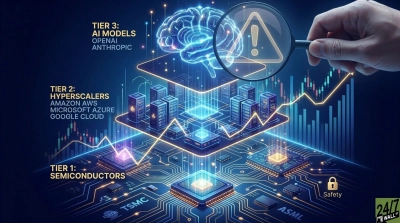
Co-hosts Andrew Sather and Stephen Morris on The Investing for Beginners Podcast recently walked through a three-tier framework for finding the best ideas in the AI value chain and ranked names by the margin of safety they see: “When you have a new industry, a new disruption… the leaders at the time aren’t always the same leaders down the line.“
As an example, they pointed to Google’s Search business, where Google beat out roughly ten competitors before anyone knew it would be the winner, showing that the long-term AI winners might not be obvious today. However, investors can position themselves to own the infrastructure layer to win no matter which companies come out on top.
The framework splits the AI stack into three tiers:
- Semiconductors (NVIDIA, Broadcom, TSMC, ASML)
- Major infrastructure (Amazon AWS, Microsoft Azure, Google Cloud)
- AI companies themselves (OpenAI, Anthropic)
The co-hosts prefer structural chokepoints over trying to figure out who will be an industry winner, which is why they want to invest in companies in Tiers 1 & 2.
Tier 1 Picks: Chokepoint Companies
Taiwan Semiconductor Manufacturing (NYSE:TSM | TSM Price Prediction) lands at number one. In the co-hosts’ view, “I don’t see anybody supplanting them,” even accounting for Taiwan geopolitical risk. Q2 2026 earnings support the company’s moat argument: TSMC raised its full-year 2026 revenue growth target to “slightly above 40% year-over-year in U.S. dollar terms” and said its conviction in the multi-year AI megatrend is “very high.”
Advanced nodes at 7nm and below made up 77% of wafer revenue, and management flagged that the next three years of capex will be “even more significantly higher than the past three years.” Shares are up 38.56% year to date and 86.28% over the past year.
ASML (NASDAQ:ASML) takes the second spot due to its current monopoly in EUV lithography. Q2 revenue of 9.3 billion euros came with a plan to lift low-NA EUV capacity roughly 30% in 2027, with management stating ASML is “close to being fully covered with orders for low NA EUV” for 2027. CFO Roger Dassen framed the capacity push as “We’re not waiting. We’re preempting.” The stock trades at a forward P/E of 39 after a 65.67% YTD run.
NVIDIA (NASDAQ:NVDA) sits in the semiconductor tier but is not ranked as high, given the pace of competitive change. Q1 FY2027 data center revenue hit $75 billion, up 92% year over year, with Jensen Huang framing Blackwell and Rubin visibility at $1 trillion from 2025 through calendar 2027.
Tier 2 Picks: The Hyperscaler Cluster
The co-hosts’ calls give their Tier 2 picks “very loose rankings,” saying that these are “almost interchangeable.” The hyperscalers are becoming the infrastructure layer powering AI:
Alphabet’s (NASDAQ:GOOGL) Google Cloud grew 82% to $24.8 billion, backlog reached $514 billion, and full-year capex guidance was raised to $195 billion to $205 billion. The stock trades at 17 times trailing earnings.
Microsoft’s (NASDAQ:MSFT) Azure grew 43%, and commercial RPO reached $678 billion, up 84%. FY2027 capex is guided to roughly $175 billion.
Amazon (NASDAQ:AMZN) is spending more on capital expenditures than any other hyperscaler, positioning it to become one of AI’s biggest long-term winners and potentially repeat the success of its earlier investments in e-commerce and AWS. AWS grew 36.7% year-over-year, its fastest growth in 18 quarters, on Q2 capex of $53.1 billion.
Andy Jassy said AWS could “very possibly be a trillion-dollar annual revenue business for us in time.” All of that hyperscaler spend has to be powered, cooled, and networked by somebody, so we created a Free Report outlining 7 suppliers powering the AI infrastructure buildout.
Tier 3: OpenAI And Anthropic Are the Hardest AI Investments to Underwrite
The third tier includes the AI companies themselves, led by private model developers OpenAI and Anthropic. The co-hosts ranked Anthropic above OpenAI but ultimately placed both in the “too hard” pile. Neither company has publicly traded shares, and their long-term value depends heavily on winning a rapidly changing model race with no obvious permanent leader.
That makes Tier 3 fundamentally harder to evaluate than the semiconductor and cloud infrastructure layers. TSMC’s multiyear lead times and ASML’s monopoly in EUV lithography create structural advantages that competitors cannot quickly replicate. OpenAI and Anthropic may produce enormous growth, but their models must continually outperform a crowded field.
Key Takeaways
The three-tier framework favors businesses that benefit regardless of which AI platform ultimately wins. TSMC and ASML control scarce manufacturing technologies, while Alphabet, Microsoft, and Amazon own the cloud infrastructure supporting the boom. In a rapidly changing industry, owning the chokepoints may be safer than betting on the winner of the race.
Contact [email protected] for any questions or corrections.
Thomas Richmond is a financial writer and content strategist with 5+ years of experience covering stocks and financial markets. He has published over 500 articles focused on individual stock analysis, helping investors better understand business fundamentals, stock valuations, and long-term opportunities.
Thomas previously served as a Content Lead at TIKR, a stock research platform, where he helped scale the company’s blog to hundreds of articles per month and contributed to a weekly newsletter reaching more than 100,000 investors.
Outside of work, Thomas enjoys weight lifting and soccer.