Apple vs. Microsoft: One Mega-Cap Looks Like the Better Long-Term Bet
Apple just posted its best June quarter ever while Microsoft locked up $678 billion in contracted backlog, but only one of these titans is making the kind of bet that shapes the next decade of enterprise technology.

Apple (NASDAQ: AAPL | AAPL Price Prediction) and Microsoft (NASDAQ: MSFT) just closed out fiscal periods that show two very different mega-caps.
Apple posted its strongest June quarter ever on iPhone 17 demand, while Microsoft wrapped fiscal 2026 with Azure crossing $100 billion in annual revenue. Both companies grew revenue in the high teens, but the engines driving them are pulling in opposite directions.
iPhone Supply Squeeze Meets Azure’s $678 Billion Backlog
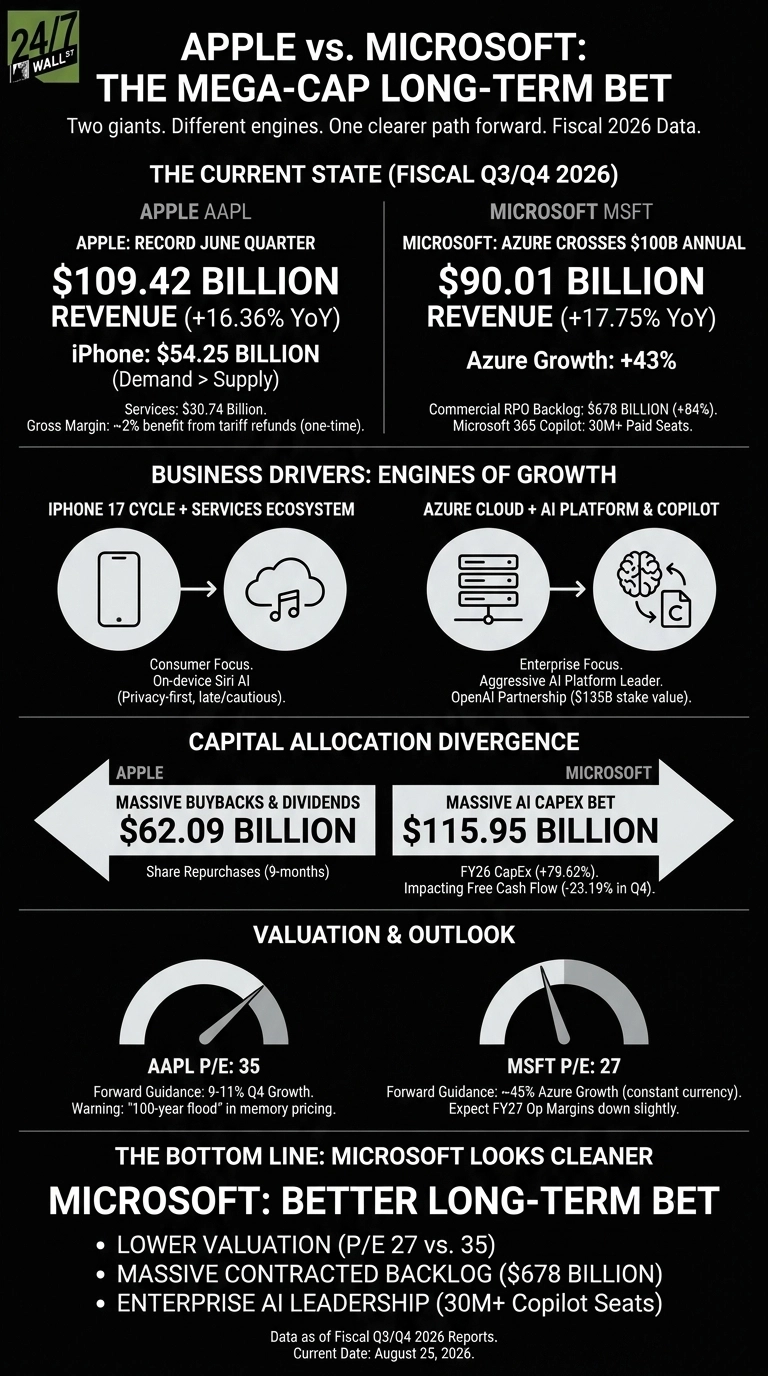
Apple’s June quarter delivered revenue of $109.42 billion, up 16.36% year over year, with iPhone alone at $54.25 billion. Tim Cook flagged an unusual problem: demand is outrunning supply. He called the root issue “a demand forecast issue” rather than a broken supply chain.
Services hit $30.74 billion, and gross margin got a roughly 2 percentage point lift from tariff refunds. That tailwind is real, though one-time in nature.

Microsoft’s fiscal Q4 revenue landed at $90.01 billion, up 17.75%, with Azure growing 43%. The eye-popping number is commercial remaining performance obligation of $678 billion, up 84%. That is contracted future revenue already under signed customer commitments.
Microsoft 365 Copilot now sits at over 30 million paid seats, and Satya Nadella said the company is “advancing the frontier on the cost-to-outcome curve.”

| Business Driver | Apple | Microsoft |
| Main Growth Engine | iPhone 17 cycle plus Services | Azure and Copilot |
| Backlog Visibility | Not disclosed | $678B commercial RPO |
| Customer Base | Consumers | Enterprise |
Buybacks vs. a $116 Billion CapEx Bet
Capital allocation is where the two companies diverge most sharply. Apple returned roughly $33 billion to shareholders in the quarter and repurchased $62.09 billion of stock over nine months.
Microsoft went the opposite direction, spending $115.95 billion on CapEx in fiscal 2026, up 79.62%, to build AI infrastructure. Free cash flow fell 23.19% in the quarter as a result. That is the price of trying to own the AI platform layer.

On AI positioning, Apple’s story is on-device Siri AI plus private cloud compute, framed around privacy.
Microsoft is running a very different playbook, with an approximately 27% stake in OpenAI valued at approximately $135 billion and a $3.2 billion gain from Anthropic. Valuation reflects the divergence too: Apple trades at a P/E of 35, Microsoft at 27.
Memory Costs and AI Returns Will Decide the Next Two Quarters
Apple guided September-quarter growth of 9% to 11% and warned of a “100-year flood” in memory pricing. I will be watching whether Cook can push through those input costs without breaking the premium consumer.
On Microsoft’s side, Azure is guided to grow around 45% in constant currency next quarter, and management expects fiscal 2027 operating margins to slip less than a point. You should watch whether Copilot’s per-seat plus consumption model actually scales revenue faster than depreciation eats into it.

Why Microsoft Looks Like the Cleaner Long-Term Bet to Me
I lean toward Microsoft here, and the valuation gap is a big reason. Paying a P/E of 27 for a business with $678 billion in contracted backlog and 30 million Copilot seats feels more defensible than paying 35 for an iPhone cycle boosted by one-time tariff refunds.
Apple still fits an investor who wants steady buybacks, brand strength, and a dividend cushion, and its 36.76% one-year return has already rewarded that patience.
But if you believe enterprise AI spending compounds through 2027, Microsoft’s CapEx bet becomes harder to dismiss (the power, cooling, and networking suppliers behind that buildout are the subject of a free report we put together on seven AI infrastructure names that aren’t the chipmakers). Memory-cost normalization is the key variable to track before Apple’s margin story firms up again.
Contact [email protected] for any questions or corrections.
Vandita Jadeja is a financial copywriter who loves to read and write about stocks. She believes in buying and holding for long term gains. Her knowledge of words and numbers helps her write clear stock analysis. She has contributed to several publications, including the Joy Wallet, Benzinga, The Motley Fool and InvestorPlace.