This 1 Number Proves Why You Should Buy Palantir on Every Dip
One metric separates Palantir from every other enterprise software company at scale, and understanding it changes how you think about buying the dips that keep rattling nervous shareholders.

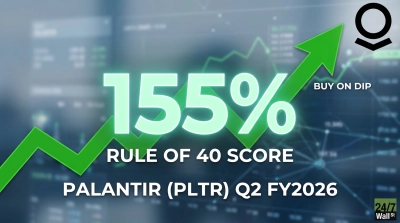
Palantir Technologies (NASDAQ:PLTR | PLTR Price Prediction) stands out on every pullback because a Rule of 40 score of 155% in Q2 FY2026 does not exist anywhere else in enterprise software at this scale. That single number, revenue growth plus adjusted operating margin, sits nearly four times the 40% bar that defines a healthy software business, and it has now expanded for 12 consecutive quarters. For a retirement-focused portfolio that needs durable compounding, that trajectory is difficult to match elsewhere.

Rule of 40 Trajectory Is the Whole Thesis
The trend is what matters. Palantir went from 114% in Q3 2025 to 127%, then 145%, and now 155%, a 10-point increase in a single quarter. CEO Alex Karp put the peer set bluntly last quarter: “a feat matched only by other fellow AI infrastructure companies: NVIDIA, Micron and SK hynix.” Revenue accelerated to 92.8% year-over-year, U.S. commercial revenue grew 149%, and adjusted operating margin hit 62%. Acceleration and margin expansion at the same time is the rarest combination in software.
Cash Generation Backstops the Multiple
Q2 delivered $1.22 billion in free cash flow, up 130% year-over-year, on $1.94 billion in revenue. Management raised full-year 2026 guidance to $8.150 billion to $8.158 billion in revenue (82% growth) and adjusted free cash flow of $4.5 billion to $4.7 billion. The balance sheet holds $9.2 billion in cash and short-term Treasuries. This is a debt-free, cash-gushing operator.

Head-to-Head Comparison Favors Palantir Decisively
The obvious alternatives fall short on the exact metric that matters. Snowflake (NYSE:SNOW) grew Q1 FY27 revenue just 33.5% and still posted a GAAP operating loss of $326 million. Palantir is growing nearly three times as fast and posted a GAAP operating margin of 47% in the same period. Salesforce (NYSE:CRM) grew Q2 FY27 revenue just 10.8%. There is no Rule of 40 math where CRM’s low-teens growth and 21% operating margin get near 155.
Valuation Risk Is Already Priced In
Yes, PLTR trades at a P/E of 251, and Q2 stock-based compensation was $265 million. Those numbers are real. They are also why the stock is roughly flat year-to-date despite blowout results. Meanwhile, guidance implies 82% revenue growth and up to $4.7 billion in adjusted free cash flow this year. Growth this fast, at margins this wide, on a net-cash balance sheet, retires the multiple concern quickly. History reinforces the dip-buying setup: across the last nine earnings beats, the average one-day change was negative 0.77%, followed by an average one-week gain of 6.83%.

The setup to watch: each time PLTR sells off on valuation chatter, the fundamentals argue for reassessing the thesis rather than the price action.
Contact [email protected] for any questions or corrections.
After two decades of patrolling the dark corners of suburbia as a police officer, Rich Duprey hung up his badge and gun to begin writing full time about stocks and investing. For the past 20 years he’s been cruising the markets looking for companies to lock up as long-term holdings in a portfolio while writing extensively on the broad sectors of consumer goods, technology, and industrials. Because his experience isn’t from the typical financial analyst track, Rich is able to break down complex topics into understandable and useful action points for the average investor. His writings have appeared on The Motley Fool, InvestorPlace, Yahoo! Finance, and Money Morning. He has been featured in both U.S. and international publications, including MarketWatch, Financial Times, Forbes, Fast Company, and USA Today.