11,500 Acre-Feet of Colorado River Water Rights Could Be Monetized. Social Security Can Treat the Water, Land and Farm Income Three Different Ways
A farmer collecting Social Security early can sell half a million dollars of land and owe nothing to the earnings test, while a modest crop profit shrinks his check the same year. Water rights from the same operation land in…

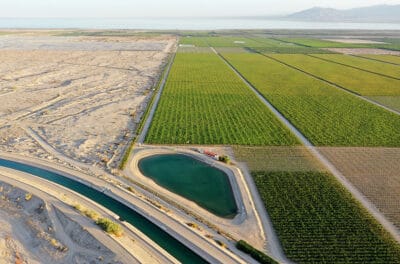
Limoneira (NASDAQ:LMNR) says its Yuma farming operation has access to about 11,500 acre-feet of Class 3 Colorado River water rights, and it expects a monetization event tied to those rights. The citrus grower has also identified more than $200 million of real estate development assets, non-strategic land and certain water rights for potential monetization. Water rights can be worth a lot on their own, apart from the crops they irrigate.
Imagine a 64-year-old farmer collecting Social Security with three kinds of value: crops, land, and water. Social Security treats each differently. This matters most before he reaches full retirement age (FRA) at 67.
Crop Profit Can Shrink an Early Benefit Check
Crops raised for sale are the farming business itself. The net profit on Schedule F (the farm section of a tax return) becomes net earnings from self-employment, and those earnings feed Social Security’s earnings test.
Say he clears $40,000. Only 92.35% of that counts, leaving $36,940.
In 2026, someone who hasn’t reached the age for full benefits can earn $24,480 before the earnings test applies.
Above that, Social Security withholds $1 of benefits for every $2 earned, totaling $6,230 this year.
Those benefits are not simply returned later. At FRA, Social Security recalculates his monthly benefit to credit the months benefits were withheld, but he loses that cash flow in the meantime.
A Half-Million-Dollar Land Gain Can Count as Zero
Now suppose he sells some of the acreage he farms. Of the sale price, $1 million goes to the land. His adjusted basis (roughly what he paid plus improvements) is $500,000, so his gain is $500,000.
Social Security excludes gains from capital assets and business property not held for sale to customers. Farmland used to grow crops typically qualifies. The amount counting toward the earnings test is generally $0. A modest crop profit cuts his check, while a much larger land gain may not touch it.
Water Rights Fall Into a Third Lane
Water rights tied to farmland may produce capital or business-property gains instead of ordinary crop income. If the sale qualifies for Social Security’s property-sale exclusion, the gain generally stays out of self-employment earnings. A lease or temporary transfer may be treated differently from a permanent sale.
| Source | Amount | Earnings Test Treatment |
|---|---|---|
| Net crop profit | $40,000 | Can count as self-employment earnings |
| Land gain | $500,000 | Generally $0 if it is qualifying property |
| Water-rights gain | $250,000 | Possibly $0 if treated as a qualifying property sale |
The type of income determines how Social Security treats it, no matter how large the check is.
Income Taxes and Medicare Still See the Gain
A taxable gain raises adjusted gross income (AGI). Up to 85% of benefits can become taxable once combined income exceeds $34,000 for single filers or $44,000 for married couples filing jointly. A six-figure gain can easily push combined income well past those thresholds.
For 2026, Medicare’s income-related surcharges begin above $109,000 of modified adjusted gross income (MAGI) for single filers and $218,000 for joint filers. A 2026 sale would generally affect 2028 Medicare premiums, using the income thresholds in effect for that year.
Questions to Settle Before the Water Changes Hands
- What exactly is being sold? A permanent right, lease, or temporary transfer can receive different tax and Social Security treatment.
- How was the right used? Water used in the farm business may be classified differently from a right held separately.
- What basis applies to the water? Any supportable basis allocated to the water rights affects the taxable gain when those rights are sold separately.
- Is part of the payment for acreage? The contract’s allocation between land and water determines the tax result for both.
- How much crop profit will still count? Ordinary farm income feeds the earnings test even in a year with a large sale. Timing the sale around Medicare’s lookback and tax brackets matters.
Choices That Are Hardest to Undo
Water, land, and crops from the same farm are treated as three different kinds of money. Once the contract is signed, its wording on what is sold and for how much becomes hard to change.
Water law differs from state to state, and every farm’s history is different. Going over the contract with a tax professional who knows agricultural property, before signing, is usually money well spent.
Contact [email protected] for any questions or corrections.
Gerelyn Terzo is the author of dividend investing handbook "Dividend Investing Strategies: How to Have Your Cake & Eat It Too." A veteran financial journalist, she covers agri-finance for outlets like Global AgInvesting and the broader stock market and personal finance for 24/7 Wall Street. She began at CNBC and later helped launch Fox Business in New York. Gerelyn currently resides in Woodland Park, Colorado and dabbles in nature photography as a hobby.