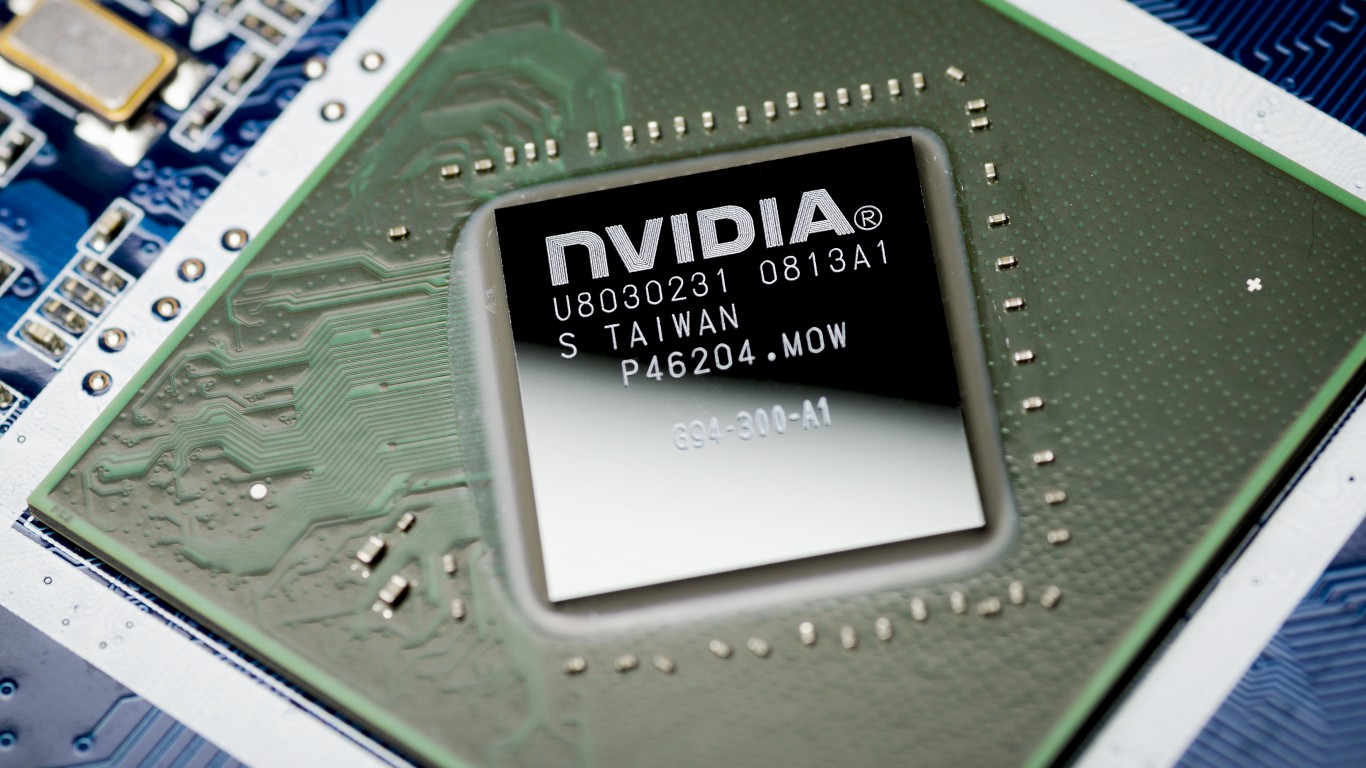
Nvidia’s Scarcity Runs Out in Five Years: ‘A Chip Designed by OpenAI, by AI’
OpenAI just built an AI-designed chip that already beats Nvidia's best in early tests, and one macro investor has pinpointed exactly when Nvidia's most valuable competitive advantage disappears entirely.


Two days after the biggest quarter in semiconductor history, macro investor Jordi Visser told listeners on The Pomp Podcast that the scarcity holding up NVIDIA (NASDAQ:NVDA | NVDA Price Prediction) has an expiration date. His argument separates near-term results from terminal value, laid out in a single line: OpenAI’s new Jalapeno silicon “a chip designed by OpenAI, by AI” and “is not going to disrupt their numbers this year, it’s not going to disrupt them next year.” Then the pivot: “Nvidia right now has scarcity, but at some point, five years from now, six years from now, it won’t have scarcity.” NVIDIA’s market cap of $5.31 trillion reflects future discounted cash flows. If the market decides GPUs are optional in a decade, that value contracts.
Record Quarter Priced Into Every Model
NVIDIA’s Q2 FY2027 report delivered. Revenue landed at $96.22 billion, up 105.8% year over year, with Data Center revenue of $89.02 billion and non-GAAP EPS of $2.22. Supply commitments jumped to $279 billion, largely memory tied to Vera Rubin. See the Q2 FY2027 8-K exhibit for the full breakout.
Jensen Huang told analysts fiscal 2028 revenue should grow approximately 70% year over year, and that “at this moment, we have supply for 70%. We have more supply than 70%, but about 70%. Our demand is much higher than that.” The stock dropped 4.57% on Aug 28, 2026, from $227.98 to $217.55, though shares are up 16.79% year to date and trade at a forward P/E of 26.

Jalapeno Already Tests Better on TCO
Chip analyst and 247 Wall Street contributor Eric Bleeker cited a SemiAnalysis headline reading “OpenAI Jalapeno better than Nvidia Blackwell,” noting initial tests point to superior total cost of ownership compared to Blackwell. Jim Cramer on CNBC added: “Nvidia invested 30 billion in OpenAI” and OpenAI is “downright gleeful about inventing this new chip, Jalapeno, that can compete with Nvidia’s.”
Chamath Palihapitiya made the structural case on All-In: “You’re going to look at these big companies in five years, they’re all going to have their own cloud, they’re all going to have their own models, they’re all going to have their own silicon, they’re all going to have their own data centers.”
Two Timelines Investors Must Reconcile
Huang counters that OpenAI’s existing and planned commitments represent approximately 12 gigawatts of NVIDIA compute through 2030, and AI-lab demand should contribute roughly a quarter of NVIDIA’s business next year. Visser agrees on the near term, calling the current setup “the sweet spot of the infrastructure build out” with “another three to five years of needing a lot.”

The terminal value debate is where the fight lives. If custom silicon peels off even a quarter of hyperscaler workloads by 2031, the DCF supporting today’s price gets rewritten downward. If Vera Rubin’s economics of $40 billion per gigawatt keep expanding, the moat holds.
Where the AI Compute Dollars Are Landing
Eli Lilly (NYSE:LLY) cited a co-innovation AI lab with NVIDIA for drug discovery and posted $22.97 billion in Q2 revenue with EPS of $8.38, raising FY26 revenue guidance to $85.0 billion to $87.0 billion. LLY shares are up 61.49% over one year.
Coinbase (NASDAQ:COIN) shows the flip side: Q2 revenue fell 18.51% to $1.22 billion, and the stock is down 21% year to date even with prediction-markets revenue past $100 million annualized.
For NVIDIA investors, the forward question is direct. If Jalapeno and successors take even a slice of inference workloads by 2030, does the current multiple compress before fiscal 2028 growth arrives? Watch memory pricing, hyperscaler capex mix, and how quickly OpenAI’s chips move from tests to deployment.
Contact [email protected] for any questions or corrections.
Joel South covers large-cap stocks, dividend investing, and major market trends, with a focus on earnings analysis, valuation, and turning complex data into actionable insights for investors.
He brings more than 15 years of experience as an investor and financial journalist, including 12 years at The Motley Fool, where he served as an investment analyst, Bureau Chief, and later led the Fool.com investing news desk. He has also co-hosted an investing podcast and appeared across TV and radio discussing market trends.