Forget Nvidia. This AI Stock Is Selling the Storage Behind the Boom
Seagate has already handed investors gains that dwarf Nvidia's returns over the past year, and Wall Street analysts think the storage giant still has a long way to run before this AI trade exhausts itself.


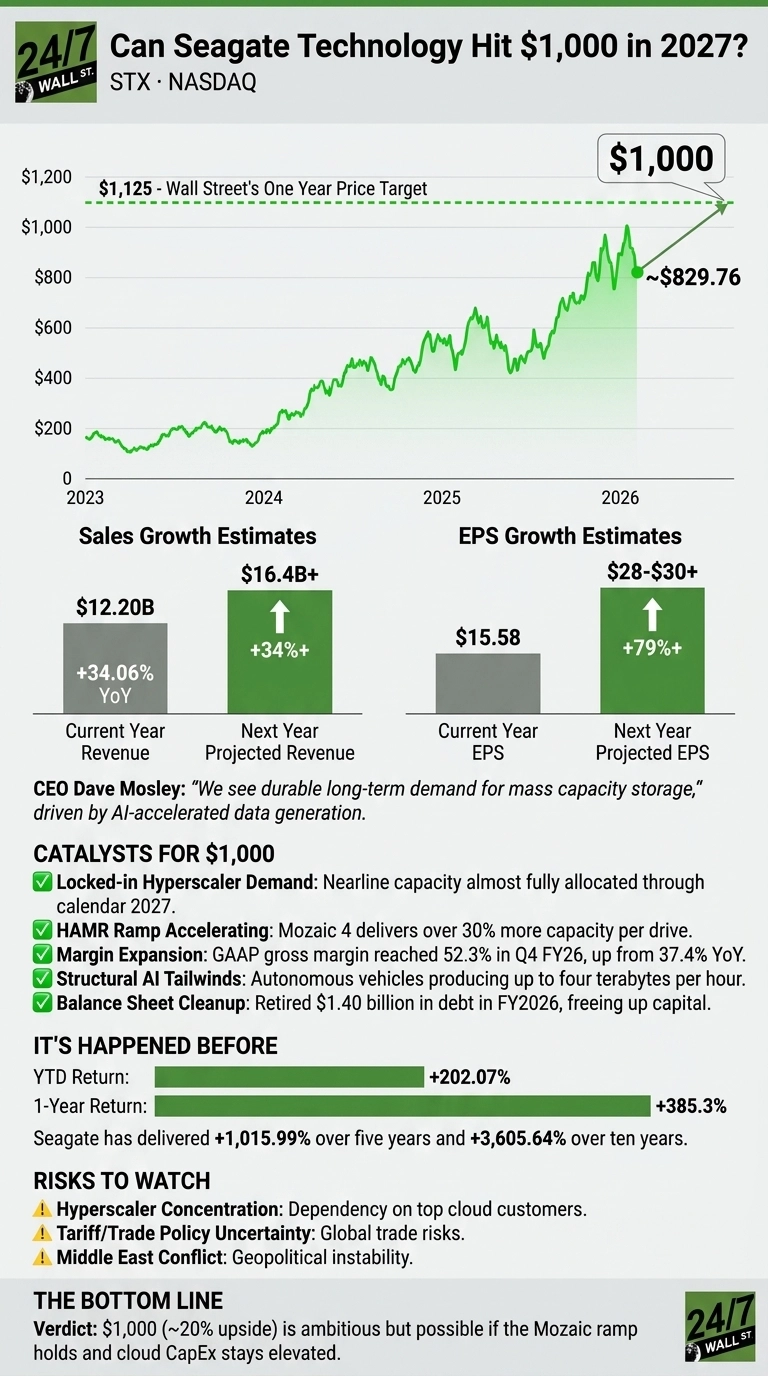
Seagate Technology (NASDAQ:STX | STX Price Prediction) has quietly become one of the loudest AI stories on the market. Shares are up 202.07% year to date and 385.3% over the past year, riding a wave of hyperscaler orders for mass-capacity hard drives.
CEO Dave Mosley told investors last month that “As AI accelerates data generation and its value, we see durable long-term demand for mass capacity storage,” and the numbers back him up. With shares near $829.76, the question is whether Seagate can push through to $1,000 in 2027.

Wall Street Sees Even More Upside From Here
The Street is unusually aggressive on this storage name. The consensus 1-year price target sits at $1,125, with 18 Buy and 4 Strong Buy ratings against just 2 Hold calls. That implies analysts see roughly 36% upside from current levels, well above our $1,000 bull case.

Why the optimism? Fiscal 2026 revenue grew 34.06% to $12.20 billion, and net income more than doubled to $3.18 billion. Q4 revenue jumped 48.49% year over year to $3.63 billion, and non-GAAP EPS of $5.71 topped estimates by 12.11%. Seagate has now beaten EPS expectations for four consecutive quarters, which suggests forward numbers may still be too low.
Path to $1,000 Per Share in 2027
Trailing valuation looks eye-watering at 61x earnings, but the forward multiple tells the real story. Forward P/E stands at 24x, roughly in line with the S&P 500’s forward multiple near 22x.
Management guided fiscal Q1 2027 to non-GAAP EPS of $7.30 on revenue of $4.1 billion. If that quarterly run-rate sustains through fiscal 2027, annual EPS could clear $28 to $30. At $1,000, shares would trade around 33x to 36x forward earnings. Rich, but defensible for a business compounding revenue at a 20%+ target rate.

Here is what could push STX to $1,000:
- Locked-in hyperscaler demand. Mosley told analysts that “Nearline capacity almost fully allocated through calendar 2027,” with build-to-order contracts covering pricing and configurations for the entire fiscal year.
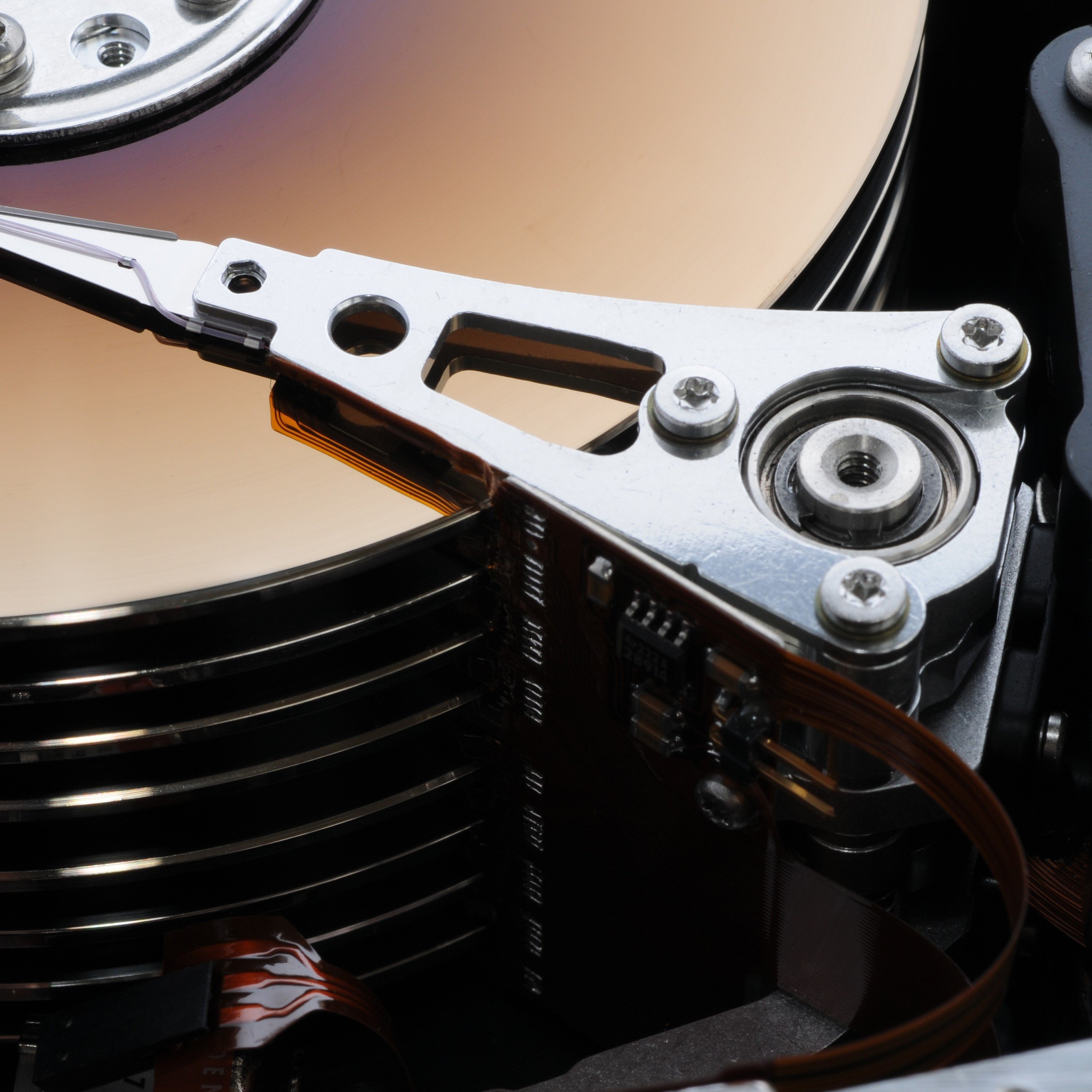
- HAMR ramp accelerating. Mozaic HAMR drives are qualified with five of the world’s largest cloud customers, and Mozaic 4 delivers “up to 44 terabytes per drive,” “over 30% more capacity compared to the first generation” with minimal added cost.
- Margin expansion. GAAP gross margin hit 52.3% in Q4, up from 37.4% a year earlier. Value-based pricing and mix shift into higher-capacity drives should continue.
- Structural AI tailwinds. Mosley described a “period of structural growth,” citing autonomous vehicles producing “up to four terabytes per hour” and compliance retention stretching “five to 10 years.”
- Balance sheet cleanup. Seagate retired $1.40 billion in debt in fiscal 2026, freeing up capital that management said would likely return to share buybacks.
Recent History Shows $1,000 Is Within Reach
A move from $829.76 to $1,000 requires roughly 20% upside. That is well within STX’s demonstrated range. The stock has already returned 1,015.99% over five years and 3,605.64% over ten.
Even more telling, shares gained 8.55% in the past month alone, and the 52-week high of $1,144.18 shows the market has already priced STX above $1,000 this year. Getting back there is more of a re-rating than a leap.
Bottom Line on $1,000
Hitting $1,000 requires roughly 20% upside from here, a modest ask for a stock that has already tripled off its 2025 base. Wall Street’s $1,125 consensus, a four-quarter beat streak, exabyte capacity sold out through calendar 2027, and a Fitch upgrade to investment grade all point in the right direction.
Hyperscaler concentration and tariff risk remain real. Still, if the Mozaic ramp holds and cloud CapEx stays elevated, we’ve outlined the blueprint for how Seagate could see outsized returns in 2027. Storage is only one slice of the AI buildout, though. We profiled seven other suppliers powering the data-center boom, from cooling to networking, in a free report you can grab here.
Contact [email protected] for any questions or corrections.
Vandita Jadeja is a financial publisher with over a decade of experience writing about financial topics, including investment, savings, retirement, insurance and banking. Vandita is a Chartered Accountant who loves to debunk financial concepts for readers.
Her work has appeared on sites that include The Motley Fool, InvestorPlace, and Benzinga. She covers investing and focuses on stock picks and price prediction for 24/7 Wall St.
When not looking for the next stock investment opportunity, she can be found traveling, reading, chasing sunsets and enjoying her iced latte.