Prediction: Seagate Could Be One of AI’s Most Unexpected Winners
While investors chase flashy AI chip stocks, a quiet storage giant has been compounding record revenues and locking in hyperscaler contracts through 2027. Whether that run still has legs depends on one critical technology bet.


Seagate has quietly become one of the most important names in the AI infrastructure trade. Seagate Technology (NASDAQ:STX | STX Price Prediction) is coming off a fiscal 2026 in which it grew revenue 34.06% and generated $3.105 billion in free cash flow, both records, on the back of hyperscaler demand for mass-capacity HDDs. Our proprietary model sees more room to run.
Our 24/7 Wall St. Price Target for Seagate
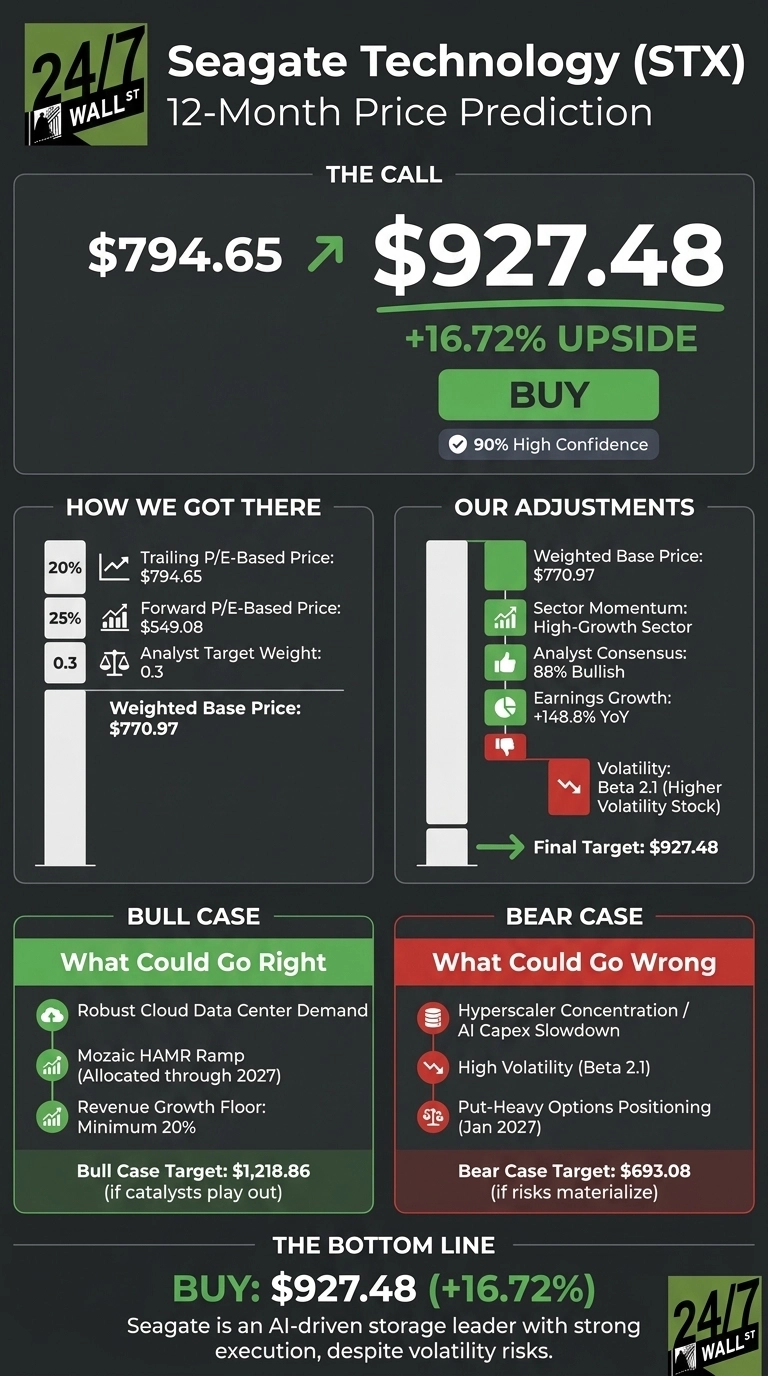
The 24/7 Wall St. price target for Seagate is $927.48 over the next 12 months, versus a current price of $794.65. That points to 16.72% upside, and our recommendation is buy with a 90% confidence level. High confidence is unusual for a stock with STX’s volatility, but the data-center visibility management laid out on the Q3 call and the pricing structure finalized through fiscal 2027 support the base case.
| Metric | Value |
|---|---|
| Current Price | $794.65 |
| 24/7 Wall St. Price Target | $927.48 |
| Upside | 16.72% |
| Recommendation | BUY |
| Confidence Level | 90% |

A Wild Year, and a Recent Cooldown
Seagate is up 403.22% over the past year and 189.29% year to date, but shares have pulled back 20.12% in the past week from the 52-week high of $1,144.18.
The Q4 report on July 28, 2026 was the catalyst: revenue of $3.629 billion beat by 3.98%, non-GAAP EPS of $5.71 beat by 12.11%, and management guided fiscal Q1 2027 revenue to $4.1 billion and EPS to $7.30. That is the fourth straight EPS beat.

Why Bulls See Higher Upside
The bull case rests on the Mozaic HAMR ramp. Management said nearline capacity is “almost fully allocated through calendar 2027,” the top three cloud providers have nearly doubled their remaining performance obligations to $1.1 trillion, and CEO Dave Mosley raised the multi-year revenue growth floor to “a minimum of 20% over the next few years.”
Our bull case targets $1,218.86, a 53.38% return, aligned with the Street’s $1,125 average target across 22 buys and 2 holds.

What Could Go Wrong
The bear case starts with concentration: hyperscaler orders drive results, and any AI capex slowdown would land hard. Add a beta of 2.1, potential dilution from Exchangeable Senior Notes due 2028, and put-heavy positioning at the January 2027 expiration (29,121 put OI versus 18,662 call OI).
Our bear case sits at $693.08, roughly 12.78% below current. Bulls counter that Fitch just upgraded Seagate to investment grade and net leverage sits at 0.7 times, hardly a fragile balance sheet.
How Seagate Compares to Western Digital and Micron
Western Digital (NASDAQ:WDC) is the cleanest comparable: a pure-play HDD company with fiscal Q4 non-GAAP EPS of $1.66 and revenue of $2.61B, up 31% YoY. WDC’s market cap of $29B trails STX’s $180.1B, but its FY26 revenue of $9.85B and EPS of $6.28 track closely. Seagate’s forward EPS of $23.12 looks aggressive by comparison, making our target dependent on HAMR execution.
Micron Technology (NASDAQ:MU) is the memory counterpoint, with fiscal Q3 revenue of $9.30B (up 37% YoY) and non-GAAP EPS of $1.91. Micron sits at a $140B market cap. Against that scale of AI-driven repricing, our Seagate target looks conservative.
My Verdict: Buy the Pullback
The 24/7 Wall St. price target of $927.48, a buy rating, and 90% confidence tell a clear story: Seagate has earned its re-rating, and the AI-driven storage cycle has room to run. Storage is one of several picks-and-shovels layers behind the AI buildout (we profiled seven of these non-chip suppliers, from power to cooling to storage, in a free report you can grab here).
I would be a buyer if Q1 2027 comes in at or above the $7.30 EPS guide. I would stay on the sidelines if hyperscaler capex commentary from NVIDIA (NASDAQ:NVDA) or the top three clouds turns cautious. As of now, the setup favors buyers.
Here is where our model projects Seagate could trade, assuming current growth trajectories hold.
| Year | 24/7 Wall St. Price Target |
|---|---|
| 2026 | $927 |
| 2027 | $933 |
| 2028 | $1,008 |
| 2029 | $1,167 |
| 2030 | $1,201 |
These projections assume Seagate executes the Mozaic HAMR roadmap and cloud capex stays intact. Significant upside or downside could come from Mozaic 5 qualification timing in late 2027 or a broader AI infrastructure pause.
Contact [email protected] for any questions or corrections.
Vandita Jadeja is a financial publisher with over a decade of experience writing about financial topics, including investment, savings, retirement, insurance and banking. Vandita is a Chartered Accountant who loves to debunk financial concepts for readers.
Her work has appeared on sites that include The Motley Fool, InvestorPlace, and Benzinga. She covers investing and focuses on stock picks and price prediction for 24/7 Wall St.
When not looking for the next stock investment opportunity, she can be found traveling, reading, chasing sunsets and enjoying her iced latte.