Prediction: This Storage Stock Could Be a Surprising AI Winner
Seagate just posted the kind of earnings that make analysts scramble to revise targets upward, yet shares have already pulled back nearly 10% from their peak, leaving investors to decide whether the AI storage boom has more room to run…


Seagate Technology (NASDAQ:STX | STX Price Prediction) has quietly become one of the AI trade’s most explosive winners, with shares up 445.36% over the past year on surging hyperscaler demand for mass-capacity storage.
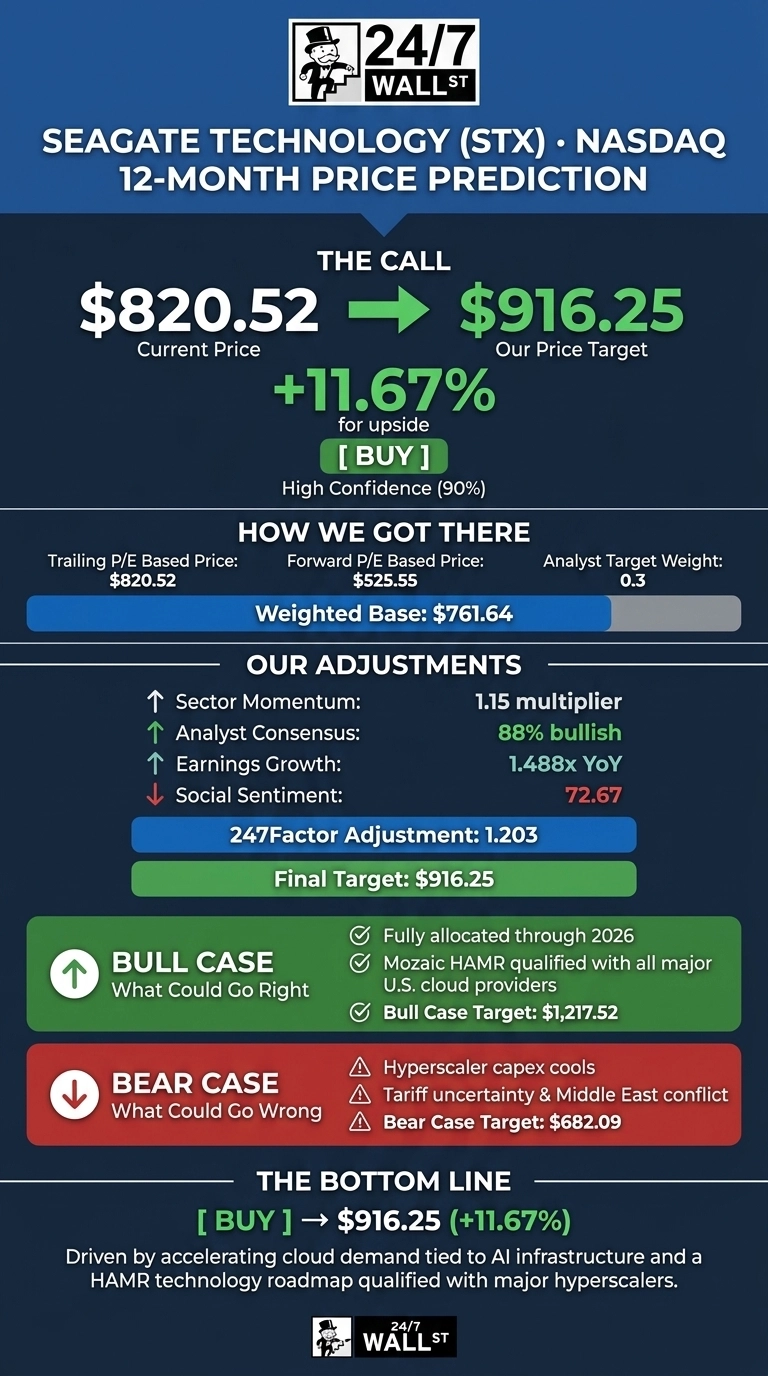
Our 24/7 Wall St. price target for Seagate is $916.25, implying 11.67% upside from the current $820.52 price. We rate the stock a buy with high conviction.
24/7 Wall St. Price Target Summary
| Metric | Value |
|---|---|
| Current Price | $820.52 |
| 24/7 Wall St. Price Target | $916.25 |
| Upside | 11.67% |
| Recommendation | BUY |
| Confidence Level | 90% |
Our confidence is anchored in four consecutive quarterly EPS beats, accelerating cloud demand tied to AI infrastructure, and a HAMR technology roadmap now qualified with every major U.S. hyperscaler.

Q4 Results Anchor the Setup
Seagate closed fiscal 2026 in July with a blowout Q4: revenue of $3.629 billion (up 48.5% year over year) and non-GAAP EPS of $5.71, beating consensus by 12.11%. Full-year free cash flow hit a record $3.105 billion, up 279.58%.
Shares have pulled back 9.87% over the past month after peaking near $1,144.18, but the YTD gain still stands at 198.7%. CEO Dave Mosley credited “robust cloud data center demand and disciplined execution” for the run.

The Case for $1,200+
Bulls point to a demand backdrop management has called extraordinary. Mosley told investors “our nearline capacity is fully allocated through calendar year 2026”, with pricing negotiations already underway for 2027 and 2028.
The Mozaic HAMR platform is qualified with all major U.S. cloud service provider customers, and Q1 FY27 guidance calls for revenue of $4.10 billion and EPS of $7.30.
Wall Street’s average target is $1,115.87, with 22 buy ratings against one sell. Our bull-case scenario gets Seagate to $1,217.52, a 48.38% gain.

What Could Go Wrong
The trailing P/E of 58 leaves no margin for error if hyperscaler capex cools. Insiders have been net sellers across 252 recent transactions, and Seagate flagged tariff uncertainty and Middle East conflict as guidance risks. A beta above 2 means volatility cuts both ways.
It should be noted, however, that insider selling near record highs often reflects routine profit-taking rather than a fundamental warning, and Seagate retired $1.40 billion in debt during FY26, materially reducing balance-sheet risk. Our bear case sees shares at $682.09.
How Seagate Compares to Western Digital and Micron
Western Digital (NASDAQ:WDC) is the closest pure-play HDD peer and directly competes for the same hyperscaler orders. WDC trades at a forward P/E of 22 with a trailing P/E of 18, nearly identical to Seagate’s forward multiple but with slower quarterly revenue growth of 43.8%.
Micron Technology (NASDAQ:MU) offers a memory-side view of the AI storage boom, trading at a forward P/E of just 6, a reminder that memory economics differ sharply from HDD. On balance, peer multiples make our Seagate target look reasonable rather than aggressive.
| Company | Forward P/E | Trailing P/E |
|---|---|---|
| Seagate | 23 | 58 |
| Western Digital | 22 | 18 |
| Micron | 6 | 20 |
Seagate Price Prediction 2026-2030
The 24/7 Wall St. price target of $916.25 reflects a buy rating with 90% confidence. The key factor tipping the scale is capacity allocation: Seagate is sold out through 2026 with pricing power intact.
The bull thesis holds if hyperscaler capex commentary stays firm through the next earnings cycle. The setup weakens if forward EPS estimates flatten or HAMR qualifications slip at Mozaic 4.
| Year | 24/7 Wall St. Price Target |
|---|---|
| 2026 | $916 |
| 2027 | $1,015 |
| 2028 | $1,100 |
| 2029 | $1,160 |
| 2030 | $1,208 |
These projections assume Seagate continues executing on its HAMR roadmap and hyperscaler demand for mass-capacity storage remains durable. Significant upside or downside could come from a step-change in AI storage architecture or a cyclical hyperscaler capex reset.
Contact [email protected] for any questions or corrections.
Vandita Jadeja is a financial publisher with over a decade of experience writing about financial topics, including investment, savings, retirement, insurance and banking. Vandita is a Chartered Accountant who loves to debunk financial concepts for readers.
Her work has appeared on sites that include The Motley Fool, InvestorPlace, and Benzinga. She covers investing and focuses on stock picks and price prediction for 24/7 Wall St.
When not looking for the next stock investment opportunity, she can be found traveling, reading, chasing sunsets and enjoying her iced latte.