Seagate Is Riding One of AI’s Most Important Trends
Seagate just shed billions in market cap on a single Toshiba headline, yet its nearline drives are locked into contracts stretching deep into 2027. Whether Friday's selloff was a warning shot or a buying window depends on one question the…


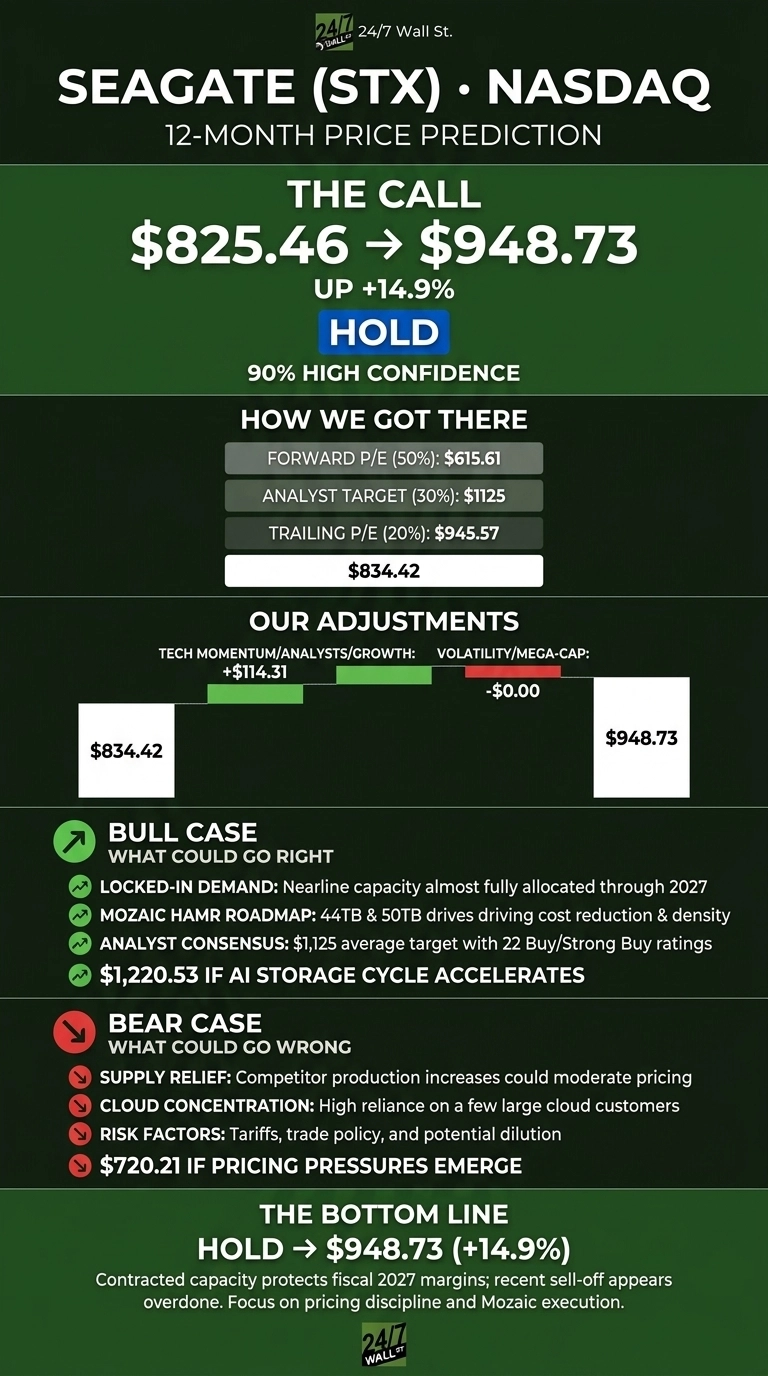
Seagate Technology (NASDAQ:STX | STX Price Prediction) is trading at $825.46 after a sharp Friday sell-off. Our 24/7 Wall St. price target is $948.73 over the next 12 months. From today’s price, that works out to 14.9% upside.
| Metric | Value |
|---|---|
| Current Price | $825.46 |
| Price Target from 24/7 Wall St. | $948.73 |
| Upside/Downside | 14.9% |
| Model Rating | HOLD |
| Confidence Level | 90% |

Our model gave Seagate a hold rating when the stock closed Thursday at $945.57. At that price the target sat only 0.33% higher, with high model confidence. Friday’s drop opened a wider gap, and the question now is whether the AI storage cycle has topped out or the market has overreacted.
Toshiba Supply Fears Hit a Triple-Digit Rally
Shares fell 12.7% on Friday and are down 8.88% for the week. Western Digital (NASDAQ:WDC) dropped too after a report on Toshiba’s production raised concern that the AI storage shortage could ease (Investopedia, Barron’s). Even so, Seagate is up 200.75% year to date. The stock trades 27.8% below its 52-week high of $1,143.27 and far above its low of $207.78.
Fiscal Q4 revenue was $3.629 billion, up 48.49% and ahead of the $3.49 billion consensus. EPS came in at $5.71, beating the $5.09 estimate. Management guided fiscal Q1 to $4.1 billion in revenue and $7.30 in EPS.
Locked-In Demand Could Push Shares Past $1,200
Seagate says its nearline capacity is “almost fully allocated through calendar 2027“, and its build-to-order contracts set pricing through fiscal 2027. Mozaic 4 holds up to 44 terabytes per drive, and Mozaic 5 targets 50 terabytes with qualification shipments planned for late 2027.
Management raised its annual revenue growth target to a minimum of 20%. Analysts count 22 Buy or Strong Buy ratings and set a consensus target of $1,125. Our bull case is $1,220.53, which would be 47.9% above today’s price.

Supply Relief Is the Threat Bears Are Pricing In
Friday’s sell-off reflects the main risk: if competitors add supply, hard drive pricing could moderate. Cloud customer concentration, tariffs and possible dilution from the Exchangeable Senior Notes due 2028 add to that risk.
The bear case is $720.21, or 12.8% below today’s price. On the other side, contracted pricing protects fiscal 2027 margins, and Seagate grows capacity through areal density rather than by adding units.

Seagate Outgrows Western Digital and NetApp
Western Digital is Seagate’s direct hard drive rival. Its revenue grew 43.84% and its non-GAAP gross margin reached 54.4%, slightly above Seagate’s 52.7%.
NetApp (NASDAQ:NTAP) sells AI data infrastructure built on flash. Its revenue grew 29.89%, which is slower than Seagate. Seagate’s faster growth supports a premium, so the peer group makes our target look reasonable.
| Company | Market Cap | Latest Quarter Revenue Growth |
|---|---|---|
| Seagate | $187.45B | 48.49% |
| Western Digital | $145.2B | 43.84% |
| NetApp | $45.17B | 29.89% |
Seagate Price Prediction 2026-2030
The 24/7 Wall St. price target remains $948.73, with the model’s hold rating set at 90% confidence. Seagate’s contracted capacity is what tips the scale for me.
The key test is whether pricing holds through fiscal 2027 contract renewals. Keep an eye on whether Toshiba’s added production starts to drag down revenue per terabyte. Friday’s drop looks larger than the fundamentals support.
Here is where our model projects Seagate would trade assuming present trends continue:
| Year | Price Target from 24/7 Wall St. |
|---|---|
| 2026 | $948.73 |
| 2027 | $955.92 |
| 2028 | $939.45 |
| 2029 | $990.12 |
| 2030 | $1,049.49 |
These projections assume Seagate keeps executing its Mozaic roadmap. Faster HAMR adoption could drive results well above these figures, and a supply glut could drive them well below.
Contact [email protected] for any questions or corrections.
Vandita Jadeja is a financial publisher with over a decade of experience writing about financial topics, including investment, savings, retirement, insurance and banking. Vandita is a Chartered Accountant who loves to debunk financial concepts for readers.
Her work has appeared on sites that include The Motley Fool, InvestorPlace, and Benzinga. She covers investing and focuses on stock picks and price prediction for 24/7 Wall St.
When not looking for the next stock investment opportunity, she can be found traveling, reading, chasing sunsets and enjoying her iced latte.