Anthropic Just Committed $35 Billion to Compute It Has Not Raised the Money For
Anthropic just signed a $35 billion computing obligation against money it has not yet raised, and the analyst watching the deal says an IPO is the only way out. The implications for NVIDIA, which sits on both sides of this…


Anthropic agreed to a $35 billion computing deal with Lambda, a cloud provider backed by NVIDIA (NASDAQ:NVDA | NVDA Price Prediction), according to Bloomberg reporting on September 1, 2026. It follows another cloud agreement Anthropic signed the previous week. Neil Campling, senior strategist, framed the deal as part of a sector-wide race for scarce compute.
Anthropic and Lambda are private, so the investable exposure runs through the chip supplier sitting behind the transaction, NVIDIA, and the neocloud economics that flow to it.
Campling said Anthropic will likely need an IPO to fund the promise, which reframes the announcement from a growth story to a funding gap.
What a Compute Commitment Actually Is
A compute commitment is a multi-year contract to purchase capacity from a cloud operator, usually with take-or-pay terms. Once signed, it behaves like a fixed obligation, closer to a lease than a variable utility bill. The buyer owes the money whether or not its own revenue arrives on schedule. The seller books the contract as backlog and uses it to underwrite the debt that funds the data center.
Lenders will not finance a GPU fleet without a signed offtake. That is why these headline numbers get so large so fast: the contract is the collateral.
NVIDIA described the mechanics on its most recent call. Management explained that it provides “a take or pay commitment on a portion of the facility’s capacity, a minimum revenue guarantee that gives lenders the confidence to underwrite the project” in exchange for a share of rental revenue.
So $35 billion signed today becomes a real cash claim tomorrow. Anthropic owes it, Lambda earns it, and the chips inside the racks come from one supplier.
Why Campling’s IPO Line Is the Whole Story
Campling said, “Anthropic needs so much compute power. So they’re looking to get it from any way that they can.” He added that “Anthropic’s demands for compute power are just infinite for the time being.”
Campling also said, “This is another example of how we’re likely to need that IPO to raise money.”
A private company signing a multi-year obligation of this size against future funding is prefunding demand with capital it has not yet raised. If public markets cool on AI, if a frontier model disappoints, if regulation tightens, the promised capital arrives later or costs more. The obligation does not adjust. The revenue Lambda books against this contract carries the credit quality of Anthropic, and Anthropic’s credit quality depends on rounds and an IPO that has not been announced.
NVIDIA Sitting on Both Sides of the Trade
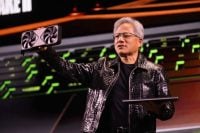
NVIDIA is an investor in Anthropic and a backer of Lambda. On the Q2 call, the company disclosed it has “invested nearly 50 billion in the Frontier AI Labs” and arranged partnerships with Apollo, BlackRock, Blackstone, Brookfield, Goldman Sachs and KKR to mobilize over $500 billion in third-party capital for AI infrastructure.
Management addressed the concern directly, saying, “we recognize the scale of this support, and we know some will call this circular financing. We see it differently.”
NVIDIA sells GPUs to Lambda, Lambda signs Anthropic to a take-or-pay deal that services the debt on those GPUs, and NVIDIA holds equity in both counterparties. Jensen Huang was candid about the economics: “In this model, we get paid twice, once on the hardware sale and again through the share of rental revenue.”
The structure is defensible today because token consumption is measurable and growing, but it deserves scrutiny rather than applause. NVIDIA reported Q2 FY27 revenue of $96.22 billion, up 105.85% year over year, with Data Center revenue of $89.02 billion, disclosed in its 8-K filing.
Is NVDA Stock a Buy?
NVIDIA trades at $217.44 with a market cap of $5.25 trillion and a P/E of 44. The stock is up 25% over the past year and 16.73% year to date.

The bull case rests on Vera Rubin production, roughly $40 billion in AI factory revenue per gigawatt, and management’s guidance for approximately 70% revenue growth in fiscal 2028.

The bear case is what Campling is pointing at. Growth funded by customers who still need equity raises to pay their bills is worth less than growth funded by hyperscaler cash flow. AMD (NASDAQ:AMD), trading at a P/E of 173x, has signed 2-gigawatt deals with Anthropic and 6-gigawatt deals with OpenAI, so the counterparty risk is shared across the industry.

Against AMD, NVIDIA earns higher margins, ships more silicon, and holds the software stack through CUDA. The circular financing critique is legitimate and worth watching quarter by quarter, but 75% non-GAAP gross margins, real free cash flow, and the installed platform advantage compensate for the risk that a handful of frontier lab counterparties disappoint on funding.
Contact [email protected] for any questions or corrections.
Omor Ibne Ehsan is a writer at 24/7 Wall St. He is a self-taught investor with a focus on growth, cyclical, and dividend equities that have strong fundamentals, value, and long-term potential. He also has an interest in high-risk, high-reward investments such as penny stocks.