Apple’s New CEO Has 8 Days to Answer the AI Question That Could Redefine Computing
John Ternus steps into the CEO role at Apple with the stock near a record high, but the hardware event eight days away demands something far harder than a good quarter: a convincing answer to why the iPhone stays at…

This post may contain links from our sponsors and affiliates, and Flywheel Publishing may receive compensation for actions taken through them.

John Ternus starts as Apple (NASDAQ:AAPL | AAPL Price Prediction) CEO with the stock near a historic high, and roughly 8 days remain before a September hardware event where he will address the entire audience for the first time. CNBC’s MacKenzie Sigalos said, “John Ternus era begins at a moment when Apple is facing historic headwinds.”
Shares rose 2.61% on his first day and traded at $325.13, up 40.58% over one year and 19.92% year to date on a market cap of $4.745T. The pressures Ternus inherits are real but uneven. Memory costs squeezing hardware margins will pass. The AI question is structural, and Apple has to answer it in a way that changes minds about where the next computing interface will actually live.
Margin Squeeze Is the Mechanical Problem
Fiscal Q3 revenue was $109.42 billion, up 16.4% year over year, with EPS of $2.02 beating the $1.89 consensus, per Apple’s 8-K filing.
Gross margin was 50.1%, and tariff refunds added roughly 2 percentage points on top. Strip those out and Apple still ran a very good quarter.
September guidance points to gross margin between 47% and 48%. Tim Cook described memory pricing as “a 100-year flood on the memory pricing with exponential increases in memory prices” driven by only three DRAM suppliers.
Sigalos framed the tension precisely: “Push iPhone prices too far, and you risk slowing the device growth that ultimately feeds services.”
Services delivered $30.74 billion at 75.6% gross margin. Hardware volume feeds that annuity, and Ternus cannot let iPhone unit economics slip while he defends the average selling price.

AI Question Is the Structural One
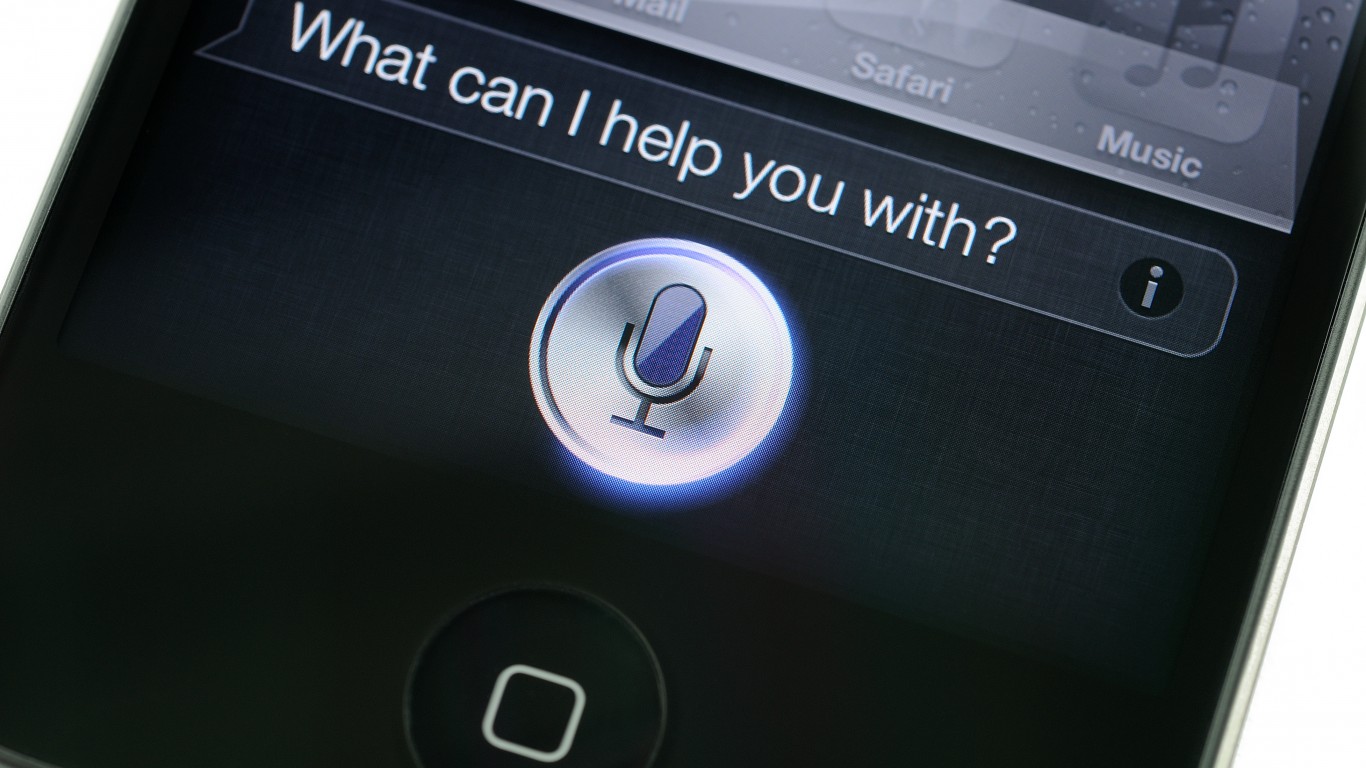
Siri AI shipped to developers after WWDC26, and Cook said early reviews were “phenomenal,” although that assessment comes from Apple itself.
The competitive set does not flatter Apple’s positioning. Microsoft (NASDAQ:MSFT) passed 30 million paid Microsoft 365 Copilot seats, and Azure surpassed $100 billion in fiscal-year revenue, growing 41%.
Alphabet’s (NASDAQ:GOOG, NASDAQ:GOOGL) Gemini app hit 950 million monthly active users, and Google Cloud revenue grew 82% in Q2. Meta (NASDAQ:META) is putting personal agents on top of Family DAP of 3.60 billion.
Apple’s R&D of $11.73 billion a quarter is real spending, but Microsoft alone plans roughly $175 billion in FY27 capex, and all of that buildout has to be powered, cooled, and networked by somebody (we rounded up seven of those infrastructure suppliers in a free report).
Sigalos captured the real risk: “The AI challenge goes well beyond fixing Siri. As agents become the front door to apps and services, Apple has to make sure that the iPhone stays at the center of that experience, even as rivals start experimenting with entirely new AI native devices.” If the agent becomes the interface, the operating system becomes plumbing.
Foldable Would Be Loud But Not Sufficient
Sigalos reported that “A recent operating system leak directly from Apple exposed clues to ten plus still unannounced devices, including a foldable iPhone, potentially the first major change to the phone’s form factor in 20 years, something that we might see as soon as next Wednesday.” Treat that as reported and unconfirmed.
Polymarket puts the probability of an Apple foldable iPhone before 2027 at 0.949, while a broader “new product line” market sits at only 0.305.
A foldable would help Apple close ground on Samsung and reset the upgrade cycle, although the AI question would remain open.
Apple is also in an escalating legal dispute with OpenAI over hardware and trade secrets, per Sigalos, while OpenAI has been buying Macs by the tens of thousands.
Hardware theater buys Ternus time to prove out Siri AI at scale, while the interface question stays open.
Is AAPL Stock a Buy?

Apple trades at a P/E of 37x and a forward P/E of 33x against an analyst target of $324.45, so the average Street target sits at roughly today’s price.

Samsung leads foldables and will not be caught by novelty alone. Alphabet and Microsoft are ahead on models, cloud economics, and the distribution of agents into enterprise workflows.
Meta Platforms is spending $130 to $145 billion in 2026 capex to put personal agents into billions of hands. Apple’s counter is the installed base of more than 2.5 billion active devices, silicon integration, and a services flywheel most rivals cannot replicate.
That mix is enough to hold the position because Apple still monetizes its users better than anyone, though adding on strength should wait until Ternus proves the platform still leads.
The margin squeeze looks likely to pass, as memory cycles always do, and paying 33x forward for a company in the middle of a platform transition reads as fair value, given the unresolved AI question.
Contact [email protected] for any questions or corrections.
Omor Ibne Ehsan is a writer at 24/7 Wall St. He is a self-taught investor with a focus on growth and cyclical stocks that have strong fundamentals, value, and long-term potential. He also has an interest in high-risk, high-reward investments such as cryptocurrencies and penny stocks.